
Rosy leaf-curling aphid
Dysaphis sorbi
Description
How to identify
The rosy leaf-curling aphid (Dysaphis sorbi) belongs to the Hemiptera order and the Aphididae family. Adult wingless females are oval, about 2.5 mm long, with yellow-green or brownish bodies and dark heads.
Winged forms can be distinguished by a dark abdominal pattern and transparent wings with distinct venation, which allows them to migrate between host plants.
Nymphs are similar to adults in appearance but are significantly smaller and usually have a lighter coloration, often blending in with the leaf tissue.
The eggs are tiny, elongated, and shiny black; they are laid near buds and are remarkably resistant to freezing temperatures during the winter months.
Colonies are typically found on the undersides of leaves, which provide protection from environmental conditions and natural predators.
What it damages
While the primary host is the rowan tree (Sorbus), this aphid species is a major pest for apple trees, which serve as intermediate hosts for summer generations.
Both nymphs and adults feed on plant sap, injecting saliva that disrupts normal development and growth of the host plant tissues.
Feeding results in severe leaf curling, distortion of young shoots, and general stunting of the affected tree parts, weakening the overall plant.
Heavy infestations reduce the vigor of the tree, leading to decreased yields and distorted, low-quality fruit that is often unmarketable.
Stressed trees are significantly more vulnerable to secondary infections and opportunistic pests, often leading to a long-term decline in orchard productivity.
When it appears
The pest overwinters as eggs located in bark crevices on rowan trees, hatching in early spring in synchronization with bud burst.
After the first generations develop on rowan, winged migrants move to apple trees in early summer, where they continue to reproduce throughout the growing season.
Several generations are produced on apple trees during the summer months before winged sexual forms return to rowan in the autumn.
The autumn migration is critical for the lifecycle, as it facilitates mating and the laying of overwintering eggs on the primary host.
Warm and humid spring conditions typically accelerate the development of the population, leading to rapid colonization of fruit trees.
Signs of infestation
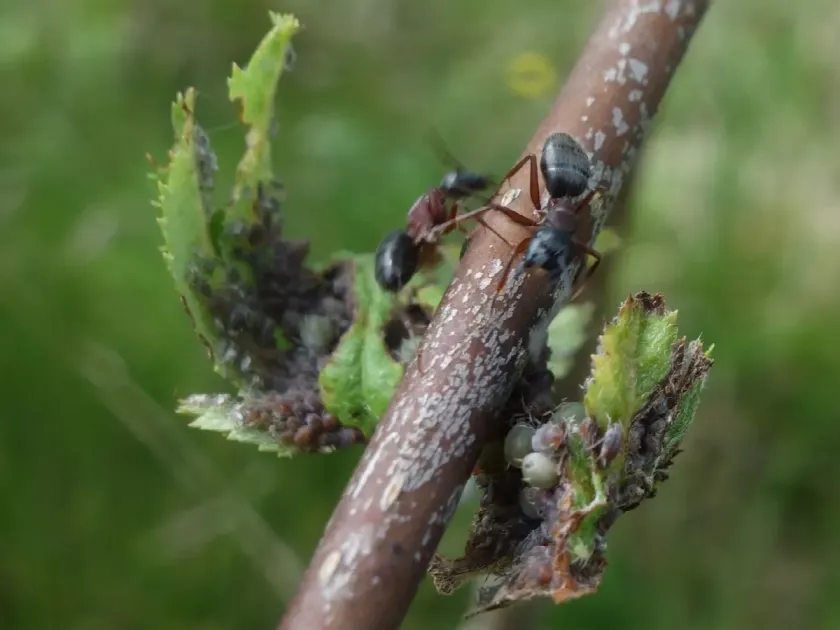
The most characteristic sign is the formation of tight, reddish leaf galls on rowan trees, which house the developing aphid colonies.
On apple trees, infested leaves curl severely, become puckered and distorted, and often turn yellow before dropping prematurely.
The presence of sticky honeydew on the foliage and branches is a clear indicator of aphid activity, often accompanied by the presence of ants.
Sooty mold frequently grows on the honeydew, forming black patches on leaves that hinder photosynthesis and negatively impact tree health.
Visual inspection of the underside of leaves during late spring or early summer usually reveals clusters of grayish or pinkish aphids.
Control measures
Effective management begins with dormant season sprays using horticultural oils to destroy overwintering eggs on the tree bark.
During the growing season, systemic insecticides should be applied upon the first signs of infestation to prevent population spikes and subsequent damage.
Cultural practices include removing rowan root suckers and maintaining optimal tree health through balanced fertilization to improve natural resistance.
- Encouraging natural enemies such as ladybeetles, lacewings, and hoverflies in the orchard.
- Using sticky bands on tree trunks to block ant access, which protects the aphids from predators.
- Regular monitoring and spot-treating affected areas before the infestation spreads throughout the entire canopy.
Integrated pest management strategies are crucial to minimize chemical inputs while maintaining effective control over the aphid population.
Taxonomy
- Latin name
- Dysaphis sorbi
- Order
- Hemiptera (bugs, aphids, leafhoppers)
- Family
- Aphididae
- EPPO code
- SAPPSO
Discussion
No discussions yet — be the first.