
Rosy apple aphid
Dysaphis devecta
Description
How to identify
The rosy apple aphid (Dysaphis devecta) is a significant pest belonging to the Aphididae family. Unlike other aphid species, this pest is monophagous, meaning it feeds exclusively on apple trees throughout its life.
Adult females are wingless, oval-shaped, and measure about 2.5 mm in length. They are typically pink, reddish, or yellowish, often coated with a powdery white wax that gives them a dull appearance.
Winged forms appear later in the season to migrate or spread the population. They possess darker heads and thoraxes, making them distinct from the earlier generations.
The overwintering stage consists of black, shiny eggs laid in crevices of the bark on the trunks and main branches of apple trees.
Nymphs emerge in early spring, precisely as the buds begin to break. They immediately start feeding on the underside of young leaves, causing rapid tissue deformation.
What it damages
The rosy apple aphid primarily targets apple trees. It causes the most severe damage to young trees and nursery stock, significantly stunting their growth and development.
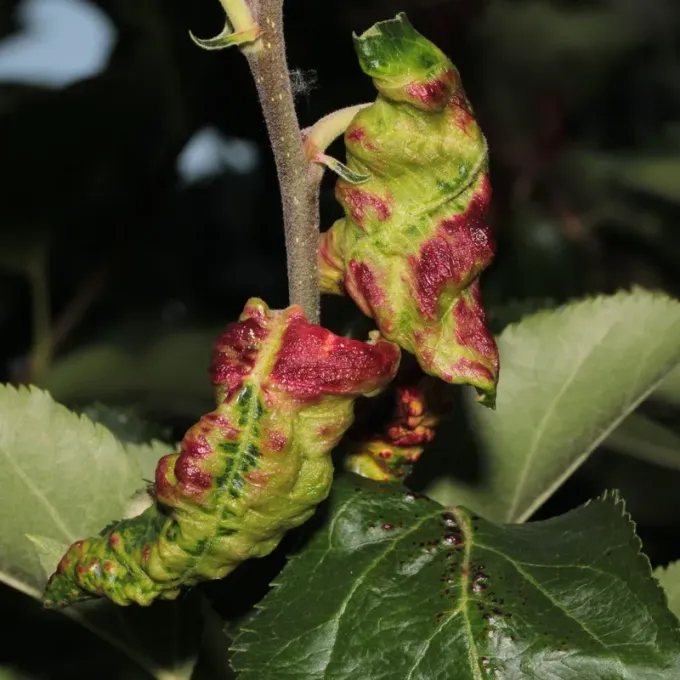
The aphid feeds by sucking sap from young leaves, causing them to curl downward and develop characteristic bright red or purple galls.
If the aphids colonize the fruit spurs, the resulting apples become severely deformed, stunted, and covered with unsightly bumps, rendering them unmarketable.
Heavy infestations lead to premature leaf drop and weakened tree vigor. This stress can impair flower bud formation, negatively impacting the yield for the following year.
Furthermore, the sugary honeydew secreted by the aphids serves as a substrate for sooty mold, which can further impede photosynthesis on the affected leaves.
When it appears
The cycle begins in spring when the eggs hatch at the same time as bud burst. The aphids quickly colonize the succulent new foliage of the apple trees.
Population growth peaks in late spring and early summer. During this period, the aphids live protected inside the tightly curled galls, making them harder to reach.
Throughout the summer, several overlapping generations are produced. The population remains active as long as there is fresh, young tissue available for feeding.
By late summer or early autumn, sexual forms appear. These mate, and the females lay eggs on the bark of the host tree to overwinter.
The weather conditions in spring play a major role in the initial infestation size; mild and dry conditions generally favor faster population growth.
Signs of infestation
The most diagnostic sign of an infestation is the presence of bright red or pinkish galls on the leaves, which become tightly curled and distorted.
Looking inside these rolled-up leaves reveals clusters of pinkish aphids covered in white, waxy dust, often accompanied by their shed skins.
Stunted and curled new shoot growth is a strong indicator of an aphid colony. Affected shoots often stop growing entirely and become brittle.
The presence of ants crawling on the tree is a secondary indicator, as they are attracted to the honeydew produced by the aphids and protect them from predators.
Malformed, small, and misshapen fruit with uneven coloring is a definitive late-season sign that the aphids have impacted the developing fruit crop.
Control measures
The most critical window for control is the period between bud burst and the appearance of leaves. Early spraying with systemic insecticides is highly effective.
Once the leaves have curled and formed galls, physical control becomes difficult because the aphids are shielded from contact insecticides.
Encouraging natural predators such as ladybirds (ladybugs), lacewings, and hoverflies can help suppress the population naturally during the growing season.
- Apply systemic insecticides at the green cluster stage.
- Hand-pick and destroy early infested curled leaves.
- Keep the orchard clear of ants to allow predators access.
- Maintain tree health through proper fertilization and pruning.
Dormant oil sprays applied in late winter can help destroy the overwintering eggs on the bark, reducing the initial spring infestation level.
Taxonomy
- Latin name
- Dysaphis devecta
- Order
- Hemiptera (bugs, aphids, leafhoppers)
- Family
- Aphididae
- EPPO code
- DYSADE
Discussion
No discussions yet — be the first.