
Hawthorn aphid
Dysaphis crataegi
Description
How to identify
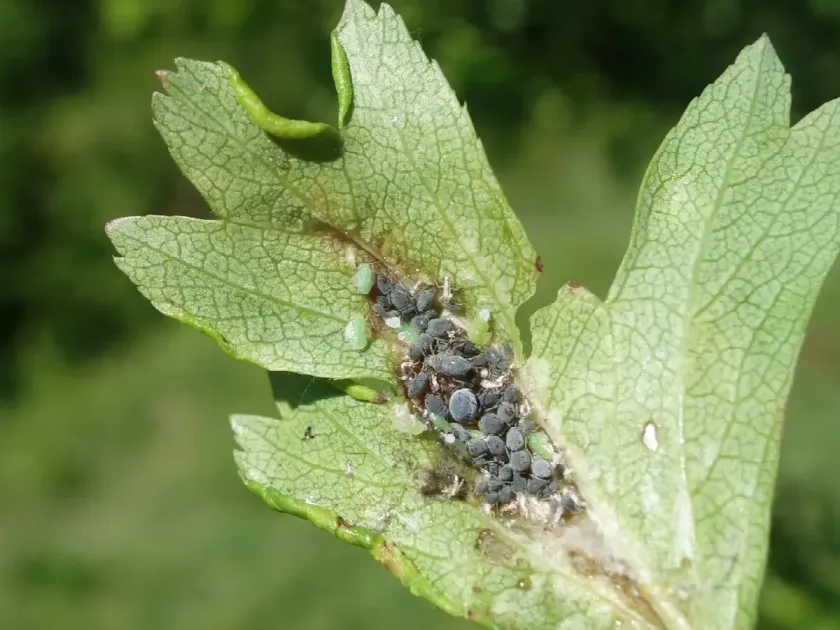
The Hawthorn aphid (Dysaphis crataegi) belongs to the order Hemiptera, family Aphididae. Wingless adults typically measure up to 2 mm in length and exhibit an oval body shape in pinkish-brown or greyish tones.
Nymphs resemble the adults in structure but are smaller in size. Their coloration ranges from light yellow to deep red, depending on the instar stage and the nutritional quality of the host plant.
Eggs are small, shiny, and black. They are laid singly or in small clusters in bark crevices of perennial branches, typically near the buds of host trees, serving as the overwintering stage for the species.
Winged forms appear in mid-summer to facilitate migration. These morphs are characterized by a darker head and thorax, specifically adapted for long-distance flight to move between host plants.
Identification often requires careful inspection as this species may inhabit mixed colonies alongside other leaf-curling aphids, making precise species verification essential for targeted treatment.
What it damages
Primary hosts include apple, pear, and hawthorn trees. These aphids feed by piercing plant tissues and extracting sap from young leaves, petioles, and the developing fruitlets.
The feeding process causes severe stress to the tree. Leaves typically curl, turn reddish, and become deformed, which significantly reduces the efficiency of photosynthesis and overall plant vigor.
Infested fruitlets often fail to develop properly, resulting in deformed fruit or premature drop. This direct damage leads to significant yield losses, especially in young orchards or susceptible apple cultivars.
The aphids act as vectors for various plant viruses that cause leaf mottling and structural distortion. Once a tree is infected with such viruses, its long-term productivity and immune status are compromised.
The excretion of honeydew promotes the growth of sooty mold, a dark fungal layer that coats leaves and stems, further blocking sunlight and hindering the plant's natural gas exchange processes.
When it appears
The life cycle begins in early spring when eggs hatch into fundatrices. This emergence is synchronized with the bud-burst stage of apple trees, providing the insects with immediate access to tender tissues.
Several generations occur during the spring and early summer. As temperatures rise, the aphid population multiplies rapidly, often overwhelming the terminal shoots of the host tree within a few weeks.
In early summer, winged migratory forms develop. These individuals abandon the fruit trees to colonize intermediate herbaceous hosts, where they continue their reproductive cycle throughout the warmer months.
As day length decreases in the autumn, reverse migration occurs. The winged sexual morphs return to apple and hawthorn trees to mate and deposit the overwintering eggs, completing the annual cycle.
Monitoring the phenology of apple trees is crucial for growers to predict peak infestation periods and implement control measures before the aphids migrate or reach high density.
Signs of infestation
The most diagnostic sign of an infestation is the curling and distortion of leaves. Affected leaves often turn bright red or purple, creating protective, dense clusters known as leaf nests.
Inside these curled leaves, large colonies of aphids can be found. The presence of shed white skins (exuviae) from molting nymphs is another clear indicator of active feeding colonies.
The presence of ants is a common secondary sign. Ants are attracted to the honeydew produced by the aphids and are often seen patrolling the branches and actively defending the aphid colonies from predators.
Sticky residue, known as honeydew, on leaves and fruit is a definite sign. This substance makes the foliage appear shiny and eventually becomes a substrate for black sooty mold fungus.
Stunted growth of new shoots and the twisting of young twigs provide evidence that the aphid population has been feeding in that specific location for an extended period.
Control measures
Cultural management includes the removal of root suckers and excessive vegetative growth (water sprouts) in early spring, as these provide the initial sites for aphid colonization.
Managing ant populations is vital to preventing the spread of aphids throughout the tree. Applying sticky barriers around the trunks can effectively disrupt the symbiotic relationship between ants and aphids.
Chemical control should be timed to the green-tip or post-bloom stages. Using systemic insecticides is recommended, as these products move within the plant tissue to reach aphids protected inside curled leaves.
Encouraging natural predators such as lady beetles, lacewings, and hoverflies is an essential component of integrated pest management. Minimize the use of broad-spectrum pesticides during the peak season of these beneficials.
For sustainable orchards, soaps, horticultural oils, or biological control agents (like entomopathogenic fungi) can be used, provided that thorough coverage of the leaf undersides is achieved.
Taxonomy
- Latin name
- Dysaphis crataegi
- Order
- Hemiptera (bugs, aphids, leafhoppers)
- Family
- Aphididae
- EPPO code
- DYSACR
Discussion
No discussions yet — be the first.