
Drymaeus dormani
Drymaeus dormani
Description
How to identify
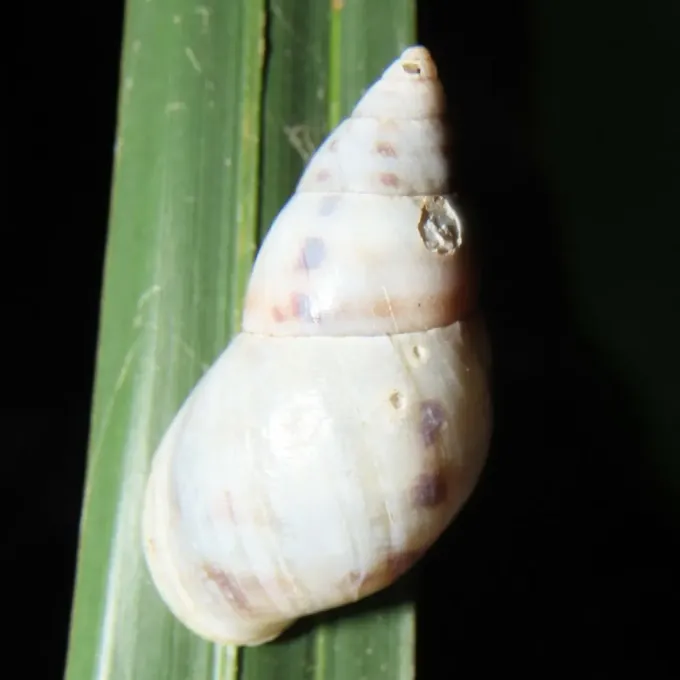
Drymaeus dormani is a species of land snail belonging to the family Bulimulidae (order Stylommatophora). It is characterized by an elongated, spirally coiled shell, often featuring patterns of dark bands or spots that serve as camouflage on tree surfaces.
The adults are medium-sized snails that are typically arboreal, meaning they spend a significant portion of their life cycle on the bark, branches, and leaves of trees and shrubs.
Their biology is highly dependent on humidity levels. As mollusks, they require moist environments to maintain their body moisture and facilitate movement via their muscular foot.
Reproduction involves laying eggs in hidden, damp environments such as decaying leaf litter or crevices in bark. The juveniles grow by gradually secreting calcium to enlarge their shells.
Identification is primarily based on their shell morphology and their presence on woody vegetation rather than on the ground, distinguishing them from common garden slugs.
What it damages
This species can pose a threat to various horticultural and ornamental plants. They feed on tender plant tissues, including foliage, buds, and young, succulent shoots of trees and shrubs.
By consuming leaf tissue, they reduce the plant's capacity for photosynthesis, which can lead to weakened growth, stunted development, and overall decreased vigor of the affected plant.
In addition to direct feeding, the damage caused by these mollusks creates wounds on the plant surface, which become entry points for secondary pathogens like fungi and bacteria.
Heavy infestations can lead to significant aesthetic damage to ornamental plants or potential loss of foliage in productive fruit trees, affecting the plant's long-term health.
The cumulative effect of feeding by a large population of these snails can be devastating in high-density garden environments if left unmanaged.
When it appears
Drymaeus dormani activity is closely linked to weather conditions, with peaks occurring during periods of high humidity and rainfall. They are most active when the environment provides ample moisture.
During dry spells, these snails often enter a period of dormancy. They adhere to tree trunks or retreat into shaded, cool crevices to minimize water loss until conditions improve.
Spring and early summer are usually the seasons of highest activity, coinciding with warmer temperatures and moisture that support the development and movement of the snail population.
As autumn approaches and temperatures begin to drop, the snails reduce their feeding frequency and prepare for overwintering in protected spots.
Local microclimates within a garden or orchard can significantly influence how long the snails remain active, even if surrounding areas are becoming drier.
Signs of infestation
A primary indicator of their presence is the silver, glistening mucus trails left on leaves, branches, and trunks as the snails move throughout the plant.
Observation of the plants may reveal the snails themselves, often tucked away on the underside of leaves or in the crotches of branches during the day to avoid direct sun.
Feeding damage typically presents as irregular holes or scalloped edges on the leaves, reflecting the action of the snail's radula (the tooth-like structure used for feeding).
- Silver, dried mucus trails on plant surfaces.
- Scalloped or jagged leaf margins.
- Presence of snail shells in hidden, shaded plant areas.
- Accumulation of waste pellets beneath the canopy.
If a plant shows sudden signs of leaf loss and the presence of these shiny trails, it is a strong indicator that a snail population has established itself on the tree.
Control measures
Managing Drymaeus dormani requires a strategy that combines mechanical control, habitat modification, and, if necessary, the application of targeted molluscicides.
Cultural practices are essential; gardeners should remove debris, fallen leaves, and unnecessary mulch from the base of plants to reduce the number of hiding spots available to the snails.
Mechanical control involves manual collection, especially during early morning or late evening when the snails are most active and visible on the plant surfaces.
Barriers, such as copper tape applied around the trunks of trees, can be highly effective at deterring the snails from climbing up to reach the foliage.
When using molluscicides (such as iron phosphate or metaldehyde-based products), ensure they are applied according to label directions to ensure safety for the environment and to be effective against the targeted pest.
Taxonomy
- Latin name
- Drymaeus dormani
- Order
- Molluscs
- Family
- Orthalicidae
- EPPO code
- DRYSDO
Discussion
No discussions yet — be the first.