
Sycamore aphid
Drepanosiphum platanoidis
Description
How to identify
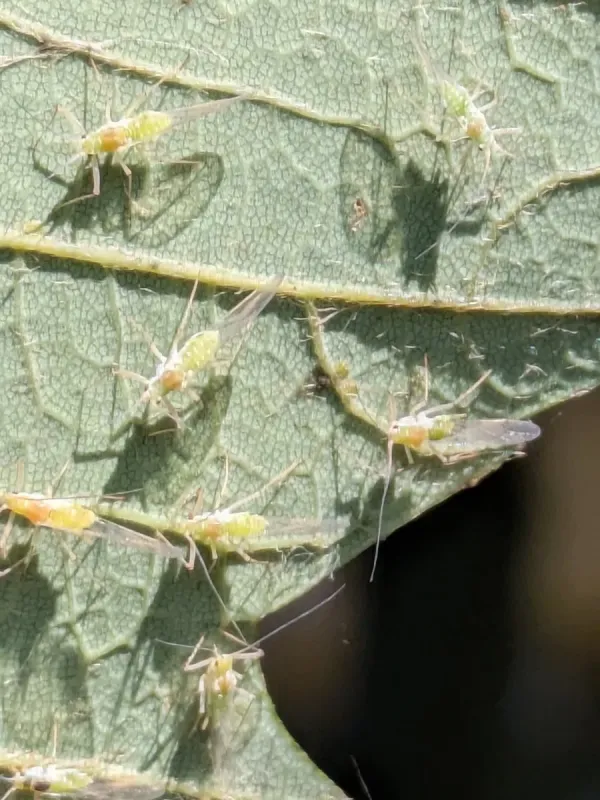
The sycamore aphid (Drepanosiphum platanoidis) belongs to the family Aphididae. It is a large, conspicuous species, with adults measuring between 3 and 5 mm in length.
These aphids are characterized by their elongated bodies, long legs, and notably long antennae. Their coloration varies from pale green to yellowish-brown, often with darker markings.
A distinctive feature of this species is its exceptionally long siphunculi. The winged adults have transparent wings with dark veins, which makes them easy to identify under close inspection.
Nymphs are similar to adults but smaller and lack developed reproductive organs. They are highly mobile and spread across the tree canopy throughout the growing season.
As a specialist species, it relies exclusively on specific host plants, primarily within the Acer genus, which dictates its population distribution.
What it damages
The sycamore aphid primarily attacks sycamore and other maple trees. The insects congregate on the undersides of leaves to feed on phloem sap.
Heavy feeding causes leaf yellowing and can lead to early leaf drop, which significantly impacts the aesthetic value of the trees in urban environments.
Like many aphid species, they excrete a sticky substance known as honeydew. This substance accumulates on the foliage and branches below the aphid colonies.
The honeydew acts as a medium for sooty mold growth, which appears as a black, velvety coating on the leaves. This mold inhibits the tree's ability to photosynthesize effectively.
Prolonged heavy infestation can weaken the tree, making it more susceptible to environmental stress, drought, and other secondary pathogens.
When it appears
The life cycle begins in spring with the hatching of eggs that have overwintered on the tree bark. This coincides with the tree's bud burst.
During the summer months, the species reproduces through parthenogenesis, allowing for rapid population growth and the development of multiple generations.
The peak population is usually observed in early to mid-summer, when temperatures are optimal for the insect's metabolism and reproductive activity.
In autumn, sexual forms develop to mate and lay overwintering eggs. These eggs are laid in bark crevices and remain dormant throughout the winter.
This survival strategy ensures that the population is ready to colonize the fresh spring growth as soon as conditions become favorable once again.
Signs of infestation
Initial signs of infestation include curling or distorted leaves, which may show yellow discoloration. Colonies of aphids are usually visible on the underside of these leaves.
A sticky film on the leaves and nearby branches is a hallmark of aphid presence. This honeydew is often very noticeable and can attract various other insects.
The presence of black sooty mold is a clear indicator that the infestation has persisted for some time. This soot can cover entire branches if left unchecked.
High ant activity on the tree trunk is often a reliable signal of aphid colonization, as ants "farm" the aphids to consume the sweet honeydew they produce.
- Yellowing of leaf tissue.
- Leaf curling and deformation.
- Sticky honeydew residue.
- Sooty mold on foliage.
- High ant traffic on branches.
Control measures
Systemic insecticides are the most effective method for controlling large infestations. These treatments ensure the chemical reaches the phloem where the aphids feed.
Biological control plays a significant role; preserving natural predators such as ladybirds, lacewings, and hoverflies helps keep aphid populations in check.
Proper tree maintenance is essential for prevention. Ensuring the tree is well-watered and healthy increases its natural resistance to aphid attacks.
For smaller trees, high-pressure water sprays can physically dislodge colonies and reduce the population without the need for chemical intervention.
Monitoring the tree early in the season is critical, as controlling the first generations can prevent the rapid population explosions observed later in summer.
Taxonomy
- Latin name
- Drepanosiphum platanoidis
- Order
- Hemiptera (bugs, aphids, leafhoppers)
- Family
- Aphididae
- EPPO code
- DRESPL
Discussion
No discussions yet — be the first.