
Schefflera whitefly
Dialeurodes schefflerae
Description
How to identify
The Schefflera whitefly (Dialeurodes schefflerae) is a small sap-sucking insect belonging to the family Aleyrodidae, specifically adapted to feed on ornamental plants.
Adult whiteflies appear as tiny, moth-like insects measuring approximately 2 mm in length, with wings covered in a white, powdery wax that provides protection.
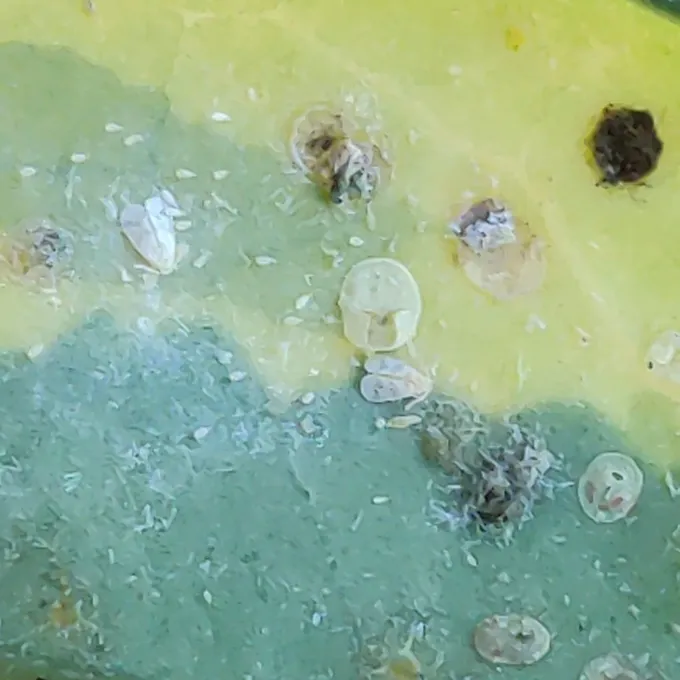
The immature stages, known as nymphs or crawlers, are flattened, oval, and often pale or yellowish, making them difficult to spot against the leaf tissue.
Their life cycle is accelerated in indoor environments, where stable temperatures allow for overlapping generations to develop continuously throughout the year.
Female whiteflies lay their eggs primarily on the underside of young, tender leaves, securing them firmly to the leaf surface with tiny stalks.
What it damages
This pest primarily targets Schefflera species, but it can also infest other closely related foliage plants in the Araliaceae family kept in greenhouses.
The whitefly damages plants by inserting its stylets into the leaf tissue to extract phloem sap, leading to stunted growth and reduced plant vigor.
A major side effect of infestation is the excretion of honeydew, a sticky substance that coats the leaves and serves as a substrate for sooty mold fungi.
The accumulation of sooty mold blocks sunlight from reaching the leaf surface, which severely interferes with the plant's ability to perform photosynthesis.
Severe infestations lead to chlorosis, leaf yellowing, tissue curling, and eventually widespread leaf drop, significantly reducing the plant's aesthetic and biological value.
Signs of infestation
A classic sign of infestation is a white cloud of insects rising into the air when the plant foliage is gently shaken or disturbed.
Close inspection of the underside of the leaves usually reveals the presence of stationary, scale-like nymphs clustered along the leaf veins.
The leaves often feel sticky to the touch due to the honeydew excretion, which is a clear indicator that the pest population is active and feeding.
The presence of black, velvety patches on the leaves indicates that sooty mold has begun to grow on the secreted honeydew.
General lack of growth, yellowing foliage, and distorted leaves in a formerly healthy plant are strong indicators of a chronic whitefly infestation.
Control measures
Manual removal of insects is the first step: wash the leaves thoroughly with a mild soapy solution to physically remove the nymphs and sticky residue.
Yellow sticky traps are highly effective for capturing adult flying whiteflies and serve as a vital tool for monitoring population density.
Systemic insecticides, particularly those containing neonicotinoids or similar active ingredients, are the most effective solution for systemic long-term control.
- Isolate infested plants immediately to prevent spread.
- Improve air circulation to reduce humidity levels around the foliage.
- Apply repeat insecticide treatments 7-10 days apart to target emerging nymphs.
Maintaining strict hygiene and regular inspection cycles are necessary to prevent the whitefly from re-establishing itself within your collection.
Taxonomy
- Latin name
- Dialeurodes schefflerae
- Order
- Hemiptera (bugs, aphids, leafhoppers)
- Family
- Aleyrodidae
- EPPO code
- DIALSC
Discussion
No discussions yet — be the first.