
Citrus whitefly
Dialeurodes citri
Description
How to identify
The citrus whitefly (Dialeurodes citri) is a small sap-sucking insect belonging to the Aleyrodidae family. Adult individuals are approximately 1.2–1.5 mm long, possessing two pairs of wings covered with a white, powdery wax.
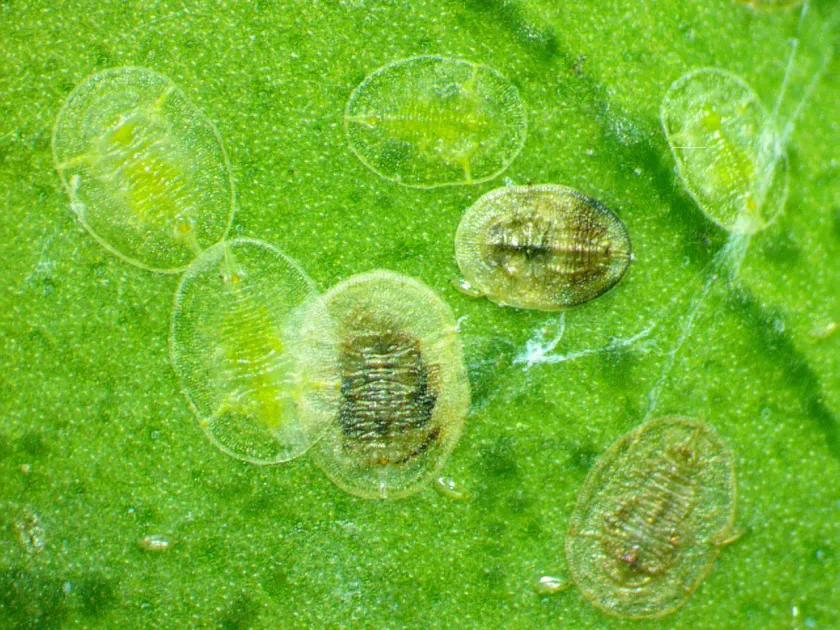
The nymphs go through several stages, with the first instar being mobile enough to find a suitable feeding site on the leaf. Once settled, they become sedentary, flat, and oval-shaped, resembling small scales on the underside of leaves.
The pupal stage is characterized by a specific morphology and firm attachment to the plant tissue. They are often pale yellow or greenish, which makes them difficult to spot against the leaf veins.
Their life cycle depends heavily on climatic conditions, with optimal development occurring at temperatures between 24°C and 28°C, which allows for rapid completion of generations.
This species is highly adaptable and has become a global concern, especially in greenhouse environments where it can maintain permanent populations throughout the year.
What it damages
Citrus plants, including lemons, oranges, and grapefruit, are the primary hosts for Dialeurodes citri. However, it can also infest ornamental plants like gardenias, jasmine, and privet.
Feeding nymphs drain cell sap from the leaves, which causes significant physiological stress to the plant. This leads to stunted growth, leaf curling, and overall decline in tree health.
A major indirect impact of the infestation is the excretion of honeydew, a sweet, sticky substance that covers the foliage. This serves as a primary substrate for the growth of sooty mold.
The dense black layer of sooty mold physically blocks sunlight, severely hindering photosynthesis. This reduction in energy production results in smaller fruits and poor harvest quality.
In cases of heavy infestation, the combination of direct sap loss and fungal interference can lead to the complete defoliation and death of young or weakened specimens.
When it appears
In outdoor subtropical climates, the activity of the citrus whitefly typically begins in spring as temperatures rise consistently above 15°C.
Inside greenhouses or interiors, the whitefly can produce multiple overlapping generations, often totaling 4 to 6 generations per year depending on the heat supply.
The peak population density usually occurs during the mid-summer months when ambient temperatures are at their highest, facilitating faster reproduction cycles.
Eggs are typically laid on the underside of young leaves, often in circular patterns. Monitoring for these egg clusters is crucial during the active growing season.
Overwintering occurs primarily in the nymphal or pupal stage on the leaves that remain on the tree, allowing the population to persist into the following year.
Signs of infestation
The most obvious sign of an infestation is the presence of adult whiteflies flying in clouds when an infested branch or leaf is disturbed or shaken.
The presence of honeydew on the upper surface of leaves lower in the canopy indicates that an active colony is feeding higher up on the tree.
The development of sooty mold (a black, powdery fungus) on the leaves is a hallmark symptom that the infestation has been present for a significant period.
Yellowing, chlorosis, and the curling of new leaf growth are common physiological responses to the toxins injected by the whiteflies during their feeding process.
Reduced vigor of the tree, combined with excessive fruit drop or poor coloration, serves as a late-stage warning of severe infestation requiring immediate action.
Control measures
Cultural control involves proper pruning of the tree canopy to increase airflow and sunlight penetration, which discourages whitefly colonization.
Biological control is highly effective in closed environments, utilizing the parasitoid wasp Encarsia formosa, which selectively targets and kills whitefly nymphs.
Chemical control usually relies on systemic insecticides, such as neonicotinoids, which are absorbed by the plant and provide long-lasting protection against sucking pests.
Horticultural oils and insecticidal soaps can be applied as contact sprays, forming a physical barrier that suffocates the insects without leaving toxic residues.
- Utilizing yellow sticky traps to monitor adult population levels and reduce their numbers.
- Washing the plant foliage with water or mild detergent solutions to remove honeydew and larvae.
- Rotating chemical classes to prevent the development of pesticide resistance in whitefly populations.
Taxonomy
- Latin name
- Dialeurodes citri
- Order
- Hemiptera (bugs, aphids, leafhoppers)
- Family
- Aleyrodidae
- EPPO code
- DIALCI
Discussion
No discussions yet — be the first.