
Citrus whitefly
Dialeurodes cinnamomicola
Description
How to identify
The Citrus whitefly Dialeurodes cinnamomicola is a member of the order Hemiptera and the family Aleyrodidae. These are tiny insects with adults typically measuring 1.5–2 mm in length, characterized by two pairs of wings covered in a fine, white waxy powder.
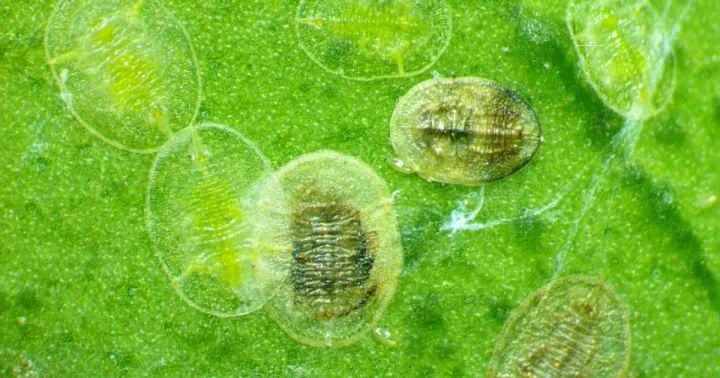
The life cycle includes a larval stage where the nymphs are sessile. After the initial "crawler" stage, they attach firmly to the underside of leaves, resembling flat, pale-yellow or greenish scale-like structures.
Adults are active during the day and are commonly found on the underside of young, tender leaves where they feed by piercing and sucking plant sap.
In greenhouse conditions or warm climates, the life cycle can be continuous throughout the year, with multiple overlapping generations occurring if the environment remains stable.
Identification is often difficult because the immobile larval stages blend perfectly with the plant tissue, requiring a close, systematic inspection of foliage to detect early infestations.
What it damages
The primary hosts of this pest are citrus trees, including lemons, oranges, and mandarins. Occasionally, they can infest various ornamental shrubs present in the same vicinity.
Damage is caused by both adults and nymphs extracting cell sap, which leads to general plant weakening, stunted growth, and the distortion of new leaf flushes.
The insect secretes large quantities of honeydew, a sticky substance that coats the leaves and stems, significantly hindering the plant's ability to perform photosynthesis.
This honeydew acts as a substrate for sooty mold fungi, which develop as a thick black layer on the leaves, further reducing plant vitality and aesthetic value.
Severe infestations can lead to premature leaf drop and a significant reduction in fruit yield, often rendering the remaining fruit unmarketable due to the mold cover.
Signs of infestation
The most prominent sign is the presence of sticky honeydew on the foliage, followed by the appearance of dark sooty mold growth covering the leaves and branches.
Infested plants show visible signs of decline, such as yellowing, chlorosis, and general wilting, especially in young, tender shoots that are preferred by the insects.
A cloud of small white insects appearing when a branch is shaken is a definitive indicator of a high population level and active infestation.
Close observation of the underside of leaves will reveal numerous stationary, scale-like nymphs and the empty white casings (exuviae) left after adult emergence.
The overall plant vigor decreases, and in commercial orchards, this can be observed as a marked decrease in growth rates compared to non-infested trees.
Control measures
Effective management requires an integrated approach that combines cultural practices, biological control, and targeted chemical applications to minimize population density.
Cultural control involves regular pruning to remove infested branches and improve air circulation within the canopy, making the environment less favorable for the whitefly.
Systemic insecticides, particularly neonicotinoid-based products, are highly effective against nymphs because they are absorbed into the sap that the insects ingest.
Biological control, using specific parasitoid wasps or predators, serves as a sustainable way to keep populations below economic injury levels, particularly in enclosed environments.
Monitoring using yellow sticky traps helps agronomists track population trends and timing of applications, ensuring that control measures are implemented precisely when needed.
Taxonomy
- Latin name
- Dialeurodes cinnamomicola
- Order
- Hemiptera (bugs, aphids, leafhoppers)
- Family
- Aleyrodidae
- EPPO code
- DIALCN
Discussion
No discussions yet — be the first.