
Poultry red mite
Dermanyssus gallinae
Description
How to identify
The poultry red mite (Dermanyssus gallinae) is a parasitic mite belonging to the order Mesostigmata and family Dermanyssidae, primarily infesting various bird species.
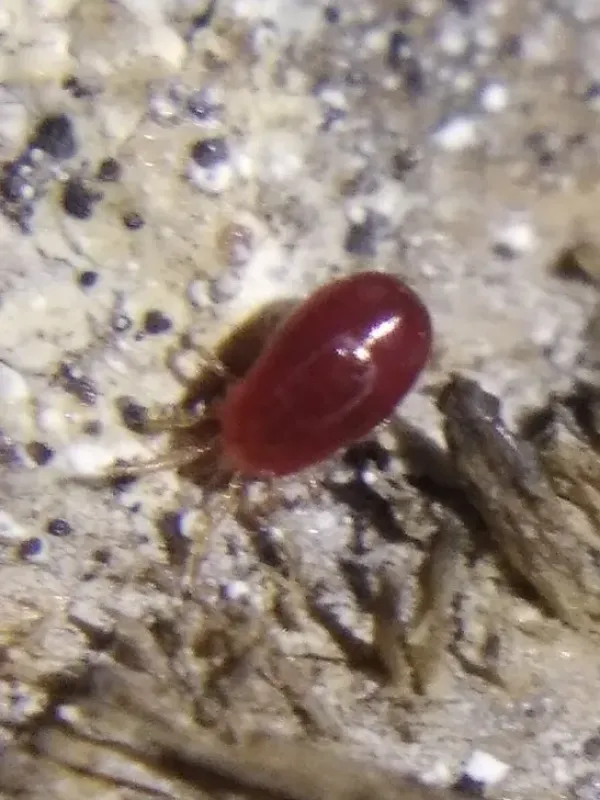
Adult mites are approximately 0.7 mm long. Their appearance changes significantly based on their feeding status: hungry mites are greyish-white or yellow, while blood-fed individuals are bright red or dark red.
These parasites are nocturnal feeders. During the day, they hide in cracks, crevices, nesting materials, and under equipment, making them difficult to detect during daylight hours.
The mite has a high survival rate; it can remain in an unfed state in empty poultry houses for up to 8–10 months, waiting for the return of a host.
Its life cycle is exceptionally fast, allowing a population to explode from a few individuals to millions in a very short period under optimal conditions.
What it damages
Dermanyssus gallinae targets chickens, turkeys, pigeons, and other avian species. It is a major global pest that causes severe stress and physical harm to poultry.
The mite feeds on the blood of the host, which directly leads to iron-deficiency anemia, weakness, and overall suppressed immune systems in the affected birds.
Egg production in layers drops significantly, while the eggs themselves may show blood spots or exhibit lower shell quality, leading to commercial losses.
In cases of heavy infestation, mortality can occur, especially in young chicks and brooding hens that are unable to leave their nests to escape the mites.
Beyond direct feeding, they serve as biological vectors for various pathogens, including viruses and bacteria that can infect the entire flock.
When it appears
Mite population growth is highly dependent on environmental temperature, with 20°C to 25°C being the optimal range for rapid development.
In natural settings, the infestation peaks during the spring and summer months when temperatures allow for the accelerated hatching of eggs and maturation of nymphs.
In modern intensive poultry farming, climate-controlled environments enable the mite to multiply throughout the entire year without any winter dormancy.
Humidity also plays a critical role in the life cycle, with higher moisture levels often supporting the survival of eggs and larvae in the poultry house environment.
When temperatures drop significantly, the mites enter a dormant state, huddling in dark, hidden corners of the coop until temperatures rise again.
Signs of infestation
One of the primary clinical signs is restlessness in birds, as they experience itching and pain from the bites, often leading to feather pecking and aggressive behavior.
Physical examination of the birds, particularly under the wings and around the vent, often reveals pale skin due to anemia and small red or black bite marks.
The presence of Dermanyssus gallinae is often identified by the accumulation of "mite dust," which appears as dark spots or smears in cracks and seams of equipment.
Sudden declines in egg weight and yield, combined with birds refusing to sit on their nests, are strong indicators of a severe infestation within the coop.
Utilizing white cardboard traps or sticky tape inside the coop is a standard professional method for monitoring mite activity levels and confirming the infestation.
Control measures
Managing the poultry red mite requires a holistic approach combining chemical treatments, physical cleaning, and persistent monitoring to prevent population spikes.
Deep cleaning is essential: all organic material, including manure and old bedding, must be removed to eliminate hiding spots for the mite colonies.
Chemical control involving acaricides needs to be timed correctly, targeting both the birds and the environment, while adhering to strict withdrawal periods.
- Application of amorphous silica or diatomaceous earth to desiccate the mites.
- Heat treatment or flame-gunning of metal surfaces to destroy mites and eggs.
- Biological control using predatory mites that feed on Dermanyssus gallinae.
- Implementation of strict biosecurity to prevent reintroduction of mites from other flocks.
Success is only achieved through repeated applications, as chemical treatments often do not destroy mite eggs; thus, follow-up cycles are mandatory every 7–10 days.
Taxonomy
- Latin name
- Dermanyssus gallinae
- Order
- Mites
- Family
- Dermanyssidae
- EPPO code
- DERYGA
Discussion
No discussions yet — be the first.