
Tropical rat mite
Allodermanyssus
Description
How to identify
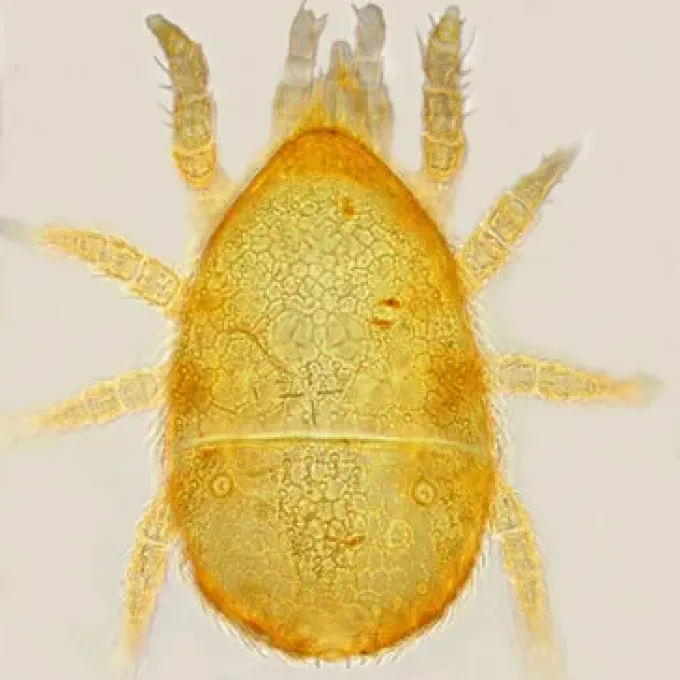
The Tropical rat mite, known scientifically as Allodermanyssus sanguineus, belongs to the Mesostigmata order and Dermanyssidae family. These mites are very small, typically 0.7 to 1.0 mm in length, and vary in color from pale yellowish to dark red after a blood meal.
These mites are obligate hematophagous parasites of rodents. They do not feed on crops or plants, but their presence in agricultural settings like grain storage facilities or produce warehouses is a direct indicator of rodent activity.
Mites are nocturnal and hide in wall cracks, floor crevices, and ventilation ducts during the day. Their detection is crucial for identifying areas where rodents have nested, as the mites rarely travel far from their hosts' habitats.
The life cycle involves five stages: egg, larva, protonymph, deutonymph, and adult. Development is highly sensitive to ambient temperature; in warmer storage conditions, the lifecycle completes rapidly, allowing for massive population explosions in a short time.
Females are highly prolific, capable of laying numerous eggs throughout their lifespan. Because they can survive for extended periods without a host, any residual infestation in a storage facility remains a constant threat to operations.
What it damages
While these mites do not damage crops or plants, they represent a severe biological hazard in agricultural logistics. As vectors for rickettsial diseases, including rickettsialpox, they pose a significant health risk to farm workers and warehouse staff.
An infestation leads to the rejection of agricultural products during quality control checks. Stored grain or produce contaminated by mites becomes unsuitable for human consumption or processing, resulting in significant commercial loss.
The presence of mites causes severe discomfort, including itching and dermatitis among employees exposed to infested areas. This leads to decreased labor efficiency and potential work stoppages in logistics hubs.
Economic damage is compounded by the need for costly emergency professional disinfection of storage facilities. Furthermore, the destruction of infested packaging and the loss of product inventory impact the overall profitability of the harvest season.
Prolonged infestations can damage a facility's reputation and lead to legal issues regarding food safety compliance. Strict adherence to sanitation protocols is necessary to prevent the spread of mites through distribution channels.
Control measures
The primary control strategy must be integrated pest management, starting with comprehensive rodent control. As long as rodent hosts are present in the facility, any chemical mite control will provide only temporary relief.
Professional acaricide treatments must target all cracks, crevices, and hiding spots within the warehouse. Direct contact treatment of the environment is essential, as the mites spend most of their time in the structure rather than on the hosts themselves.
- Implement rigorous rodent proofing of all storage structures.
- Clear all debris and waste that could serve as nesting materials for rodents.
- Use sticky traps for continuous monitoring of both rodent and mite activity.
- Regularly sanitize warehouse equipment and transport vehicles.
Chemical control must be carried out by professionals using products registered for use in storage environments to ensure safety for the handled crops. Treatment timing should target multiple generations of mites to ensure total elimination.
Successful management relies on persistent surveillance of the external premises. Eliminating rodent access to the facility is the most effective long-term preventative measure against the establishment of Tropical rat mite populations.
Taxonomy
- Latin name
- Allodermanyssus
- Order
- Mites
- Family
- Dermanyssidae
- EPPO code
- ALLDSP
Discussion
No discussions yet — be the first.