
Persimmon leaf miner
Cuphodes diospyrosella
Description
How to identify
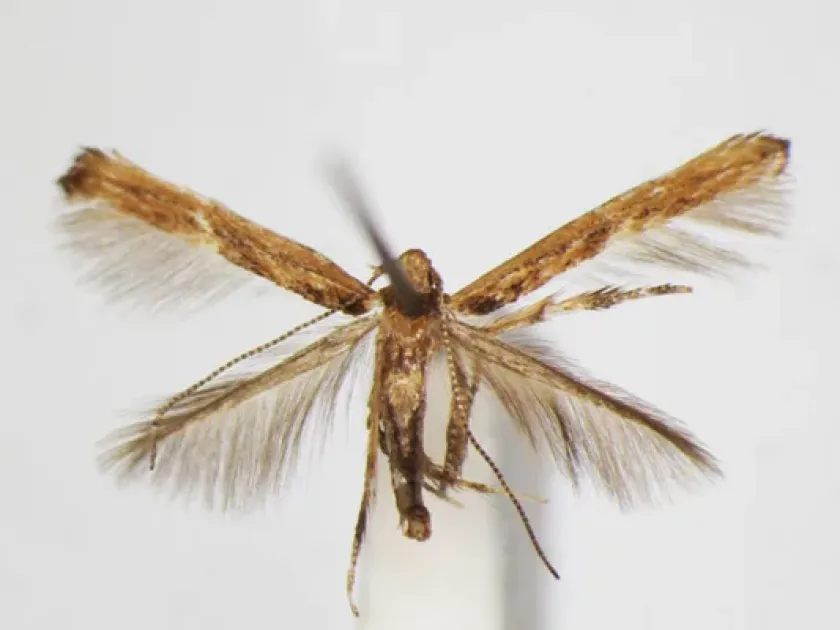
The persimmon leaf miner (Cuphodes diospyrosella) belongs to the order Lepidoptera, family Gracillariidae. These small insects possess narrow wings with distinct patterns, providing excellent camouflage against the bark of host trees.
The larvae of this pest have a cylindrical body shape, specifically adapted for life within the leaf tissues. In their early developmental stages, they remain well-hidden, making them difficult to detect during standard inspections.
The lifecycle consists of four main stages: egg, larva, pupa, and adult. Females deposit eggs directly onto the surface of persimmon leaves, where the larvae hatch and immediately begin feeding.
Pupation typically occurs either inside the leaf mine or within a folded leaf, where the insect constructs a protective silk cocoon. The speed of the developmental cycle is highly dependent on ambient air temperatures.
Under favorable, warm climatic conditions, the moth can produce multiple generations per season, which significantly increases the risk of rapid infestation throughout the orchard.
What it damages
The primary host for this pest is the oriental persimmon and other related species within the Diospyros genus. Larvae feed on the leaf parenchyma, creating tunnels known as mines that can be linear or blotchy in shape.
The damage to the foliage disrupts the photosynthetic process, leading to premature yellowing and dropping of leaves. This weakens the tree, affecting its overall vigor and long-term health.
Severe infestations can lead to a significant loss of leaf mass, which reduces the tree's winter hardiness and makes it more susceptible to various other pathogens and environmental stresses.
When infestation levels are high, the impact on fruit yield and quality is substantial due to the decreased capacity of the tree to produce necessary nutrients for fruit development.
Damage occurs throughout the growing season, starting from the moment buds break and young foliage begins to develop in the spring months.
Signs of infestation
The first noticeable sign of an infestation is the appearance of whitish or brownish winding trails (mines) on the leaf surface. When held up to the light, frass (larval excrement) can often be seen inside these tunnels.
Leaves affected by the miner often curl, deform, or develop chlorotic patches before drying out completely. This is a primary diagnostic indicator for orchard managers.
Opening the mine may reveal the presence of a larva or the discarded skins from previous molts. The larvae are quite active and will attempt to exit the mine if disturbed.
Premature leaf drop in mid-summer, which is uncharacteristic for healthy trees, is a major warning sign that an intervention is required to manage the pest population.
Adult moths are nocturnal and rarely seen during the day. However, using light traps at night is an effective diagnostic tool for confirming their presence in the orchard.
Control measures
The primary cultural control method is the careful removal and destruction of fallen leaves, which serve as the overwintering site for pupae, effectively reducing the next generation.
Systemic insecticides are effective when applied during the early stages of infestation, as the active ingredients are absorbed into the leaf tissues to target the larvae inside the mines.
- Deploy pheromone traps to monitor adult flight activity and population density.
- Use biological control agents, such as specific bacteria, to manage larval populations.
- Ensure proper fertilization to maintain tree vigor and resilience against pest attacks.
- Follow strict quarantine protocols when introducing new nursery stock to the orchard.
To protect beneficial insects that prey on the leaf miner, it is advisable to use selective insecticides that do not harm natural predators and parasitoids.
Regular orchard scouting is essential, as early detection allows for targeted control measures that prevent widespread damage without the need for excessive chemical use.
Taxonomy
- Latin name
- Cuphodes diospyrosella
- Order
- Lepidoptera (butterflies)
- Family
- Gracillariidae
- EPPO code
- PHRIDI
Discussion
No discussions yet — be the first.