
Red currant blister aphid
Cryptomyzus houghtonensis
Description
How to identify
The red currant blister aphid (Cryptomyzus houghtonensis) is a small pest belonging to the order Hemiptera and the family Aphididae. It is a highly specialized insect that targets specific species within the Ribes genus.
The life cycle begins with overwintering eggs located on the bark of shoots, particularly near the buds. As soon as the leaves begin to unfold in early spring, the nymphs hatch and immediately start feeding on the succulent undersides of the foliage.
Throughout the spring and early summer, the aphids undergo several generations. The population density can increase dramatically in a short period, creating vast colonies that are hidden from casual observation.
Winged forms appear later in the season to migrate between plants, ensuring the colonization of the entire shrub. This rapid spread is characteristic of the species during favorable, humid conditions.
As autumn approaches, the aphids produce sexual generations. After mating, the females deposit eggs that are designed to survive winter temperatures, ensuring the survival of the population until the next spring.
What it damages
The primary hosts of this aphid are red and white currants. By piercing the plant tissue to extract sap, the aphids inject toxins that induce abnormal growth in the leaves.
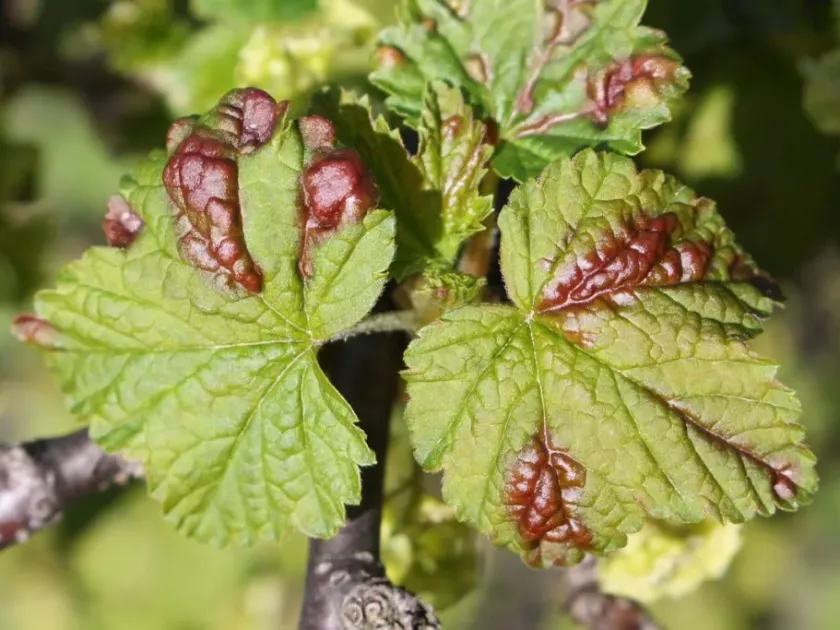
The most visible sign of infestation is the formation of blister-like galls on the upper leaf surface. These are initially pale green but quickly turn vivid shades of red, purple, or deep crimson.
As the aphids continue to feed, the affected leaves become severely distorted, eventually drying out and curling. This damage disrupts the plant's ability to photosynthesize effectively.
Persistent infestations lead to a decline in plant vigor, stunted growth of shoots, and a significant reduction in fruit yield. In severe cases, premature leaf drop can occur, leaving the plant vulnerable to winter stress.
- Characteristic red gall formation.
- Severe leaf curling and chlorosis.
- Stunted terminal shoot growth.
Control measures
Cultural control is essential. Regularly prune shrubs to remove excessive basal growth and to improve air circulation, which reduces the microclimate favoring aphid survival.
Natural predators play a crucial role in maintaining balance. Encouraging populations of ladybirds, lacewings, and hoverflies by avoiding broad-spectrum pesticides can significantly lower aphid numbers.
When chemical intervention is required, systemic insecticides applied before or immediately after the flowering stage provide the most reliable protection. Always ensure thorough coverage of the leaf undersides.
Biological pesticides, including oils or soaps, can be used as a contact treatment. These are effective if applied early enough before the leaves become tightly curled, which protects the aphids from the spray.
Monitoring the undersides of the leaves starting in early spring is vital. Early detection allows for spot treatment, which is often sufficient to prevent the infestation from becoming widespread across the garden.
Taxonomy
- Latin name
- Cryptomyzus houghtonensis
- Order
- Hemiptera (bugs, aphids, leafhoppers)
- Family
- Aphididae
- EPPO code
- CRYMHO
Discussion
No discussions yet — be the first.