
Currant-lettuce aphid
Cryptomyzus galeopsidis
Description
How to identify
The currant-lettuce aphid (Cryptomyzus galeopsidis) is a small insect species belonging to the Aphididae family. Adults typically measure about 1.5–2 mm in length and exhibit a pale green or yellowish body color.
The species displays a complex life cycle, featuring both wingless and winged morphs. Wingless females are responsible for rapid colonization of host plants, while winged individuals facilitate migration between different plant species.
These insects overwinter in the egg stage, attached to the stems and buds of currant bushes. When temperatures rise in the spring, the eggs hatch into fundatrices, which begin the seasonal cycle.
The biology of this aphid is characterized by parthenogenesis during the summer months, allowing populations to expand exponentially under favorable climatic conditions.
Unlike some other aphid species, C. galeopsidis maintains a specific relationship with its hosts, often moving between shrubs and various herbaceous plants throughout the growing season.
What it damages
The primary damage is caused by aphids sucking the phloem sap from the developing leaves and tender shoots of the host plants, which leads to significant metabolic stress.
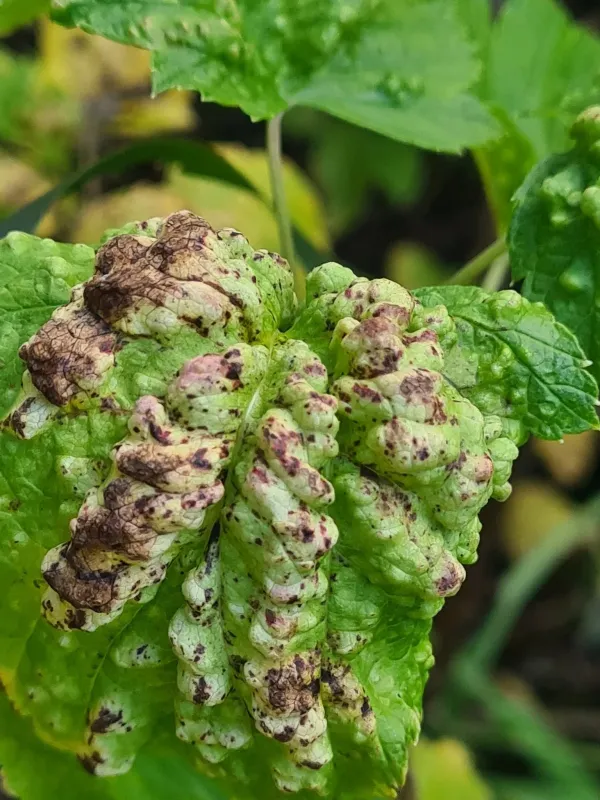
As the insects feed, they inject saliva that contains substances causing localized tissue deformities. This results in severe leaf curling, wrinkling, and the formation of characteristic leaf galls.
The reduction in photosynthetic area due to deformed leaves impairs the plant's growth, leading to stunted shoots and overall weakened immunity against environmental stressors.
Affected plants often show premature leaf drop, which negatively impacts the storage of carbohydrates for the next season and decreases the plant's winter hardiness.
Beyond direct damage, the aphid acts as a vector for various plant viruses. Transmission of these pathogens can severely compromise the quality of the harvest and the longevity of the shrubs.
When it appears
The seasonal activity begins in early spring as soon as the buds start to break, marking the transition from the overwintering egg stage to the active feeding phase.
May and June represent the peak periods for colony development, as warm weather and soft young foliage provide optimal conditions for reproduction and growth.
During the peak of summer, partial migration to secondary hosts often occurs, temporarily reducing the density of colonies on the currants while ensuring the species' survival.
The return migration typically occurs in late summer and autumn, as sexual forms move back to the woody stems of currant bushes to mate and deposit overwintering eggs.
Temperature fluctuations and rainfall patterns significantly dictate the annual population dynamics, with spring moisture being a key factor in early-season outbreaks.
Signs of infestation
The most prominent sign of infestation is the curling and distortion of young leaves at the tips of the shoots, often accompanied by a pale, yellowish discoloration.
The presence of honeydew, a sticky secretion produced by aphids, on the leaf surface is a reliable indicator of an active population that requires immediate attention.
The development of sooty mold, which appears as a black dusty coating, often follows the presence of honeydew and further degrades the plant's ability to photosynthesize.
Intense ant activity around the bushes is frequently linked to aphid infestations, as ants are known to tend and protect these insects to collect their sugary excretions.
Close observation of the underside of leaves will reveal clusters of small, pale insects, which confirms the presence of the pest and justifies the application of control measures.
Control measures
Integrated pest management starts with cultural practices, including winter pruning to remove shoots heavily infested with eggs, which significantly lowers the initial population.
Natural biological control by predators such as ladybirds, lacewings, and hoverflies should be encouraged by creating diverse habitats and avoiding broad-spectrum pesticides.
Systemic insecticides are effective for large-scale infestations, as they provide lasting protection for the interior leaf tissues where aphids hide, but they must be used carefully.
For organic management, applications of insecticidal soaps or neem-based solutions can be effective if applied early enough before the leaves become severely curled.
- Monitor the undersides of young leaves regularly starting from the bud-burst stage.
- Manage weed populations nearby to remove secondary hosts that support the aphid's summer cycle.
- Avoid excessive nitrogen fertilization, which creates succulent growth that is highly attractive to aphids.
Taxonomy
- Latin name
- Cryptomyzus galeopsidis
- Order
- Hemiptera (bugs, aphids, leafhoppers)
- Family
- Aphididae
- EPPO code
- MYZLGA
Discussion
No discussions yet — be the first.