
Corylobium
Corylobium
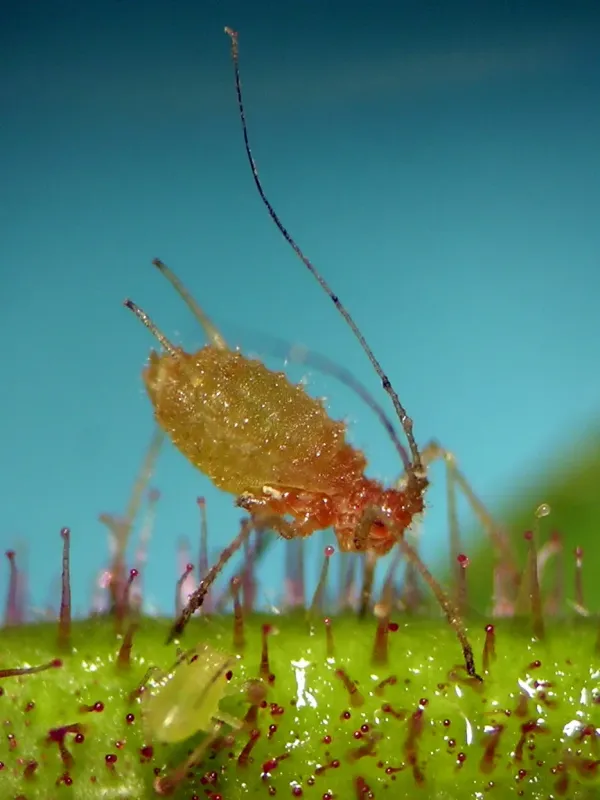
Description
How to identify
Corylobium is a genus of small insects belonging to the family Aphididae (aphids). The most recognized species is the rose aphid (Corylobium avellanae), which specifically targets shrubs of the Rosaceae family.
Adult individuals typically exhibit an elongated body shape, usually in shades of green or yellowish-green, providing excellent camouflage against young shoots and leaves.
These insects possess a specialized piercing-sucking mouthpart designed to penetrate plant tissues and extract nutrient-rich phloem sap.
The lifecycle includes both apterous (wingless) and alate (winged) forms, allowing the population to disperse effectively across a garden in search of new food sources during the growing season.
Reproduction occurs parthenogenetically, which allows for an extremely rapid increase in pest numbers when environmental conditions are favorable.
What it damages
The primary hosts of Corylobium are plants of the Rosaceae family, with a strong preference for the genus Rosa.
The pest favors young, actively growing plant parts because these tissues are tender and highly concentrated with nutrients.
Infestations typically begin at the tips of shoots, on flower buds, and on the undersides of young leaves, where they congregate in dense colonies.
Beyond roses, depending on the specific species, Corylobium may be found on wild relatives, which can serve as reservoirs for re-infestation of garden plants.
Heavy infestations drain the plant's resources, slowing down growth and development, which significantly degrades the aesthetic value and flowering potential of the bushes.
When it appears
The emergence of the first Corylobium individuals usually coincides with the start of active sap flow and bud break in the spring.
Peak population density is observed in late spring and early summer when temperatures are optimal for their reproductive cycle.
Prolonged heat and low humidity may temporarily slow development, but the presence of irrigation ensures that pest activity remains high throughout the summer.
In autumn, many aphid species migrate to winter hosts or lay dormant eggs in bark crevices to ensure the species survives through the winter.
Understanding these seasonal patterns allows agronomists and gardeners to implement preventive measures before colonies reach critical thresholds.
Signs of infestation
The first indicator of infestation is characteristic curling and yellowing of young, developing leaves.
Stems and leaves often become covered in a sticky substance known as honeydew, which is excreted by the aphids during feeding.
Honeydew provides an ideal substrate for sooty mold, resulting in a black, unsightly coating on foliage that interferes with efficient photosynthesis.
Flower buds under severe attack may fail to open, dry out, or become distorted, leading to significant losses in bloom quality.
Close inspection of the underside of leaves or shoot tips usually reveals dense clusters of these small, light-colored insects.
Control measures
Managing Corylobium requires an integrated approach combining biological and chemical control methods.
Biological control involves encouraging natural predators in the garden, such as ladybugs (Coccinellidae), lacewings, and predatory gall midges.
When populations exceed acceptable levels, the application of systemic or contact-action insecticides registered for horticultural use is recommended.
- Spraying with pyrethroid-based insecticides.
- Applying systemic products that are translocated within plant tissues.
- Regular pruning and removal of heavily infested shoot tips.
It is essential to rotate between different classes of insecticides to prevent the development of resistance within the aphid population.
Taxonomy
- Latin name
- Corylobium
- Order
- Hemiptera (bugs, aphids, leafhoppers)
- Family
- Aphididae
- EPPO code
- CRLOSP
Discussion
No discussions yet — be the first.