
Eastern dobsonfly
Corydalus cornutus
Description
How to identify
The Eastern dobsonfly (Corydalus cornutus) belongs to the order Megaloptera and the family Corydalidae. It is a large insect characterized by a wide wingspan, often exceeding 12-15 cm.
Males of the species are famously equipped with long, sickle-like mandibles that are used in mating displays rather than for biting plant tissues.
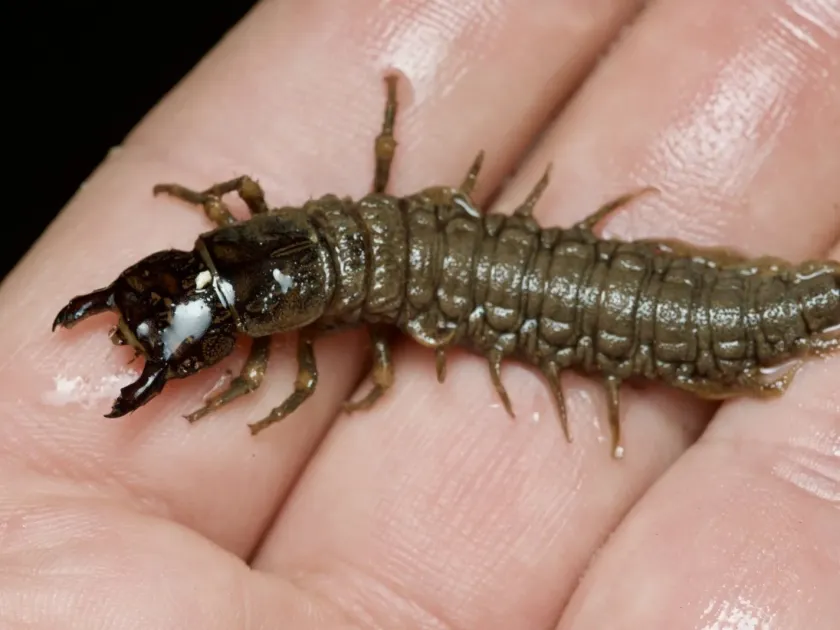
The larval stage, commonly known as a hellgrammite, possesses a robust, dark-colored body and powerful biting mouthparts, living primarily underwater.
Adults are nocturnal and are usually found near water bodies, often resting on tree trunks or foliage during the daylight hours.
Due to their size and intimidating appearance, they are easily recognized and distinguished from other common insects found in the vicinity of ponds and streams.
What it damages
Adult Eastern dobsonflies have vestigial mouthparts that are ineffective for feeding; they primarily consume water or nectar, causing zero damage to crops.
The larvae are aquatic predators that feed on smaller insects and invertebrates, playing a vital role in maintaining the balance of aquatic ecosystems.
There is no evidence that this species causes damage to foliage, fruits, or roots of plants in commercial or home agriculture.
As they are not phytophagous, they are not considered pests in the traditional sense, despite their occasionally frightening size.
In some rare cases, their presence in irrigation pumps or filtration systems might be perceived as a nuisance, requiring simple mechanical intervention.
When it appears
The lifecycle begins with egg-laying in late spring or early summer, where females attach masses of eggs to structures overhanging water.
Larvae hatch and immediately enter the water, where they will spend several years maturing, periodically molting as they grow in size.
Adult emergence occurs during the warm summer months, particularly in June and July, when adults gather for mating rituals.
The peak activity is restricted to the vicinity of healthy freshwater ecosystems, such as clean rivers, streams, and lakes with adequate vegetation.
As temperatures begin to drop in autumn, the activity ceases, and the larvae move deep into the sediment to survive the winter months.
Signs of infestation
White, crusty egg masses found on stones, dock pilings, or leaves near the water's edge are the primary indicator of a nearby population.
Adults are highly attracted to porch lights at night, making them a common guest in suburban or rural homes located near water bodies.
Larvae can sometimes be observed during dredging or debris removal in ponds, where they hide among rocks and aquatic plant stems.
The presence of large, distinctive insect carcasses around outdoor lighting fixtures is a common sign of their seasonal flight phase.
Observing large, dark insects resting on trees during the day, particularly near streams, confirms their active presence in the environment.
Control measures
No chemical control is recommended for the Eastern dobsonfly, as it is not an agricultural pest and contributes to healthy water biodiversity.
If adults become a nuisance near outdoor living spaces, simply reducing outdoor lighting or using yellow-tinted bulbs will deter them effectively.
Physical barriers such as window screens are sufficient to prevent them from entering homes or barns during their flight season.
Cleaning debris from the edges of private ponds can help discourage egg-laying in specific areas if human-insect interaction is undesirable.
Always prioritize the preservation of this species as it acts as a bio-indicator for clean, well-oxygenated water in the surrounding landscape.
Taxonomy
- Latin name
- Corydalus cornutus
- Family
- Corydalidae
- EPPO code
- CDLSCO
Discussion
No discussions yet — be the first.