
Fishfly genus Chauliodes
Chauliodes
Description
How to identify
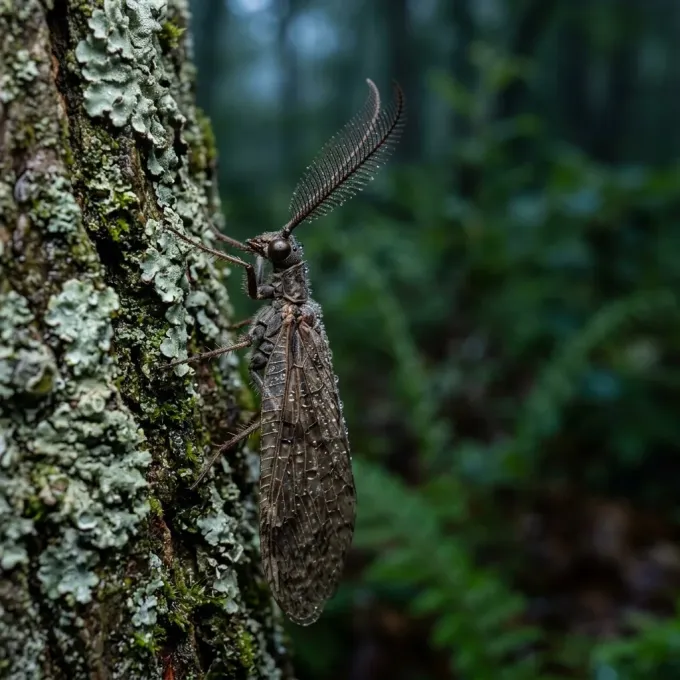
Fishflies of the genus Chauliodes belong to the order Megaloptera, family Corydalidae. These are relatively large insects that, in the adult stage, have a characteristic appearance with reticulated wing venation that folds roof-like over the abdomen.
Adult individuals possess powerful, often serrated mandibles, although in some species these are poorly developed. The body is colored in shades of brown, which allows them to effectively camouflage against tree bark.
Fishfly larvae are aquatic, inhabiting the bottom layers of water bodies, flowing streams, or moist soil near the shoreline. They have distinct external gills along the sides of the abdominal segments.
The life cycle of the insect includes complete metamorphosis: egg, larva, pupa, and adult. The larval stage is the longest and can last from one to three years depending on environmental conditions.
Identification of adults is possible by their large size (often up to 50 mm in wingspan) and their specific habit of resting on vegetation near bodies of water.
What it damages
The primary damage caused by larvae stems from their predatory lifestyle, although they may damage the roots of moisture-loving agricultural crops growing in flooded areas.
For cultivated plants, direct damage is often indirect: larvae disrupt soil structure and the root systems of seedlings planted in waterlogged areas or near ponds.
Adult individuals consume little to no food, or feed only on nectar and pollen, meaning they pose no threat to the above-ground parts of plants by gnawing leaves.
Damage is most often noted in nurseries where seedlings are grown under conditions of excessive moisture, which attracts adult females to lay eggs on coastal vegetation.
Despite their predatory instincts, this genus does not usually cause mass destruction of crops, being more of a specific inhabitant of agro-landscapes with water bodies.
When it appears
Adult Chauliodes activity is observed mainly in late spring and the first half of the summer season, when the insects emerge for mating.
The period of mass hatching of larvae from eggs laid on leaves or branches overhanging the water occurs in mid-summer, after which they enter the aquatic environment.
Adults are most active at dusk and at night, as they are strongly attracted to light sources, which is often noticeable near country houses and gardens.
Larvae are active year-round, but the intensity of their feeding increases in the warm season, when metabolism in the aquatic environment accelerates due to rising water temperatures.
The insect overwinters in the larval stage, hiding in silt, under rocks, or deep in shoreline soil, which allows them to successfully survive unfavorable conditions.
Signs of infestation
A sign of the pest's presence on the site is the discovery of large, often grayish egg masses on coastal vegetation or tree branches overhanging the water.
On damaged seedlings in moisture-affected areas, one can notice wilting of tops caused by larval damage to the root system.
The presence of a large number of adults on illuminated surfaces of buildings near the garden at night indicates the proximity of their breeding sites.
- Yellowing and stunted growth of seedlings in the coastal zone.
- Discovery of tunnels in the soil near the roots of moisture-loving crops.
- Mass flight of insects to lights near ponds.
If large larvae with gill-like appendages are found in the soil during cultivation, this is a direct indicator of the presence of the Chauliodes species on the site.
Control measures
The main control measure is an agrotechnical method: draining excessively moist soil areas where larvae feel most comfortable.
It is recommended to clear the banks of garden ponds of excess vegetation, where female fishflies often place their egg masses.
The use of biological plant protection products is justified only in cases of high larval density that threatens valuable varieties of cultivated plants.
Chemical insecticides are practically ineffective against larvae in the aquatic environment, so the primary emphasis is on creating unfavorable conditions for their development on land.
Timely weeding and removal of weeds in the coastal zone prevents egg attachment and reduces the overall pest population on the farm.
Taxonomy
- Latin name
- Chauliodes
- Family
- Corydalidae
- EPPO code
- CHULSP
Discussion
No discussions yet — be the first.