
Eastern Fishfly
Chauliodes pectinicornis
Description
How to identify
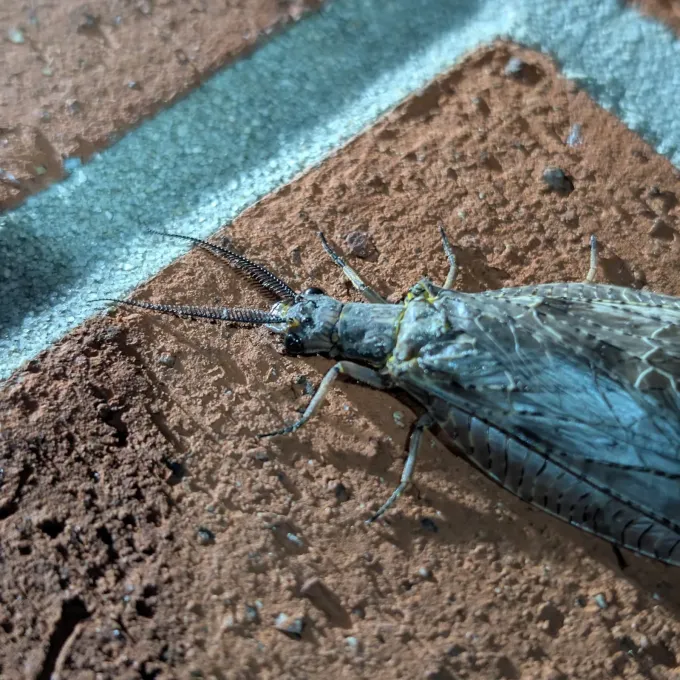
The Eastern Fishfly, Chauliodes pectinicornis, belongs to the order Megaloptera and the family Corydalidae. These insects are well-known for their distinct feathery, comb-like antennae.
Adults are large insects with a wingspan ranging from 60 to 80 mm. Their wings are transparent with dark venation and are held flat over the body when the insect is at rest.
The larvae are aquatic and possess powerful mandibles, which they use to hunt small organisms in the water. They are essential components of the aquatic food web.
The lifecycle involves complete metamorphosis, including egg, larva, pupa, and adult stages. Most of their life is spent as aquatic larvae in streams or ponds.
Adults are short-lived and primarily focus on reproduction, often appearing near water sources during warm summer evenings.
What it damages
The Eastern Fishfly is not a pest of agricultural crops. Adults do not feed on plant tissues and are entirely harmless to farmland and orchards.
Larvae are strictly aquatic predators, feeding on other invertebrates such as insect larvae, worms, or small crustaceans within water bodies.
There is no record of this species causing damage to leaves, stems, roots, or fruit, making it irrelevant to standard crop protection strategies.
Unlike some other insects, they do not carry plant pathogens, and their presence in the environment is generally considered a sign of healthy aquatic habitats.
Farmers do not need to implement any control measures for this insect as it poses no threat to agricultural productivity or plant health.
When it appears
The adult emergence typically occurs during late spring and throughout the summer months when environmental conditions are optimal for mating.
Larvae remain active throughout the growing season, growing steadily within their aquatic environments before transitioning to pupation.
Emergence peaks often coincide with warm evenings, and adults are highly attracted to artificial light sources near fields and infrastructure.
Pupation usually takes place in late summer or early autumn in moist soil or debris near the banks of water bodies.
Monitoring their seasonal activity can provide insights into the ecological health of water sources surrounding agricultural lands.
Signs of infestation
The most common sign of their presence is the appearance of large, winged insects gathering around outdoor lights during the night.
Egg masses can sometimes be found attached to vegetation hanging directly over the water, which is a key indicator of local breeding sites.
Identifying the species is straightforward due to the comb-like antennae present in males and the large, mesh-patterned wings.
Aquatic surveys in irrigation canals or farm ponds may reveal the presence of larvae, which have a segmented body with lateral filaments.
A high density of adults on walls or nearby structures suggests a healthy nearby water habitat and the peak of the insect's mating season.
Control measures
No chemical or biological control measures are required, as the Eastern Fishfly does not interfere with crop health or economic output.
If adult insects become a nuisance near farm equipment or lighting, switching to warmer color temperatures for lamps is a simple deterrent.
Maintaining clean water edges and minimizing excessive vegetation overgrowth along irrigation ditches can discourage egg-laying in undesirable areas.
Farmers are encouraged to view these insects as part of the natural ecosystem, as their larvae help keep water bodies in balance.
- Use motion-sensor lighting to reduce attraction;
- Clean irrigation canal banks;
- Preserve native aquatic habitats near agricultural areas.
Taxonomy
- Latin name
- Chauliodes pectinicornis
- Family
- Corydalidae
- EPPO code
- CHULPE
Discussion
No discussions yet — be the first.