
Ash darkling beetle
Corticeus fraxini
Description
How to identify
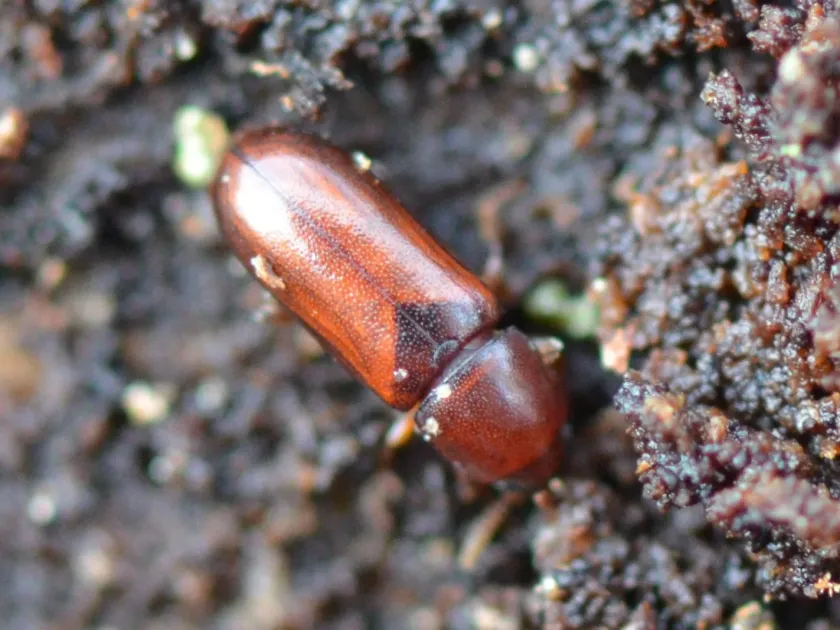
The ash darkling beetle (Latin: Corticeus fraxini) is a small coleopteran belonging to the Tenebrionidae family. Adult beetles typically feature an elongated, flattened body ranging in color from dark brown to deep black.
As members of the subfamily Hypophloeinae, these beetles are morphologically specialized for life in the confined spaces beneath tree bark. Adults generally measure between 4 and 6 mm in length.
Larvae are characterized by a cylindrical, yellowish-white body with a sclerotized terminal abdominal segment. They reside exclusively beneath the bark, where they consume tissues of weakened or dying ash trees.
The species serves as a vital indicator in forest pathology, as its presence often points toward underlying stress factors in the host tree, such as previous infestation by primary wood-boring insects.
Identification often requires careful inspection under bark during forestry surveys, as the species is cryptic and frequently co-occurs with other wood-boring beetle populations.
What it damages
The beetle primarily targets various species of ash (Fraxinus). It is a secondary pest, meaning it usually settles in trees that are already compromised by diseases, environmental stress, or primary insect attacks.
By feeding on the phloem and inner bark layers, the beetle disrupts the tree's ability to transport nutrients and water. This interference accelerates the decline of the host tree significantly.
Healthy trees with vigorous sap flow can often repel colonization through defensive secretions, but high populations in a localized area can overcome these defenses even in relatively healthy trees.
The galleries created by larvae provide entry points for secondary infections, including necrotrophic fungi and various pathogens that further rot the wood and structural integrity of the trunk.
Large-scale infestations can cause widespread mortality in ash stands that are already struggling with environmental change or other pest pressures, such as the emerald ash borer.
When it appears
Adult activity begins in the spring, once temperatures rise sufficiently to allow for emergence from hibernation sites. This is the primary period for mating and dispersal.
Egg-laying typically occurs in late spring and early summer. Females deposit eggs into crevices in the bark, where the offspring can safely bore into the inner tissues upon hatching.
The larval stage is the most prolonged, occurring throughout the summer months. Larvae are highly active during this time, creating extensive feeding galleries beneath the bark surface.
Pupation usually takes place in late summer within specially constructed chambers beneath the bark. After emerging, the new adults typically remain in the wood to overwinter.
Overwintering occurs inside the host tree, where the adult beetles are protected from extreme cold and desiccation by the thick insulating layer of the bark.
Signs of infestation
Small, circular entry/exit holes on the bark surface are a primary sign of an infestation. These are often accompanied by fine frass (wood dust) appearing in the crevices of the bark.
Loose or peeling bark is a significant diagnostic feature. When bark is removed from a compromised section of the trunk, larval galleries become clearly visible on the surface of the wood.
Increased woodpecker activity on ash trees often signals a high density of larvae beneath the bark, as the birds utilize these insects as a high-protein food source.
Canopy thinning and yellowing of foliage in the summer are indirect symptoms that the tree's vascular system has been severely compromised by the cumulative effects of the beetle infestation.
Bark cracking and general tree decline indicate advanced stages of colonization, suggesting that the tree is nearing total mortality due to the combined impact of pests and pathogens.
Control measures
Sanitary logging is the most effective management strategy. Removing and destroying infested trees before new adults emerge is critical to preventing the spread of the population to neighboring trees.
Silvicultural measures should focus on maintaining overall forest health. Ensuring that ash trees have adequate space, light, and soil moisture increases their resistance to secondary pest colonization.
Biological control methods involving natural predators and parasitoids are effective in maintaining the balance of forest ecosystems and preventing massive population outbreaks.
In high-value ornamental or park trees, trunk injections with systemic insecticides may be used by professionals. This approach is costly and reserved for special cases where individual tree preservation is prioritized.
- Implement regular forest pathology monitoring.
- Properly dispose of logging slash to eliminate breeding grounds.
- Encourage local bird populations as natural insect controllers.
- Select resistant or well-adapted ash cultivars for planting.
Taxonomy
- Latin name
- Corticeus fraxini
- Order
- Coleoptera (beetles)
- Family
- Tenebrionidae
- EPPO code
- HYOHFR
Discussion
No discussions yet — be the first.