
Lesser water boatman
Corixa punctata
Description
How to identify
The Lesser Water Boatman (Corixa punctata) is an aquatic insect belonging to the family Corixidae and the order Hemiptera.
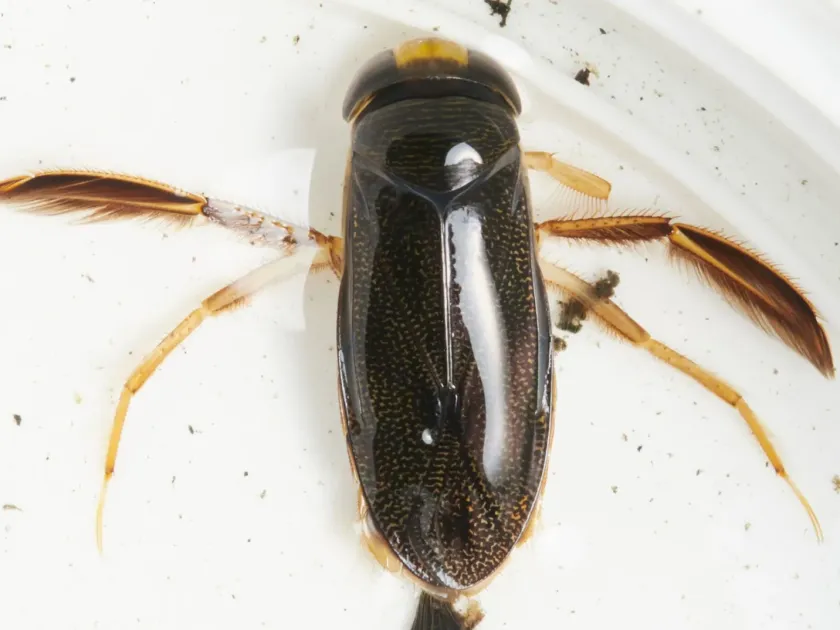
These insects typically grow to 12–16 mm in length and possess a flattened body shape with a distinctive spotted pattern on their wings.
They are equipped with specialized oar-like hind legs covered in fine hairs, allowing them to swim rapidly through the water column.
Their large eyes allow them to navigate well underwater, and their overall coloration ranges from olive to brownish-gray.
Unlike predatory water bugs, these insects are primarily detritivores or algae feeders, using their specialized front legs to collect food.
What it damages
The primary concern regarding these insects is their negative impact on aquaculture, specifically in nursery ponds for fish fry.
They compete directly with young fish for food by consuming large amounts of zooplankton and algae, which are essential for fish growth.
In high densities, their presence can lead to a significant depletion of natural food sources, reducing the overall productivity of the pond.
While they do not feed on terrestrial crops, they can cause maintenance issues in irrigation reservoirs by clogging systems.
Their impact is predominantly economic, affecting the growth rates and survival of fish stock in managed aquatic environments.
When it appears
Activity typically begins in early spring as water temperatures rise, prompting the adults to emerge from their overwintering sites in the mud.
The breeding season lasts through the spring and summer, during which females attach eggs to submerged aquatic vegetation or submerged objects.
Larval development takes place during the warmer months, involving several molting stages until the insect reaches maturity.
The population reaches its annual peak during mid-summer, when generations overlap and migration between water bodies occurs.
As autumn approaches and water temperatures drop, the insects burrow into the substrate to hibernate throughout the winter.
Signs of infestation
A primary sign of infestation is the visible swimming behavior of the insects, which appears like rhythmic rowing near the water surface.
Egg masses can often be found attached to the stems and leaves of aquatic plants when examined closely.
A decrease in water clarity and a noticeable reduction in plankton density are often associated with large populations of water boatmen.
In the evenings, individuals often surface to refresh their air bubbles, making them easily identifiable to observers.
Stunted growth or poor performance of fish fry in ponds without other obvious causes can indicate competition from these insects.
Control measures
Biological control is the most effective approach, involving the introduction of fish species that prey on both larvae and adults.
Regular maintenance of the pond, including the removal of excess aquatic weeds, significantly reduces egg-laying sites.
Draining and drying the pond bottom during the off-season is highly effective at killing overwintering populations.
If chemical interventions are necessary, only products approved for use in aquaculture should be used to avoid harming the fish population.
Ensuring good water quality and preventing excessive nutrient buildup helps to keep the population of Corixa punctata in check.
Taxonomy
- Latin name
- Corixa punctata
- Order
- Hemiptera (bugs, aphids, leafhoppers)
- Family
- Corixidae
- EPPO code
- CORXPU
Discussion
No discussions yet — be the first.