
Splendid tentiform leafminer
Coptodisca splendoriferella
Description
How to identify
The splendid tentiform leafminer (Coptodisca splendoriferella) is a small moth belonging to the family Heliozelidae. The wingspan of the adult moth is very small, typically ranging between 6 and 8 millimeters.
Adult moths are characterized by their metallic appearance, featuring gold and brown tones with distinct silvery markings on the forewings. These moths are primarily nocturnal and are rarely seen due to their size and activity patterns.
The larvae are specialized leaf miners that spend their entire developmental period between the upper and lower epidermal layers of the host plant leaves. They possess a flattened body shape, which is an evolutionary adaptation for life within thin leaf tissue.
The life cycle involves a metamorphosis that is closely tied to the phenology of the host plant. Overwintering occurs as mature larvae inside small cases, known as hibernacula, which are attached to the bark of branches or trunks.
Upon the arrival of spring temperatures, the larvae pupate, and the adult moths emerge shortly thereafter. They lay eggs on newly developed foliage, initiating the life cycle for the upcoming growing season.
What it damages
This pest primarily targets apple trees, although it may also infest pears, cherries, and hawthorn. It is considered a minor but potentially significant pest in commercial orchards and private gardens.
Damage is caused by larvae mining through the leaf tissue, consuming the nutritious green parenchyma cells. This feeding behavior creates characteristic spots that look like small, translucent or brown blotches on the foliage.
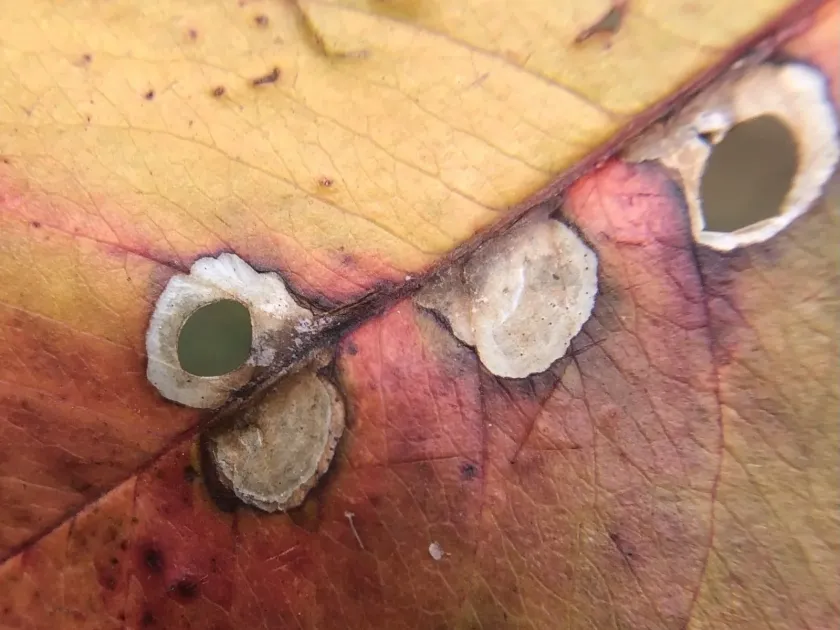
When the larva is fully fed, it cuts out a small, oval-shaped piece of the leaf to construct its case. This leaves a clean, round hole in the leaf, which can be mistaken for damage caused by other insects or mechanical injury.
Extensive mining activity by numerous larvae can cause premature browning and leaf drop. This reduces the tree's photosynthetic capacity, which is crucial for fruit development and storage of carbohydrates for winter.
Repeated or severe infestations weaken the tree, making it more susceptible to drought stress, secondary infections, and winter damage. This ultimately leads to a reduction in yield and overall orchard productivity.
Signs of infestation
Initial signs of an infestation include the appearance of small, irregular light-colored spots on the leaves. These mines gradually enlarge as the larva consumes more leaf material, becoming more visible in late spring and summer.
The presence of circular holes in the middle of leaf spots is the most diagnostic sign of the splendid tentiform leafminer. These holes represent the exit points where larvae have cut out their protective cases.
During the dormant season, careful inspection of the tree bark can reveal the small, attached cases. These cases serve as the winter home for the larvae and indicate where the next generation will emerge.
- Translucent blotches and spots on the leaves.
- Circular, neat holes in the leaf blades.
- Premature yellowing and shedding of leaves during the summer.
- Discovery of small, flattened cases on the bark.
Overall, an infested tree may show signs of thinning canopy density. The loss of leaf surface area hampers the tree's ability to maintain healthy growth rates, especially in younger, more vulnerable trees.
Control measures
Cultural control measures are highly effective for this pest. The primary strategy is to remove and destroy all fallen leaves during the autumn, which disrupts the life cycle by eliminating potential overwintering sites.
Chemical control should be timed to coincide with the emergence of larvae and the egg-laying period of adults. Broad-spectrum insecticides should be avoided to protect natural predators that help manage moth populations.
Biological control, including the use of pheromone traps, helps in monitoring the pest population levels and timing applications accurately. This allows for targeted interventions rather than blanket spraying.
Promoting a healthy orchard ecosystem is essential. Encouraging beneficial insects, such as parasitic wasps that naturally prey on leafminer larvae, can keep the population of Coptodisca splendoriferella below economic injury levels.
Proper orchard sanitation, including scraping off rough bark and keeping the trees well-nourished, helps in minimizing the success rate of the leafminer's overwintering and development on the host trees.
Taxonomy
- Latin name
- Coptodisca splendoriferella
- Order
- Lepidoptera (butterflies)
- Family
- Heliozelidae
- EPPO code
- COPDSE
Discussion
No discussions yet — be the first.