
Walnut leaf miner
Coptodisca juglandella
Description
How to identify
The walnut leaf miner Coptodisca juglandella is a tiny moth belonging to the family Heliozelidae, known for its cryptic lifestyle and specific host preference.
Adult moths are very small, usually having a metallic sheen, which helps them camouflage while resting on the bark or leaves of host trees.
The life cycle involves multiple generations per year, with the insects overwintering as pupae inside fallen leaves or bark crevices, waiting for spring temperatures.
Larvae are flat-bodied, specialized to live and feed within the mesophyll layer of the leaf, which provides them with protection from predators and environmental factors.
Identifying the species usually requires professional expertise or microscopic examination of the larval mines, as the moths are rarely seen in the field.
What it damages
The primary host plant is the walnut tree Juglans regia, though the pest can occasionally be found on related species within the family Juglandaceae.
Feeding damage occurs exclusively inside the leaf blade, where larvae consume the photosynthetic tissue, causing distinct discolored patches.
Severe infestations lead to premature senescence and leaf drop, which significantly weakens the tree's health and reduces its capacity for carbon sequestration.
The tree’s overall productivity is hampered because leaves are essential for providing the carbohydrates required for nut filling and bud formation for the following year.
Continuous damage year after year can result in stunted growth of young trees and a gradual decline in the vigor of mature walnut orchards.
Signs of infestation
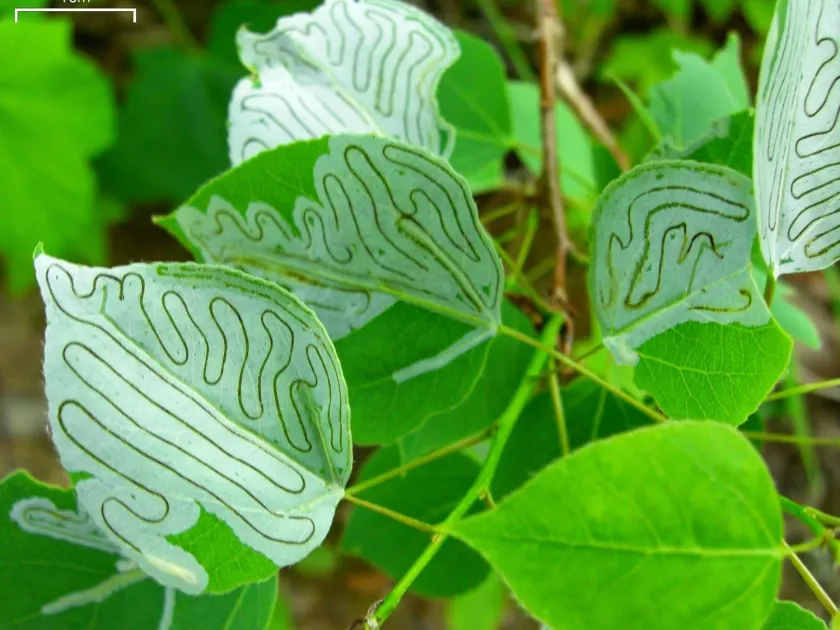
The most prominent sign is the presence of irregular, blotch-like mines on the leaves, which turn brown as the plant tissue inside dies.
Small exit holes left by the larvae are a diagnostic feature that indicates a completed larval development cycle and emergence of the pest.
Examining the underside of the leaf often reveals tiny deposits of frass (larval waste), which serve as further proof of an active infestation.
In cases of high pest density, the entire foliage may look wilted or chlorotic, leading to early defoliation before the actual autumn season.
Leaves affected by Coptodisca juglandella often show a mosaic pattern of green and brown spots, distinguishing it from general fungal blights.
Control measures
Sanitation is the most critical step in management: raking and destroying fallen leaves effectively removes the overwintering population of the pest.
Chemical control should be timed strategically, focusing on the period when larvae are hatching and moving on the leaf surface before entering the tissue.
Integrated Pest Management (IPM) practices, including the use of pheromone traps, can help detect population spikes and reduce the need for calendar-based spraying.
Promoting a healthy orchard ecosystem by supporting natural enemies like parasitic wasps can help keep the leaf miner population below economic damage thresholds.
- Prompt disposal of infested leaf litter.
- Systemic insecticide applications during larval hatching.
- Regular tree pruning to improve air circulation.
- Monitoring via pheromone traps to time treatments accurately.
Taxonomy
- Latin name
- Coptodisca juglandella
- Order
- Lepidoptera (butterflies)
- Family
- Heliozelidae
- EPPO code
- COPDJU
Discussion
No discussions yet — be the first.