

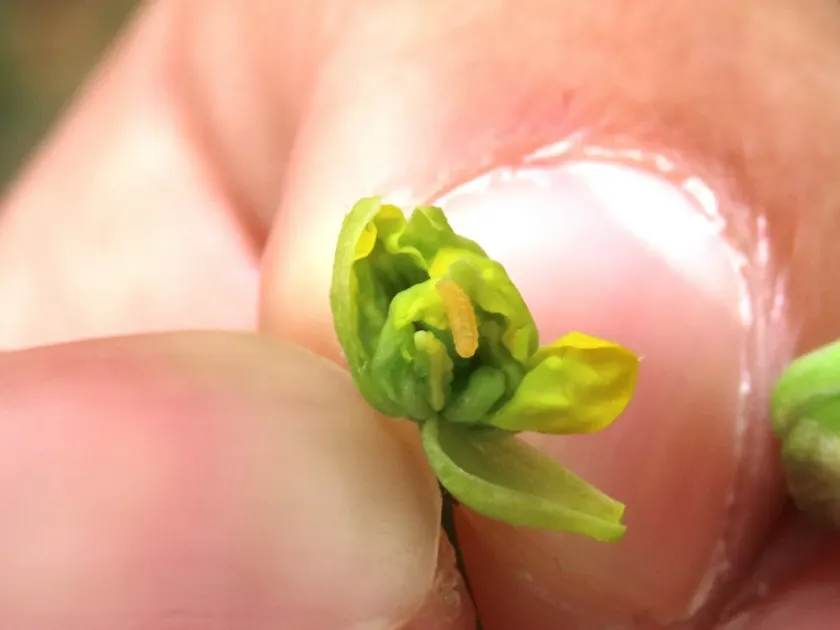
Description
How to identify
The swede midge (Contarinia nasturtii) is a small dipteran insect belonging to the Cecidomyiidae family. Adult midges are approximately 1.5 to 2 mm long with delicate, transparent wings and a brownish-yellow body.
The life cycle consists of four stages: egg, larva, pupa, and adult. They typically undergo multiple generations per season, which makes monitoring and control difficult for commercial vegetable producers.
Pupation occurs in the soil, where the insects overwinter in cocoons. As temperatures rise in late spring, the adult midges emerge to mate and lay eggs on the leaves and stems of host plants.
The larvae are small, legless, and white or yellowish. They are the stage responsible for the damage, as they feed on the meristematic tissues of the host, leading to stunted growth.
Due to their minute size and nocturnal activity, adults are often difficult to detect without the use of pheromone traps or yellow sticky traps placed within the crop field.
What it damages
The swede midge primarily attacks cruciferous crops, including cabbage, cauliflower, broccoli, Brussels sprouts, kale, and rutabaga. Young, rapidly growing plants are the most susceptible to attack.
Larval feeding involves the secretion of enzymes that alter plant hormones, causing the formation of galls (abnormal swelling) on petioles and stems. This disrupts the translocation of nutrients and water.
Symptoms often include deformed or curled leaves, commonly referred to as "crumpled leaf." If the growing point is damaged, the plant may fail to develop a main head, leading to multiple secondary side shoots.
The economic impact can be devastating, particularly in broccoli and cauliflower cultivation, where the loss of the apical meristem renders the crop unmarketable.
In addition to direct structural damage, the feeding sites create entry points for secondary bacterial soft rot infections, which can quickly destroy the remaining plant tissue.
When it appears
The swede midge usually emerges from overwintering pupae in late May or early June, depending on local soil temperatures and moisture levels. They remain active throughout the warm summer months.
There are typically three to four generations per season in most temperate regions, with peaks in activity occurring during wet, humid weather which facilitates egg-laying and larval survival.
Farmers should begin monitoring for adults in early spring, as the first generation of the season causes the most damage to early-planted brassica crops.
Activity remains high throughout the summer as long as there is an abundance of young, succulent host tissue available for the midge to deposit its eggs upon.
By late autumn, the final generation of larvae drops into the soil to pupate and overwinter, completing the seasonal cycle until the following spring.
Signs of infestation
The most distinctive sign of swede midge infestation is the stunted and twisted appearance of the youngest leaves at the heart of the plant, often accompanied by crinkling.
Swollen petioles or stems at the base of the leaf, which can feel hard to the touch, are a clear indicator of gall formation caused by larval feeding.
In cases of heavy infestation, the central growing point may turn brown, die, or be completely missing, which is commonly referred to as "blindness" in brassica crops.
Plants often exhibit a mosaic pattern of injury across the field, with groups of affected plants surrounded by healthier ones, reflecting the localized egg-laying habits of the female midges.
Detection of small yellowish larvae within the folds of damaged leaves or inside the galls confirms the presence of this pest rather than nutrient deficiency or viral disease.
Control measures
Cultural control is the most effective management strategy. Implementing a crop rotation cycle where brassicas are grown on the same land no more than once every four years is critical.
Deep plowing in the autumn helps to bury the pupae deeper in the soil or expose them to surface predators, thereby reducing the overwintering population for the next season.
Eliminating volunteer brassica weeds in the vicinity of production fields removes potential host refuges that could sustain the midge population between main crop cycles.
Insecticidal control, using systemic agents, should be timed based on trap catches and monitoring data to protect plants during the most vulnerable early growth stages.
- Utilizing floating row covers to physically exclude adult midges from the crop.
- Ensuring proper soil fertility to promote rapid plant growth, allowing crops to outgrow vulnerable stages.
- Removing and destroying infested plant material to prevent the cycle from continuing.
Content graph
Connections · Swede midge
Most often together:
Marketplace
Products · 1
Biology
Taxonomy
- Latin name
- Contarinia nasturtii
- Order
- Diptera (flies)
- Family
- Cecidomyiidae
- EPPO code
- CONTNA
Community
Discussion
No discussions yet — be the first.