
Litchi fruit borer
Conopomorpha sinensis
Description
How to identify
The Litchi fruit borer, scientifically identified as Conopomorpha sinensis, is a moth species belonging to the Gracillariidae family. These insects are small in size, with wingspans typically ranging between 10 and 12 millimeters, often blending into their environment.
As crepuscular insects, the adult moths are most active during dusk and dawn. Their camouflage makes them exceptionally difficult to spot, as their coloration mimics the texture and shade of tree bark or foliage perfectly.
The biological cycle of the borer is intrinsically linked to the fruiting stage of the host trees. Female moths lay their eggs strategically on the surface of developing fruits, prioritizing the most vulnerable areas.
Once the larvae hatch, they burrow directly into the fruit tissues. These larvae are typically whitish to pale pink and possess a segmented body structure optimized for penetrating and mining through dense plant tissues.
Pupation occurs within a characteristic white, silk-like cocoon. These cocoons are typically constructed in crevices on the tree trunk, branches, or among the leaf litter on the orchard floor.
What it damages
This pest primarily affects plants within the Sapindaceae family, with litchi (Litchi chinensis) and longan (Dimocarpus longan) being the most susceptible and commercially significant crops.
The larvae bore tunnels through the pericarp, which often prevents the fruit from developing properly and triggers premature fruit drop, leading to significant yield losses in commercial orchards.
Beyond physical damage, the boreholes serve as entry points for various pathogens, including bacteria and fungi, which cause internal fruit rot and make the harvest entirely unsalable.
If left unmanaged, Conopomorpha sinensis populations can cause devastating damage, destroying a substantial portion of the orchard's production during the peak growing season.
The economic impact of this pest is severe because it ruins the appearance and quality of the fruit, rendering it unfit for fresh market export or local distribution.
Signs of infestation
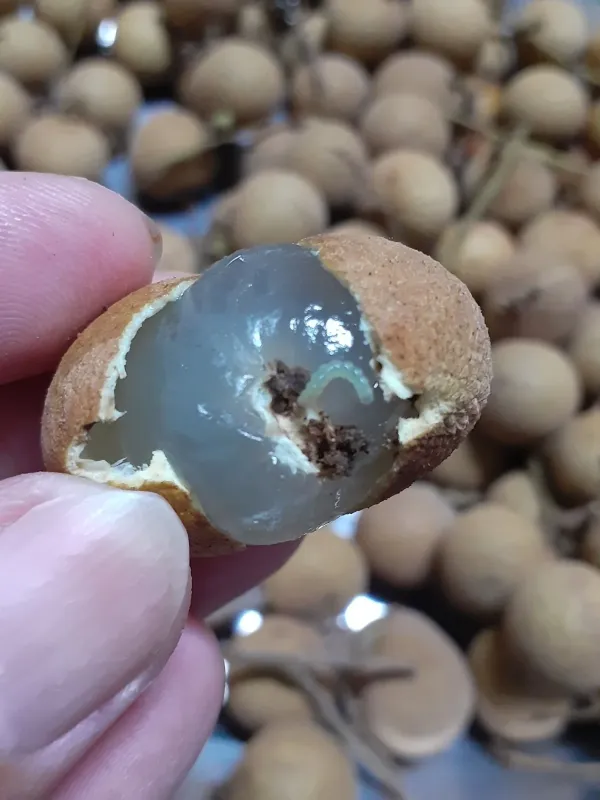
The most prominent sign of an infestation is the presence of small, puncture-like holes on the fruit skin, often surrounded by granular frass (larval waste) deposited by the borer.
When an infested fruit is opened, the internal damage becomes clear: a network of dark, irregular tunnels can be observed throughout the pulp and around the seed, often accompanied by discoloration.
Deformed or asymmetrical fruit development during the maturation phase is a common indicator that larvae are actively feeding within the pericarp and interfering with nutrient flow.
The presence of fine silk threads attaching fruits together or connecting fruits to branches is a strong indicator of high population density and active moth activity in the canopy.
Sudden, unexplained abscission of small, apparently healthy-looking fruits is another critical warning sign that requires an immediate internal inspection of the fallen material.
Control measures
Managing the Litchi fruit borer requires a multifaceted approach, focusing on integrated pest management (IPM) to minimize chemical reliance while maximizing effectiveness.
Sanitation is paramount: orchard managers must regularly remove and destroy fallen or infested fruits to eliminate the larvae and pupae residing within them, thereby breaking the cycle.
Pheromone traps are essential for monitoring adult moth populations, allowing growers to time their insecticide applications precisely to coincide with the peak egg-laying periods.
Biological control agents, such as specific parasitoid wasps, can be introduced or encouraged in the orchard to naturally suppress the moth population throughout the growing season.
- Prune orchard trees to improve air circulation and light penetration.
- Use systemic insecticides only when monitoring thresholds are exceeded.
- Promote biodiversity to encourage natural predators of the moth.
Taxonomy
- Latin name
- Conopomorpha sinensis
- Order
- Lepidoptera (butterflies)
- Family
- Gracillariidae
- EPPO code
- CNPMSI
Discussion
No discussions yet — be the first.