
Aphid
Comaphis
Description
How to identify
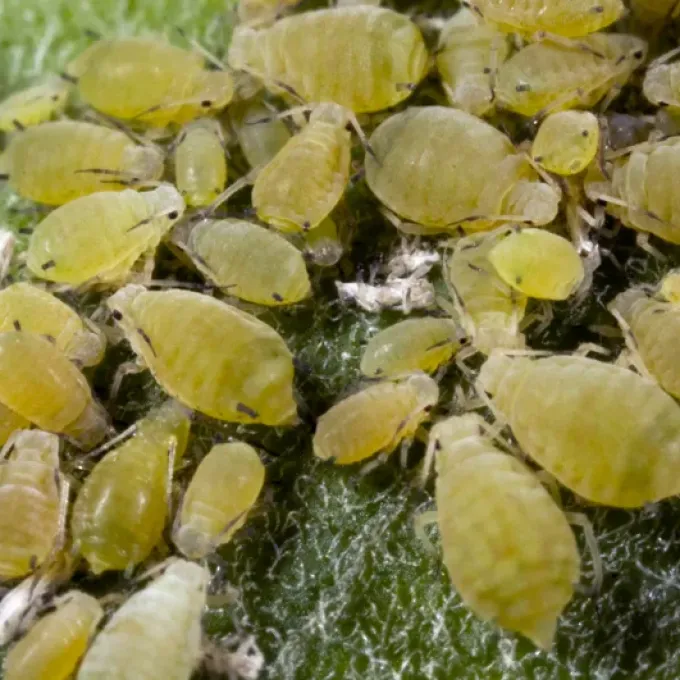
Aphids (family Aphididae) are small, soft-bodied insects, typically ranging from 0.5 to 6 mm in length. Their coloration is diverse, including green, black, yellow, or pink, often mimicking their host plant.
They possess a piercing-sucking mouthpart called a stylet, which they use to extract sap directly from the plant's vascular tissue. Many species feature a pair of tube-like structures called cornicles on their abdomen.
Their reproduction is unique, often involving asexual parthenogenesis, which allows for rapid population explosions within a very short timeframe.
Aphid populations consist of both wingless individuals and winged forms that emerge when colonies become overcrowded, facilitating migration to new host plants.
Most species overwinter in the egg stage on woody plant tissue, ensuring their survival through harsh weather conditions until spring temperatures arrive.
What it damages
Aphids infest a vast array of plant species, including vegetables, fruits, ornamental flowers, and essential field crops like grains and legumes.
The primary damage occurs on young growth, such as developing leaves, flower buds, and succulent stems, where nutrient concentration is at its highest.
As they feed, aphids inject saliva into the plant, which often leads to systemic distortion, leaf curling, and stunted growth of the entire plant.
Beyond direct sap depletion, aphids are notorious for acting as vectors for numerous plant viruses, which can cause severe crop loss.
They also excrete honeydew, a sugary substance that encourages the growth of sooty mold, which blocks sunlight and reduces the plant's photosynthetic efficiency.
When it appears
Aphid activity typically begins in early spring, synchronized with the bud burst of trees and the germination of garden seedlings.
The peak of their population density usually occurs during late spring and early summer when plants are in a vigorous vegetative growth stage.
The number of generations per season depends on the species and environmental factors, but can easily exceed ten in favorable warm climates.
As summer progresses and plant tissues harden, aphid populations may fluctuate, often migrating or producing sexual forms to lay overwintering eggs.
High temperatures combined with moisture stress can trigger massive outbreaks, making early-season monitoring essential for successful crop protection.
Signs of infestation
Visible curling, puckering, or yellowing of young leaves is often the first indicator of an aphid infestation in the garden.
Closer inspection usually reveals clusters of small insects on the undersides of leaves, along stems, or deep within floral buds.
The presence of ants on a plant is a strong indicator of aphid activity, as ants protect and cultivate aphids to harvest their honeydew secretion.
A shiny, sticky residue on foliage, known as honeydew, followed by the development of black sooty mold, points toward a significant and prolonged infestation.
Overall plant weakness, premature flower drop, and poor fruit or vegetable development are typical late-stage signs of high aphid pressure.
Control measures
Effective aphid control relies on integrated pest management (IPM) practices, emphasizing prevention and minimal chemical intervention.
- Monitor fields regularly to detect early arrivals before colonization occurs.
- Encourage beneficial predatory insects like lady beetles, lacewings, and hoverflies.
- Use systemic or contact insecticides only when populations exceed economic thresholds.
- Implement mechanical methods like high-pressure water sprays to dislodge colonies.
- Avoid excessive nitrogen fertilization, which promotes soft growth preferred by aphids.
Taxonomy
- Latin name
- Comaphis
- Order
- Hemiptera (bugs, aphids, leafhoppers)
- Family
- Aphididae
- EPPO code
- COMPSP
Discussion
No discussions yet — be the first.