
Coenosia
Coenosia
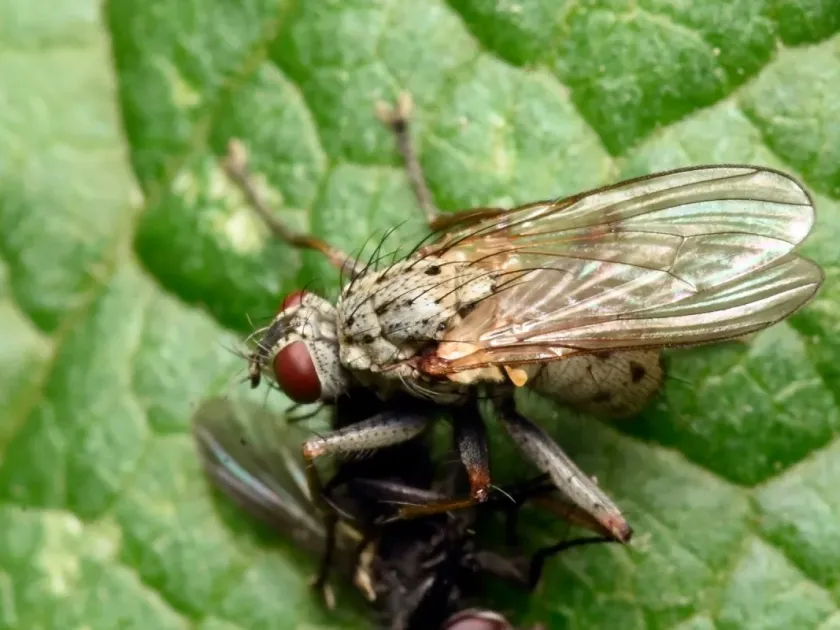
Description
How to identify
The genus Coenosia belongs to the family Muscidae of the order Diptera. These insects are known as small predatory flies that resemble common house flies but possess a slimmer body and more aggressive hunting behavior.
Adult Coenosia measure between 3–6 mm in length. Their body coloration ranges from gray to brownish, often featuring noticeable bristles on their legs which assist in grasping their prey during flight.
The larvae of Coenosia develop in substrates rich in organic matter, including soil, humus, or decaying plant debris. They lead a cryptic lifestyle, making them difficult to detect in the early stages of infestation.
Unlike many other flies, adult Coenosia are active hunters. They frequently perch on plant leaves, waiting for small pest insects, which they attack either mid-air or upon landing on the leaf surface.
It is important to distinguish the beneficial role of these flies as predators from their potential negative impact on greenhouse ecosystems, where their high activity can interfere with other beneficial insect populations.
What it damages
Coenosia primarily impacts vegetable crops in greenhouses, including cucumbers, tomatoes, and peppers. They are most commonly found in environments with high humidity and organic fertilizer accumulation.
The main damage caused by the larvae involves feeding on the delicate roots and root collars of young seedlings. In high-density populations, the larvae can significantly weaken or destroy young transplants.
Adult flies, being predators, may unintentionally consume beneficial pollinators or other biological control agents (such as predatory mites) used in greenhouse plant protection.
Damage to plant tissues by larvae creates entry points for secondary infections, such as bacterial or fungal root rots, further exacerbating the stress on the plants.
In commercial settings, the presence of a high population of Coenosia reduces the overall vigor of the crop, leading to stunted growth and reduced marketability of the produce.
When it appears
The appearance of Coenosia occurs throughout the growing season, provided that the microclimate in the greenhouses remains favorable for their development.
The most active period of reproduction occurs during spring and summer when temperatures in the greenhouse are consistently maintained above 20 degrees Celsius.
The developmental cycle of the fly from egg to adult is highly dependent on temperature and substrate moisture; under optimal conditions, generations can succeed one another rapidly.
As temperatures decrease in the autumn, adult activity declines, but the larvae can overwinter in the soil or decaying plant materials, entering a state of diapause.
Initial infestation often occurs through purchased potting soil containing eggs or larvae, making strict quality control of growing media essential for greenhouse management.
Signs of infestation
In the early stages of infestation, detecting the pest is challenging due to the microscopic size of the larvae buried within the soil matrix.
The first noticeable sign is the wilting of young plant tops during the day, which does not recover after watering. Inspection of the root system may reveal small tunnels or necrotic lesions.
The presence of adult flies on leaves within the greenhouse serves as a warning sign that requires soil monitoring for larval presence.
Finding specific larvae in the root-zone soil that exhibit movement when disturbed confirms the infestation by this genus.
- Yellowing of seedling cotyledons.
- Small punctures found on the stem near the soil surface.
- Increased capture of adult flies on yellow sticky traps.
Control measures
The primary control measure involves good agricultural practices, including the sterilization of potting mixes before planting and the use of high-quality, pest-free substrates.
Sanitation is crucial; regular removal and proper disposal of plant debris prevent the accumulation of the organic matter required for larval development.
Biological control methods, such as the application of entomopathogenic nematodes to the soil, can effectively reduce Coenosia larval populations without chemical residues.
Chemical control should be used with caution to avoid disrupting the balance of beneficial insects in the greenhouse; targeted soil-applied systemic insecticides are recommended if infestation is severe.
Yellow sticky traps are effective not only for monitoring population dynamics but also for reducing the number of adult flies, thereby preventing further egg-laying.
Taxonomy
- Latin name
- Coenosia
- Order
- Diptera (flies)
- Family
- Muscidae
- EPPO code
- COEASP
Discussion
No discussions yet — be the first.