
Wasp mantidfly
Climaciella brunnea
Description
How to identify
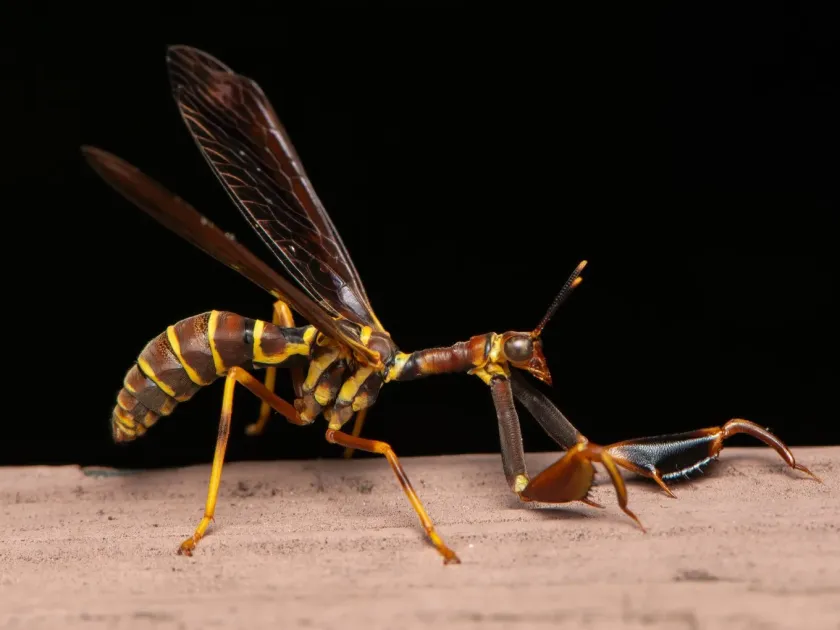
The Wasp mantidfly (Climaciella brunnea) is a species of the Mantispidae family, belonging to the Neuroptera order. It is renowned for its remarkable Batesian mimicry, resembling a wasp to deter potential predators.
Its most striking feature is the pair of raptorial forelegs, which are highly specialized for grasping prey, similar to those of a praying mantis.
Adults typically reach 15-20 mm in length and possess a color pattern of brown and yellow, which reinforces their visual similarity to wasps.
The wings are membranous with a dense network of veins, which is a diagnostic characteristic of the Neuroptera order, providing efficient flight.
The larval stage undergoes hypermetamorphosis, a complex development process that includes an active phase for finding suitable spider egg cases to parasitize.
What it damages
The Wasp mantidfly is not considered an agricultural pest because it does not consume plant tissues. Its feeding habits are strictly associated with animal protein.
However, its larvae are obligate parasites of spider eggs, which may lead to a decrease in the local population of spiders, which act as natural predators of crop pests.
In most ecosystems, the impact of these insects is neutral, as they exist within the natural regulation mechanisms of local biodiversity.
Economic damage to crops is practically non-existent, making the Wasp mantidfly a subject of interest rather than a target for eradication programs.
Understanding their role helps growers appreciate the balance between predator and parasite populations within their orchards or gardens.
When it appears
Adults are typically active during the summer months, specifically from June through August, when temperatures are favorable for mating and foraging.
The life cycle is tightly synchronized with the nesting periods of local spider species, which are essential for larval development.
During the winter, the larvae remain dormant within the spider's egg sacs, protected from cold weather and potential environmental hazards.
Pupation occurs within the same protective casing, and the emergence of the adult insect marks the beginning of a new reproductive season.
Seasonal monitoring is important for those conducting ecological research or managing specialized horticultural environments.
Signs of infestation
The most common sign of presence is spotting the adult insects resting on flowers or foliage while searching for prey or mates.
Detection of empty or damaged spider egg sacs in the field can indicate that the Wasp mantidfly has been active in the area.
When observing them in nature, the distinct "praying" posture of their forelegs is the primary visual cue to identify them correctly.
Reduced spider activity in specific areas of the garden may occasionally be linked to the successful reproduction of these mantidflies.
Visual identification is straightforward for experienced gardeners or those familiar with the morphological characteristics of Neuroptera.
Control measures
There are no chemical control measures necessary for the Wasp mantidfly, as it does not pose a threat to the health or yield of garden crops.
Maintaining a healthy garden environment involves minimizing the use of broad-spectrum insecticides that negatively affect beneficial insects like spiders.
Encouraging natural biodiversity, such as planting native flora, helps maintain the natural regulation of all insect populations in the area.
Biological monitoring is recommended for anyone wishing to understand the complex interactions between insects and their hosts in the garden.
No specific management plan is required, as this species contributes to the complex food web without causing agricultural damage.
Taxonomy
- Latin name
- Climaciella brunnea
- Family
- Mantispidae
- EPPO code
- CMCLBR
Discussion
No discussions yet — be the first.