
Juniper aphid
Cinara sabinae
Description
How to identify
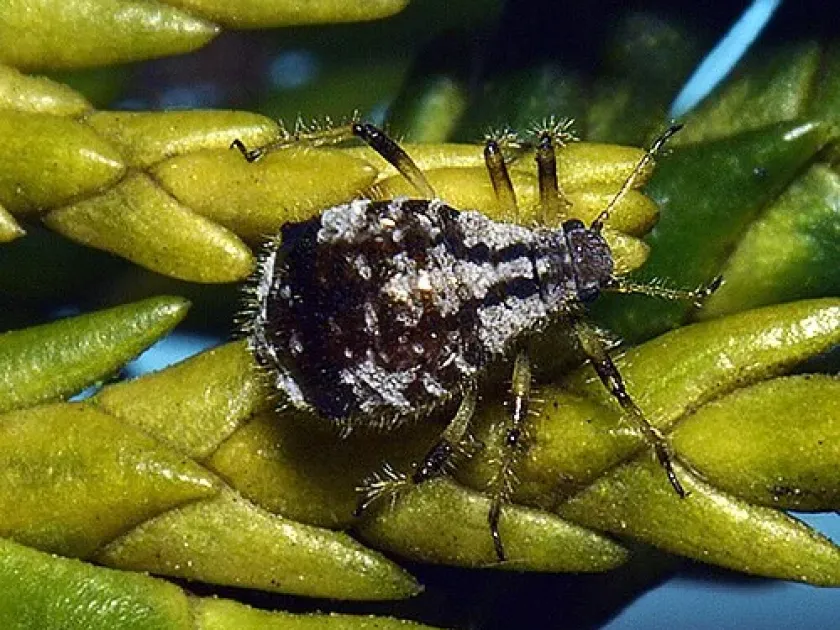
The Juniper aphid (Cinara sabinae) belongs to the order Hemiptera and is a significant pest of various juniper species. These insects are small, typically ranging from 2 to 3 mm in length, and often possess a cryptic coloration.
Their bodies are often covered with a fine waxy secretion, which provides them with a matte texture that helps them blend in perfectly with the bark and needles of their host plant.
The life cycle is complex, involving both wingless and winged morphs. Winged individuals play a crucial role in the spread of the colony to new branches or neighboring plants.
These aphids overwinter in the egg stage. The eggs are deposited on the needles or thin stems, remaining dormant until early spring when the environmental conditions become favorable.
The reproductive rate is exceptionally high, allowing the aphid population to increase rapidly within a few weeks if left unchecked by natural predators or human intervention.
What it damages
Juniper aphids primarily feed on the succulent tissues of young shoots. By piercing the plant tissues, they extract vital phloem sap, depriving the tree of essential nutrients.
Constant feeding stress leads to chlorosis, where the needles turn yellow, eventually wither, and drop prematurely, causing the plant to lose its decorative value.
In addition to nutrient depletion, the aphids excrete a sugary substance called honeydew. This substance covers the needles and stems, creating an ideal environment for sooty mold growth.
Sooty mold blocks photosynthesis by covering the needles in a black layer, which further weakens the plant and stunts its overall growth and development.
Heavy infestations can lead to the death of young shoots or even the entire plant, especially in young saplings that have not yet established a strong root system.
When it appears
Activity typically begins in early spring, synchronized with the onset of the plant's growth season. As temperatures rise, the overwintering eggs begin to hatch.
The peak population growth and damage usually occur in late spring and early summer, when environmental conditions are most suitable for the aphid's rapid reproduction.
During the hot summer months, the activity may decrease, although colonies often persist in shaded or humid areas within the dense canopy of the juniper tree.
In autumn, sexual forms appear to mate and lay overwintering eggs. This is a critical time for monitoring to prevent a large population surge in the following year.
Environmental factors, such as cool and humid springs, are particularly conducive to the survival and proliferation of these pests across the landscape.
Signs of infestation
Early warning signs include the yellowing of foliage and the presence of distorted needles on the tips of the current year's growth.
The presence of sticky honeydew on the branches is a primary indicator. If you observe shiny or sticky needles, there is a high probability of an aphid colony nearby.
The development of black sooty mold is a secondary sign. It often appears on branches where aphids have been feeding for an extended period, creating an unsightly black coating.
Observation of the stems often reveals densely packed colonies of aphids, which may look like small bumps or irregularities on the juniper bark.
A surge in ant activity on the juniper is a classic indicator. Ants farm the aphids to collect the sugary honeydew, and they will actively protect the colonies from predators.
Control measures
Systemic insecticides are generally the most effective method for managing juniper aphid populations, as they protect the plant from within for several weeks.
Contact insecticides can be used for immediate control. It is vital to ensure full coverage of the plant, focusing specifically on the underside of the branches.
Biological control is a sustainable option; encouraging natural predators such as ladybugs, lacewings, and syrphid fly larvae can help keep populations at a manageable level.
Proper cultural practices are essential. Ensuring the juniper is healthy, well-watered, and properly fertilized increases its resilience against pest attacks.
- Inspect the trees regularly starting in early spring.
- Apply insecticides in the early morning or evening to avoid harming pollinators.
- Remove and destroy heavily infested branches to reduce the population.
- Use ant control measures to disrupt the protection of aphid colonies.
- Consider dormant oil sprays in late winter to reduce egg numbers.
Taxonomy
- Latin name
- Cinara sabinae
- Order
- Hemiptera (bugs, aphids, leafhoppers)
- Family
- Aphididae
- EPPO code
- CUPRSA
Discussion
No discussions yet — be the first.