
Douglas fir aphid
Cinara pseudotsugae
Description
How to identify
The Douglas fir aphid Cinara pseudotsugae belongs to the Aphididae family, specifically within the Lachninae subfamily, which is characterized by larger body sizes.
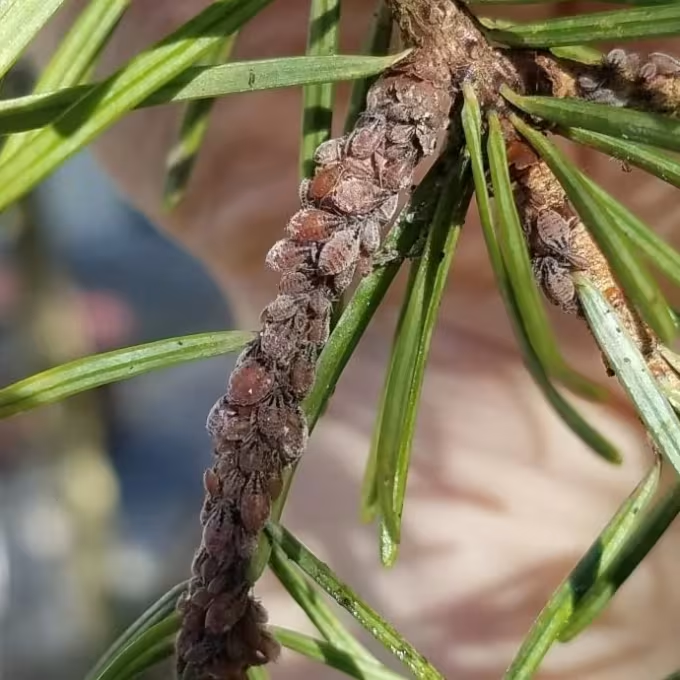
Adult aphids are typically dark brown or nearly black, allowing them to camouflage effectively against the bark of their host tree's branches.
The life cycle is complex, involving both apterous (wingless) and alate (winged) forms, which facilitates the spread of the colony across host trees.
Reproduction is primarily parthenogenetic during the active growing season, allowing for rapid population growth under ideal weather conditions.
Winter survival is ensured through eggs laid by females on needles or the thin bark of young shoots, which remain dormant until the following spring.
What it damages
The primary host for this pest is the Douglas fir (Pseudotsuga menziesii), where it settles on young shoots and branches to feed.
By extracting sap from the phloem, the aphids deprive the tree of essential nutrients, leading to a general decline in the tree's health and vigor.
Heavy infestations can cause significant yellowing and needle drop, particularly in younger trees or stressed specimens in nurseries and landscapes.
The weakening of the host tree also increases its susceptibility to other secondary pests and pathogens that may cause further damage or tree mortality.
In ornamental settings, the aesthetic damage is severe, making the trees unsuitable for decorative purposes and impacting their market value.
When it appears
The active phase begins in early spring as temperatures rise, triggering the hatching of overwintering eggs and the start of the primary feeding period.
Populations tend to reach their peak density during late spring and early summer when environmental conditions are most favorable for reproduction.
During the peak of summer heat, aphid activity may plateau, but colonies usually persist on the branches, maintaining their presence in the canopy.
As autumn approaches, the life cycle concludes with the development of sexual forms, followed by the deposition of eggs for the next generation.
Understanding these seasonal patterns is essential for orchard and forest managers to time their monitoring and treatment efforts effectively.
Signs of infestation
The most evident sign is the presence of aphid colonies on the branches, often accompanied by the activity of ants that "tend" the aphids for their honeydew.
Honeydew secretion covers the needles and branches, creating a sticky surface that often leads to the growth of unsightly black sooty mold.
Distorted or stunted young growth is a common indicator of aphid feeding, as the insects inject substances that interfere with normal plant development.
Yellowing of the needles followed by premature shedding is another classic symptom of high aphid populations and long-term phloem damage.
Close inspection of the branch undersides often reveals the clustered presence of dark-colored aphids, which can be easily identified upon manual scrutiny.
Control measures
Managing the Douglas fir aphid requires a combination of monitoring, cultural practices, and, when necessary, targeted chemical treatments.
Encouraging natural predators such as lady beetles, lacewings, and parasitic wasps is a key component of sustainable integrated pest management.
For chemical control, applying systemic insecticides during the early spring can effectively target the population before it reaches damaging levels.
Cultural methods, such as maintaining optimal soil moisture and avoiding excessive nitrogen fertilization, help keep the trees resilient against infestation.
- Regular monitoring of twigs and branches during spring.
- Encouraging populations of native beneficial insects.
- Application of horticultural soaps for light infestations.
- Systemic insecticide use for severe, persistent outbreaks.
Taxonomy
- Latin name
- Cinara pseudotsugae
- Order
- Hemiptera (bugs, aphids, leafhoppers)
- Family
- Aphididae
- EPPO code
- CINIPS
Discussion
No discussions yet — be the first.