
Spruce giant aphid
Cinara nuda
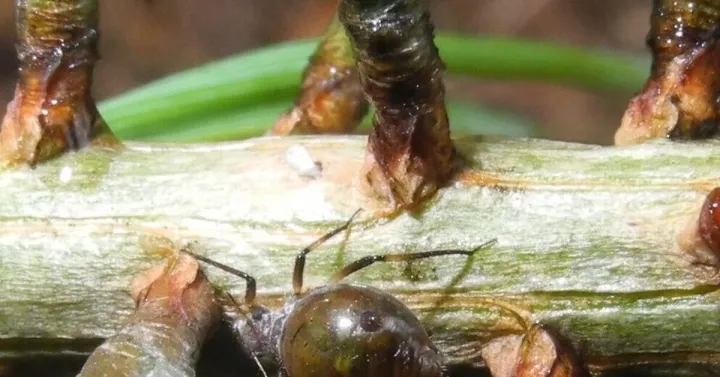
Description
How to identify
The spruce giant aphid (Cinara nuda) is a large aphid species belonging to the family Aphididae. Adults typically measure between 3 and 4 mm in length.
Their body color is dark brown to black, providing camouflage against the bark of spruce trees. Unlike many other Cinara species, their body is relatively bare, lacking dense hairs.
These insects form dense colonies on trunks and branches. They have a mutualistic relationship with ants, which feed on their honeydew and protect them from predators.
They are highly prolific, with both asexual and sexual reproduction cycles, ensuring the survival and spread of the species throughout the growing season.
The species is specifically adapted to coniferous hosts, utilizing their sap as the primary food source during all active life stages.
What it damages
Cinara nuda primarily feeds on spruce species (Picea). By piercing the bark with their mouthparts, they drain sap from the vascular system of the tree.
This persistent feeding stresses the tree, reducing its vigor and growth rates, which makes it less resilient to environmental stressors.
The production of large amounts of honeydew promotes the growth of sooty mold, which can cover needles and inhibit photosynthesis.
Chronic infestations often lead to premature needle drop and the weakening of twigs, which may eventually die back if the aphid population is not controlled.
Severely infested trees become aesthetically unappealing and are often predisposed to secondary infestations by wood-boring insects.
When it appears
The life cycle begins early in the spring when eggs, which overwinter on the bark or needles, hatch into the first generation of nymphs.
Activity peaks during late spring and early summer (May to June) when the tree exhibits rapid shoot growth and high sap pressure.
Multiple generations occur throughout the summer months, allowing the aphid populations to expand rapidly if conditions are favorable.
As autumn approaches, the aphid produces sexual forms that mate and lay overwintering eggs to ensure the next year's population survives.
Phenology is critical, as the aphids rely on the specific nutrient content found in the sap of developing spruce tissue.
Signs of infestation
The most immediate indicator of an infestation is the presence of ant activity on the tree trunk, as ants are often found tending the aphids.
Sticky honeydew deposits on the needles and bark, which quickly become covered in a black, powdery layer of sooty mold.
Yellowing or browning of needles, starting from the interior branches or areas with the highest concentration of aphid colonies.
Stunted or distorted shoot growth due to the lack of nutrients reaching the tips of the branches.
Visible clusters of large, dark, slow-moving insects visible on the branches, often hidden on the undersides of the wood.
Control measures
Integrated pest management strategies are recommended to keep spruce giant aphid populations below the economic damage threshold.
Systemic insecticides are the most effective treatment, as they are absorbed by the tree and kill aphids while they feed on the sap.
In smaller landscapes, high-pressure water sprays can be used to wash off colonies, although this is less effective for large, mature trees.
- Monitor tree health and ant presence starting in early spring.
- Apply systemic insecticides to prevent large-scale population outbreaks.
- Use sticky barriers on tree trunks to deter ants and minimize their protection of the aphids.
Maintaining proper tree health through irrigation and fertilization helps the tree recover more quickly from aphid feeding damage.
Taxonomy
- Latin name
- Cinara nuda
- Order
- Hemiptera (bugs, aphids, leafhoppers)
- Family
- Aphididae
- EPPO code
- CININU
Discussion
No discussions yet — be the first.