
Brown spruce aphid
Cinara kochiana
Description
How to identify
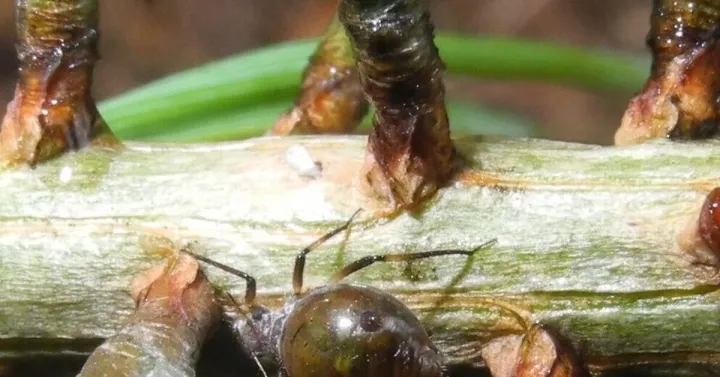
The brown spruce aphid (Cinara kochiana) is a member of the Aphididae family, known for its significant impact on spruce health. These insects are relatively large, measuring about 3-4 mm in length, and possess a dark brown to black coloration, often covered in a fine waxy bloom.
These aphids are sedentary insects that typically form dense colonies on the bark of spruce branches. They have robust legs and antennae, adapted for anchoring themselves firmly to the bark surface, where they can feed undisturbed for extended periods.
The biology of Cinara kochiana is strictly tied to coniferous hosts. They utilize a piercing-sucking mouthpart to penetrate the thin bark of young twigs to reach the phloem, extracting nutrient-rich sap essential for their survival and rapid reproduction.
Reproduction is highly efficient, involving both asexual (parthenogenetic) and sexual cycles. This adaptability allows the population to expand rapidly during the growing season, while the ability to produce cold-resistant overwintering eggs ensures the species survives harsh winter conditions.
A crucial aspect of their life strategy is the mutualistic relationship with ants. Ants tend to the aphid colonies, protecting them from natural predators like lady beetles and lacewings in exchange for the sugary honeydew secreted by the aphids during feeding.
What it damages
The brown spruce aphid primarily targets Norway spruce and its cultivars. By colonizing twigs and smaller branches, they drain the tree of vital resources, leading to significant stress and overall decline in vigor.
High infestation rates result in the depletion of stored nutrients, which causes reduced annual growth and a stunted appearance. In nursery settings, this damage can render young trees unsellable due to poor branch development and needle loss.
The extraction of sap disrupts the tree's metabolic processes. Over time, the needles become yellowed and eventually drop, leading to sparse foliage that ruins the aesthetic value of the spruce in landscaping and forestry.
The honeydew excreted by the aphids provides a medium for sooty mold to grow. This black fungal coating covers needles and stems, further interfering with photosynthesis and potentially leading to the death of smaller branches.
Repeated or severe infestations create entry points for secondary pathogens and bark-boring insects. Once a tree is weakened by aphid feeding, it becomes significantly more susceptible to fatal diseases and structural rot.
When it appears
The lifecycle typically begins in early spring, when overwintering eggs hatch into "fundatrices" (stem mothers). This hatching process is synchronized with the onset of sap flow and bud break in the spruce host.
Peak population numbers occur during the late spring and early summer (May to June), when conditions are ideal for rapid reproduction. During this window, large, visible colonies can be found covering significant portions of the branches.
As summer progresses, winged forms of the aphid develop. These individuals migrate to neighboring trees, facilitating the spread of the infestation throughout the stand or garden. Heat waves can slow down reproduction, but survivors persist in the cooler, shaded inner parts of the crown.
As temperatures drop in the autumn, the aphid produces sexual forms that mate and lay eggs. These overwintering eggs are laid in crevices of the bark, where they remain dormant until the following spring, ensuring the continuation of the cycle.
The number of generations per season varies based on regional climate, typically ranging from three to five. Extended warm autumns can lead to an increased number of generations, heightening the risk of damage in the subsequent year.
Signs of infestation
One of the earliest and most reliable indicators of an aphid infestation is the presence of ants patrolling the trunk and branches. Follow the ant trails to identify the specific branches where the aphid colonies are most concentrated.
Look for a sticky substance known as honeydew on the needles and stems. If the infestation has been present for a while, this sticky residue will likely be covered by a black, soot-like fungal growth, which is a hallmark sign of a heavy aphid presence.
Yellowing and premature shedding of needles, particularly in the inner or lower crown, are common signs of physiological stress caused by the aphids. The tree may appear generally dull or "unhealthy" compared to unaffected specimens.
Upon closer inspection, you can observe dense clusters of dark, pear-shaped insects huddled together on the branches. They are often motionless and may retreat or become agitated if the branch is disturbed.
In cases of severe infestation, the tree may exhibit stunted shoot growth. The tips of the twigs might appear twisted or shortened, and the overall density of the foliage will be noticeably reduced, revealing bare branches.
Control measures
Systemic insecticides, particularly those containing imidacloprid or acetamiprid, are highly effective as they are absorbed by the plant tissues, providing long-term protection against the sap-sucking insects.
Biological control methods are recommended for smaller infestations or sensitive sites. Encouraging natural predators, such as lady beetles, hoverflies, and lacewing larvae, is an excellent way to maintain balance in the garden ecosystem.
Ant management is a critical component of control. By applying sticky barrier bands around the spruce trunk, you prevent ants from reaching the aphids, effectively leaving the colony vulnerable to natural predation.
Cultural practices, such as ensuring adequate hydration and balanced fertilization, strengthen the tree's natural defenses, allowing it to better withstand and recover from light aphid attacks.
- Regular monitoring of spruce trees from late spring onwards.
- Physical removal of heavily infested twigs to reduce the initial colony size.
- Using insecticidal soaps or horticultural oils for targeted, low-toxicity control.
- Applying systemic treatments according to label instructions during the evening to avoid harming pollinators.
- Maintaining high biodiversity in the surrounding area to support beneficial insect populations.
Taxonomy
- Latin name
- Cinara kochiana
- Order
- Hemiptera (bugs, aphids, leafhoppers)
- Family
- Aphididae
- EPPO code
- CINAKO
Discussion
No discussions yet — be the first.