
Juniper aphid
Cinara juniperi
Description
How to identify
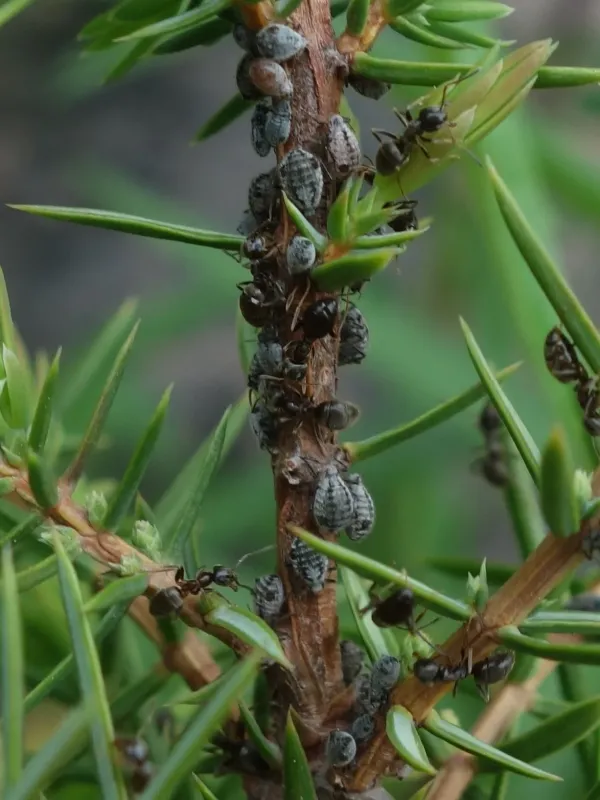
The juniper aphid (Cinara juniperi) belongs to the order Hemiptera and the family Aphididae. These small insects, measuring 2-3 mm, are typically dark brown or reddish-brown, allowing them to blend in with the bark and foliage of host plants.
They often exist in large, dense colonies, clustering on young branches and near the base of the needles. Both winged and wingless forms can be found, facilitating both local reproduction and the migration of individuals to new branches or nearby host plants.
The biological cycle is dominated by parthenogenetic reproduction throughout the warmer months, allowing populations to explode in size rapidly. This rapid reproduction makes early detection crucial for preventing widespread damage.
Overwintering occurs in the egg stage, with eggs laid on the needles or bark of the host tree. In spring, the eggs hatch into nymphs, which begin feeding immediately, initiating the seasonal cycle of infestation.
By autumn, sexual forms appear, which mate and lay fertilized eggs that are resistant to cold winter temperatures, ensuring the survival of the species until the following growing season.
What it damages
The primary hosts for this aphid are members of the Cupressaceae family, particularly Juniperus and Thuja species. By piercing the plant tissues and extracting cell sap, the aphids cause severe stress to the host plant.
As the aphids feed, they extract vital nutrients, causing the needles to lose their luster, yellow, and eventually drop prematurely. This weakening of the plant makes it susceptible to opportunistic fungal infections.
A significant issue caused by the juniper aphid is the excretion of honeydew, a sticky substance that coats the foliage. This honeydew encourages the growth of sooty mold, which blocks sunlight and hinders the plant's ability to photosynthesize.
Heavy infestations lead to stunted growth and a general decline in the plant's aesthetic value. The loss of foliage results in a sparse crown, which is particularly detrimental to high-maintenance ornamental plantings.
If left unmanaged, the cumulative impact of sap loss and fungal growth can lead to dieback of branches and, in extreme cases, the total death of the specimen, especially if the tree is already under other environmental stressors.
Signs of infestation
The most common indicator of infestation is yellowing or browning needles, which often spreads from the inner parts of the canopy outwards. This is frequently accompanied by a thin, sticky residue on the foliage.
The presence of sooty mold, which appears as a black, powdery coating on the needles and stems, is a strong sign that aphids have been present for some time. Ants are also common indicators, as they are often seen tending to the aphids to feed on the honeydew.
Closer inspection of the branches may reveal the presence of shed white skins (exuviae) left behind by nymphs as they molt. These look like tiny, white flakes caught on the needles or bark.
A simple detection method involves placing a sheet of white paper under a branch and shaking it gently. If aphids are present, the dark-colored insects will fall onto the paper and become easily visible.
Affected plants may show signs of deformity, such as twisted or curled new growth, as the aphids concentrate their feeding on the succulent tissues of the current year's growth.
Control measures
Effective management requires a combination of monitoring, cultural practices, and chemical intervention. Early intervention is the key to preventing mass outbreaks that can ruin the appearance of ornamental trees.
Systemic insecticides are the most effective chemical control, as they are absorbed by the plant and kill aphids upon feeding. Products containing active ingredients like imidacloprid or acetamiprid are standard in horticultural practice.
Managing the ant population is essential, as ants act as "bodyguards" for the aphids. Using sticky barriers on the trunk of the trees can prevent ants from accessing the aphid colonies, allowing natural predators to reach them.
Promoting a healthy garden ecosystem by providing habitats for beneficial insects such as ladybugs, lacewings, and hoverflies can help keep aphid populations in check naturally throughout the season.
- Monitor juniper and thuja plants regularly during the spring.
- Prune and dispose of heavily infested branches to reduce local populations.
- Apply systemic insecticides during the peak of the growing season if necessary.
- Use horticultural soaps or oils to wash away honeydew and kill aphids on contact.
- Maintain proper plant health through irrigation and balanced fertilization to increase pest resistance.
Taxonomy
- Latin name
- Cinara juniperi
- Order
- Hemiptera (bugs, aphids, leafhoppers)
- Family
- Aphididae
- EPPO code
- CUPRJN
Discussion
No discussions yet — be the first.