
Spruce cinara aphid
Cinara curvipes
Description
How to identify
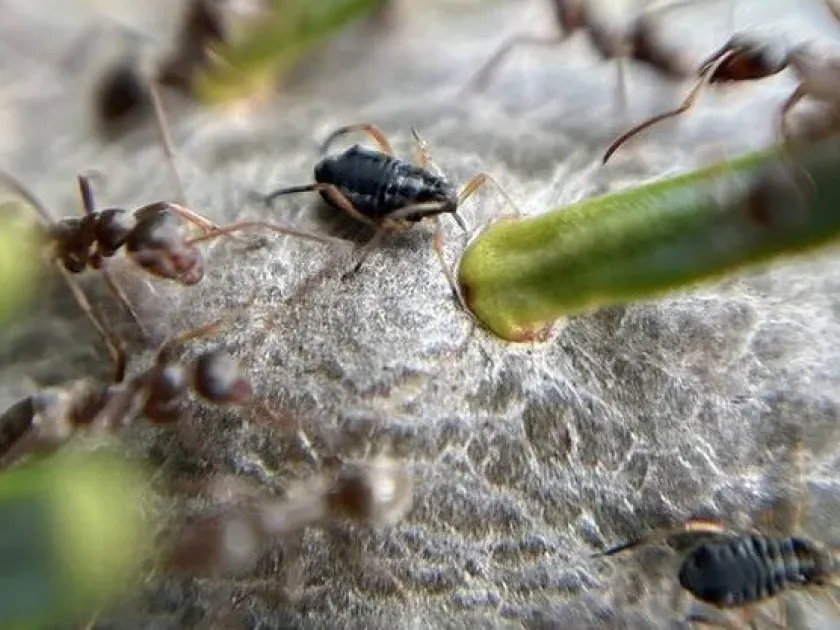
The spruce cinara aphid (Cinara curvipes) is a member of the Aphididae family within the Hemiptera order. These aphids are distinct due to their relatively large size and dark, often near-black, coloration, which allows them to camouflage perfectly on the bark of conifer trees.
Adult aphids and their nymphs possess a specialized proboscis adapted for piercing the bark of twigs and branches. This anatomical feature allows them to tap into the tree's phloem, extracting essential nutrients that sustain their large populations.
Their life cycle involves complex reproduction patterns, including both parthenogenetic and sexual stages. During the autumn, females lay eggs in rows on the needles, ensuring the survival of the next generation through the winter months.
These aphids share a mutualistic relationship with ants, which protect the aphid colonies from predators and parasites. In exchange, the ants harvest the honeydew produced by the aphids as a rich energy source.
The insects typically congregate in dense colonies on the lower parts of the trunk and branches, selecting areas where the bark is soft enough to permit feeding but provides sufficient cover from the environment.
What it damages
The primary hosts for this species are various spruce (Picea) varieties. They are frequently observed causing damage in ornamental landscapes, nurseries, and coniferous forests, particularly during favorable climatic conditions.
Signs of infestation
A primary sign of infestation is the presence of honeydew, a sticky substance excreted by the aphids that accumulates on needles and branches. This honeydew frequently promotes the growth of sooty mold, which appears as a black, velvety coating.
Needles infested by these aphids may turn yellow, lose their luster, and begin to drop prematurely. Sustained feeding leads to a significant loss of foliage density, which drastically reduces the aesthetic and structural integrity of the spruce tree.
Observing a high level of ant activity on the bark is a reliable indicator that an aphid colony is present. Ants are often seen patrolling the stems where the aphids are actively feeding, providing a clear visual cue to owners.
Upon closer inspection, one can find clusters of aphids residing directly on the bark of twigs. Their habit of moving their legs in unison when disturbed is a unique behavioral trait that helps distinguish them from other aphid species.
Chronic infestations can lead to stunted growth and structural deformities in new shoots. Weakened trees are significantly more susceptible to environmental stressors and subsequent attacks by secondary pests like borers.
Control measures
Systemic insecticides are the most effective method for controlling these pests, as they are absorbed into the plant's vascular system. Proper timing, typically during the early spring before bud break, is crucial for maximum efficacy.
Management of ant populations is an essential part of an integrated approach. By applying sticky bands around the trunks, you can physically block ants from reaching the aphid colonies, exposing the aphids to natural predators like ladybirds.
Sanitation plays a vital role in population reduction. Pruning and disposing of heavily infested branches can immediately decrease the number of pests, preventing the spread of the infestation to other parts of the tree.
Biocontrol agents, such as lacewings and ladybeetles, should be encouraged in the landscape to maintain a natural balance. Avoiding broad-spectrum pesticides helps preserve these beneficial insects that keep aphid populations in check.
- Perform regular inspections of spruce branches for honeydew.
- Apply horticultural oils during the dormant season to kill overwintering eggs.
- Use systemic chemical treatments if the population exceeds economic thresholds.
Taxonomy
- Latin name
- Cinara curvipes
- Order
- Hemiptera (bugs, aphids, leafhoppers)
- Family
- Aphididae
- EPPO code
- TODOCU
Discussion
No discussions yet — be the first.