
Giant conifer aphid
Cinara confinis
Description
How to identify
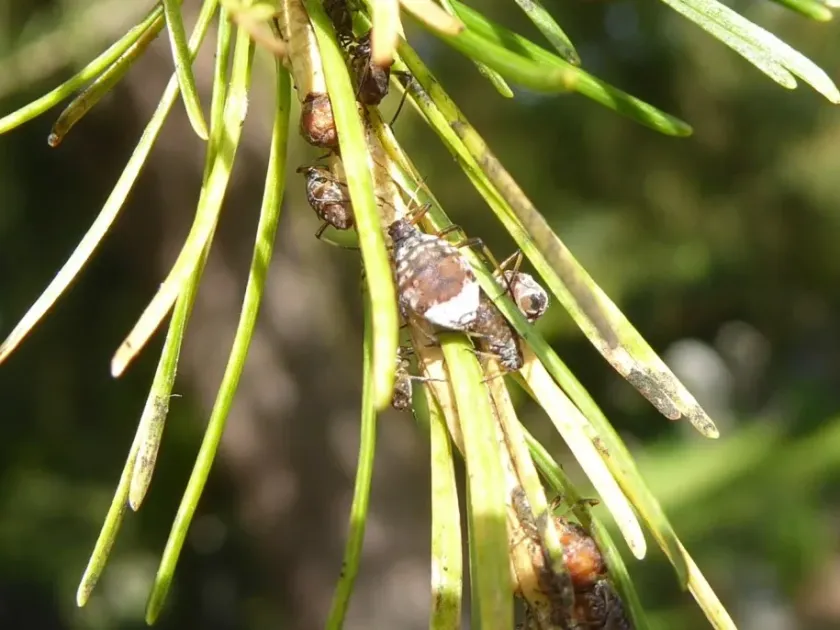
The giant conifer aphid (Cinara confinis) is a member of the Aphididae family, known for its significant size compared to other aphid species. Adults can reach lengths of 4 to 5 mm, making them easily identifiable as they cluster on the bark of their host trees.
These insects generally exhibit a dark brown or black body color, often covered in a fine, powdery wax coating that provides a matte appearance. They possess elongated legs and antennae, which are structural adaptations for navigating the rugged surfaces of coniferous bark where they establish their colonies.
What it damages
The primary host for this species is the fir tree (Abies spp.), although heavy infestations can spill over onto spruce and other conifers. They are typically found on the bark of trunks and branches, where they feed by piercing the phloem tissue to extract sap.
This feeding activity causes significant stress to the host tree, leading to a reduction in growth vigor and vitality. Severe infestations often result in branch dieback and an overall thinning of the canopy, as the tree struggles to compensate for the constant nutrient depletion caused by the aphids.
When it appears
The biological cycle of Cinara confinis is strictly synchronized with the phenology of host trees. Overwintering occurs in the egg stage, with eggs tucked securely into bark crevices, where they remain dormant throughout the cold months until temperatures rise in early spring.
Once the hatching of fundatrices occurs in spring, several overlapping generations are produced throughout the summer months. By late autumn, the production of sexual forms ensures that fertilized eggs are laid to survive the winter, thus completing the annual lifecycle of this species.
Signs of infestation
A hallmark sign of infestation is the production of copious amounts of honeydew, a sticky, sugar-rich excretion that coats the foliage and surrounding bark. This substance often promotes the growth of black sooty mold, which can discolor the tree and inhibit photosynthetic efficiency.
Ant activity is another reliable indicator; many ant species have a mutualistic relationship with these aphids, tending them to harvest their honeydew. If you observe persistent trails of ants moving up and down the trunks of your conifers, it is a strong indication of a thriving aphid colony.
Control measures
Managing the giant conifer aphid usually involves the application of systemic insecticides, which are absorbed by the tree and provide long-lasting control as the aphids feed on the sap. It is essential to apply these treatments early in the season to prevent the population from reaching damaging levels.
Cultural control measures, such as maintaining healthy tree vigor through proper irrigation and balanced fertilization, are crucial for long-term management. Encouraging the presence of natural predators, such as lady beetles, hoverflies, and lacewing larvae, can also help keep aphid populations below the economic injury threshold.
Taxonomy
- Latin name
- Cinara confinis
- Order
- Hemiptera (bugs, aphids, leafhoppers)
- Family
- Aphididae
- EPPO code
- TODOAB
Discussion
No discussions yet — be the first.