
Chrysanthemum leaf miner
Chromatomyia syngenesiae
Description
How to identify
The chrysanthemum leaf miner, scientifically known as Chromatomyia syngenesiae, belongs to the family Agromyzidae. These are tiny flies, typically measuring about 2 to 3 millimeters in length, characterized by their greyish or brownish coloration.
Adult flies are equipped with transparent wings that rest horizontally over their bodies when inactive. The most distinctive developmental stage is the larva, which spends its entire existence tunneling inside the host plant's leaves.
Identifying the pest visually can be challenging due to the cryptic behavior of the adults. Growers usually detect the infestation by the specific damage caused by the larvae, rather than by observing the tiny flies themselves.
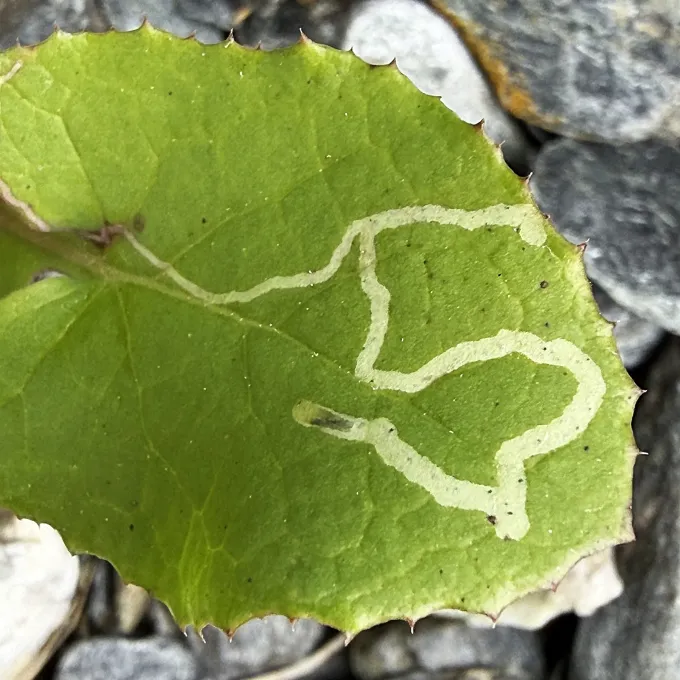
Females insert eggs into the leaf parenchyma using their ovipositor. The larva then hatches and begins feeding on the leaf tissue, creating the signature trails known as mines that appear on the leaf surface.
In commercial greenhouse settings, yellow sticky traps are standard tools for identifying and monitoring the population levels of adult flies, allowing for timely intervention before the infestation becomes severe.
What it damages
This pest is a polyphagous species that poses a significant threat to various Asteraceae family members, particularly chrysanthemums, gerberas, cinerarias, and asters. Weeds can also harbor the pest, acting as reservoirs.
Larval feeding causes the destruction of the leaf's internal mesophyll tissue, while leaving the upper and lower epidermis layers intact. These wandering tunnels, or mines, significantly impede the plant's ability to photosynthesize.
Heavy infestations lead to stunted growth, reduced flower production, and premature leaf drop. Furthermore, the tunnels created by the larvae serve as entry points for secondary fungal and bacterial infections.
For ornamental plant growers, the aesthetic damage is often the most critical factor, as infested leaves render the plants unsuitable for sale or high-quality floral arrangements.
In greenhouses, if left uncontrolled, the leaf miner population can escalate rapidly, leading to substantial economic losses and requiring intensive management strategies to recover crop quality.
When it appears
In indoor environments like greenhouses, the chrysanthemum leaf miner can reproduce throughout the year without a distinct dormant period, provided temperatures are favorable for development.
In outdoor settings, adult activity begins in late spring as temperatures rise. The species may complete multiple generations during a single growing season depending on the local climate and temperature.
The life cycle from egg to adult is highly temperature-dependent. During warm summer months, a full generation can develop in less than three weeks, leading to rapid population surges in the field.
Overwintering typically occurs as pupae within the soil or in sheltered debris near host plants. As conditions warm up in the spring, adult flies emerge to initiate the new season's infestations.
A proactive agronomic approach involves monitoring for peak activity periods, usually correlating with the emergence of young, tender foliage which is highly susceptible to egg-laying by females.
Signs of infestation
The primary symptom of an infestation is the appearance of winding, pale-colored lines on the leaf surface. These trails gradually widen as the larva grows and consumes more leaf tissue.
Small, white circular spots on the leaves are indicators of feeding punctures made by the adult females. These marks provide evidence of the adult population present in the growing area.
Close inspection of the foliage may reveal the presence of pupae at the end of the mines, appearing as small, brownish, oval capsules attached to the leaf tissue or occasionally in the soil.
As the damage progresses, the leaves become discolored, brittle, and eventually dry out. Severe infections often cause the affected leaves to curl, become deformed, and drop off the plant prematurely.
- Visible winding, light-colored trails (mines) on leaves.
- Small, white feeding puncture marks across the leaf surface.
- Yellowing and drying of infested leaf tissues.
- Deformation and premature dropping of foliage.
- Presence of small brown puparia on leaves or in surrounding soil.
Control measures
Management of the leaf miner is difficult because the larvae are protected within the leaf tissues, making standard contact insecticides largely ineffective against them. Systemic insecticides are preferred for better control.
Strict sanitation practices are crucial. Removing and destroying infested plant material at the end of the growing cycle helps eliminate overwintering pupae and reduces the potential population for the following year.
Biological control agents, particularly parasitic wasps, can be highly effective in suppressing leaf miner numbers. Introducing these beneficial insects is a cornerstone of modern integrated pest management (IPM).
Using yellow sticky traps is an essential monitoring strategy. It not only reduces the number of adult flies but also serves as an indicator to guide the timing and necessity of chemical or biological applications.
Quarantine measures should be enforced when bringing new plant stock into the facility. Thorough inspection of all incoming nursery stock is the most effective way to prevent the introduction of this pest.
Taxonomy
- Latin name
- Chromatomyia syngenesiae
- Order
- Diptera (flies)
- Family
- Agromyzidae
- EPPO code
- CHMTSY
Discussion
No discussions yet — be the first.