
Cereal leaf miner
Chromatomyia nigra
Description
How to identify
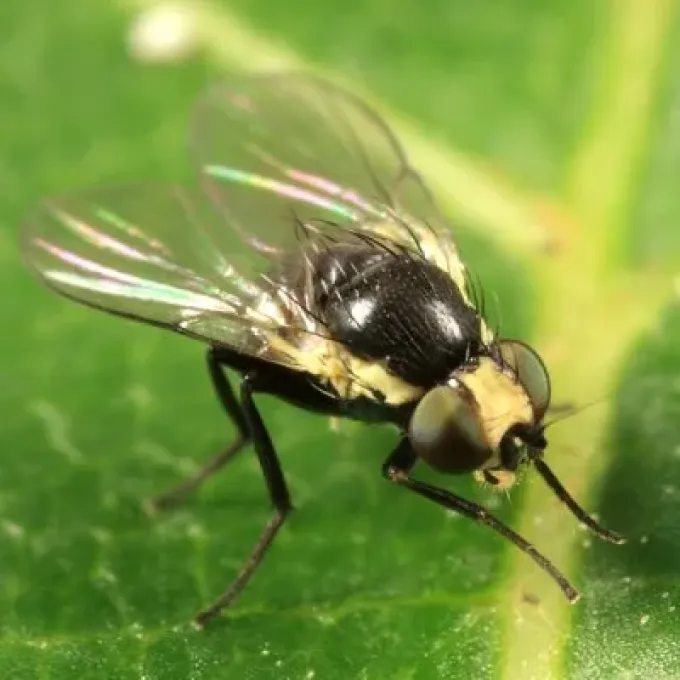
The Cereal leaf miner (lat. Chromatomyia nigra) belongs to the order Diptera and the family Agromyzidae. These are tiny flies, with adults typically measuring 2–3 mm in length, characterized by a dark, inconspicuous appearance.
The larvae are maggot-like, legless, and yellowish-white in color. They spend their entire developmental period protected within the leaf tissue of the host plant.
Pupation occurs inside a puparium, which resembles a flattened grain in shape. These puparia are often found on the leaf surface or near the base of the plant.
The life cycle is highly dependent on environmental conditions. Depending on the geographical region, this pest can complete three to five generations per year.
The species primarily overwinters in the pupal stage within plant residues or the upper soil layer, making it well-adapted to surviving cold winter conditions.
What it damages
This pest causes significant economic damage to a wide range of cereal crops. Primary hosts include winter and spring wheat, barley, oats, rye, and various forage grasses.
In addition to cultivated crops, the fly frequently colonizes wild grasses, which act as reservoirs and breeding grounds for the pest throughout the growing season.
The most severe damage occurs during the tillering and stem elongation stages. Intense infestation leads to a reduction in the plant's photosynthetic leaf area.
In cases of high infestation rates, the overall vitality of the crop is weakened, leading to decreased yields and inferior grain quality at harvest time.
Damage can result in leaf deformation, premature yellowing, and necrosis, which can significantly affect the plant's ability to recover from other environmental stresses.
When it appears
Adult fly activity begins in early spring as soon as ambient temperatures remain consistently above the threshold required for insect emergence and reproduction.
Peak larval activity generally occurs in May and June, coinciding with the active vegetative growth phase of winter and spring cereals.
During the summer months, high temperatures and drought may slow down the development of subsequent generations, though activity resumes with sufficient moisture.
In the autumn, as new winter cereal shoots emerge, a secondary increase in pest pressure is often observed as the flies move onto younger plants.
Each generation completes its cycle in approximately 20 to 30 days, allowing the population to expand rapidly when weather conditions are favorable.
Signs of infestation
The primary symptom of infestation is the appearance of distinct "mines" — winding, light-colored trails created by larvae feeding between the leaf cuticles.
Initial signs appear as thin, pale lines that gradually widen as the larva grows. These tracks are easily visible when inspecting the crop under direct sunlight.
Close inspection of the mines reveals the larva inside, along with small dark dots representing excrement, which are typically arranged in a line along the tunnel.
Over time, infested leaf areas may turn yellow, curl, and eventually wither, particularly when multiple larvae inhabit a single leaf blade.
- Visible serpentine mines on leaves
- Yellowing and drying of leaf tips
- Stunted growth of tillers
- Premature death of lower foliage
- Reduced biomass and lower overall plant vigor
Control measures
The core of integrated pest management is agrotechnical: deep autumn plowing helps incorporate plant residues into the soil, burying the pupae and preventing emergence.
Strict crop rotation and the systematic removal of grassy weeds from field margins are essential, as these serve as refuge for the pest during the off-season.
Adjusting planting dates to avoid the peak flight period of the flies allows crops to reach a more robust growth stage before infestation risks become critical.
Chemical control using systemic insecticides is recommended during peak egg-laying or larval hatching periods, provided the economic threshold is exceeded.
Biological control methods, including the preservation of natural predators and parasitic wasps, play an important role in keeping populations below economic damage levels.
Taxonomy
- Latin name
- Chromatomyia nigra
- Order
- Diptera (flies)
- Family
- Agromyzidae
- EPPO code
- PHYYNI
Discussion
No discussions yet — be the first.