
Chromatomyia
Chromatomyia
Description
How to identify
Chromatomyia is a genus of leaf-mining flies belonging to the family Agromyzidae within the order Diptera. These are tiny insects, with adults typically measuring 2–3 mm in length and exhibiting a grayish or blackish appearance.
The primary damage is caused by the larvae, which live a concealed life while developing inside the leaf tissue. Adult flies feed on plant sap by piercing the epidermis with their ovipositor, which also leaves characteristic micro-wounds.
The life cycle of Chromatomyia is highly dependent on temperature. Under favorable conditions (above +20°C), the complete development of one generation can take about three to four weeks, allowing for multiple generations per season.
Pupae are often found on the surface of the leaf or in the soil near the infested plant. They are typically barrel-shaped and possess a brownish color, making them somewhat difficult to spot in soil.
Identifying adult flies is challenging due to their small size and mobility. Professionals use yellow sticky traps to monitor the activity of adults in greenhouses and fields to determine the need for intervention.
##damage##Chromatomyia is a polyphagous pest that attacks a wide variety of plants. Common hosts include chrysanthemums, bulbous plants, various vegetable crops (such as lettuce, beans, and tomatoes), and numerous ornamental species.
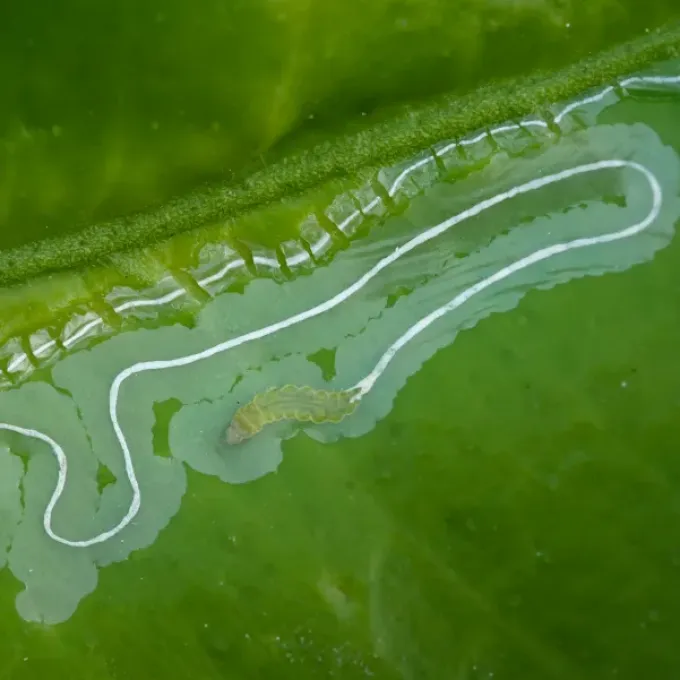
Larvae create winding tunnels or "mines" inside the leaf tissue, consuming the mesophyll. This disrupts photosynthesis and the plant's overall metabolism, which is critical for seedlings and young, developing shoots.
The damaged tissue serves as an entry point for secondary infections, including fungal and bacterial rots. In severe infestations, plants experience premature wilting and premature leaf drop.
Reduced leaf surface area leads to a direct loss in marketable fruit weight and a decline in the aesthetic value of ornamental plants. In greenhouse environments, this pest can spread rapidly throughout the entire crop.
Beyond direct physical harm, the visible mines significantly degrade the marketability of flowers and ornamental foliage, rendering them unsuitable for commercial sale.
Signs of infestation
The most visible sign of infestation is the appearance of whitish or light-green serpentine lines on the leaf surface, which gradually darken and widen as the larva continues to feed and grow.
During the early stages, one may notice tiny stippling or pinprick punctures on the leaves, created by female flies during feeding or egg-laying. These marks are often the first indicator of a pest presence.
When held up to the light, the larva or its dark, chain-like frass deposits can often be seen inside the mines within the leaf tissue.
In areas of heavy infestation, leaves may start to curl, yellow, and eventually desiccate. This pattern typically begins at the lower canopy, where the pest often initiates its activity.
Shaking an infested plant often causes small flies to take flight, confirming that adults are active in the immediate vicinity.
Control measures
Agronomic control methods include the thorough removal and destruction of crop residues after harvest, as pupae can overwinter in plant debris or the top layer of the soil.
The use of yellow sticky traps is effective for both reducing adult fly populations and monitoring the timing of pest peaks, which helps in scheduling targeted insecticide applications.
Biological control involves the introduction of natural enemies, such as specialized parasitic wasps (e.g., those from the genera Dacnusa or Diglyphus), which effectively parasitize larvae inside their leaf mines.
Chemical control using systemic insecticides is justified when pest pressure is high. Treatments should possess translaminar activity to penetrate the leaf tissue and reach the feeding larvae.
- Regular inspection of the underside of leaves for early signs.
- Elimination of weed hosts that act as reservoirs for the pest.
- Implementation of proper crop rotation practices.
- Use of protective floating row covers to exclude adult flies.
- Rigorous greenhouse sanitation and disinfection between growing cycles.
Taxonomy
- Latin name
- Chromatomyia
- Order
- Diptera (flies)
- Family
- Agromyzidae
- EPPO code
- CHMTSP
Discussion
No discussions yet — be the first.