
Spruce gall adelgid
Cholodkovskya viridula
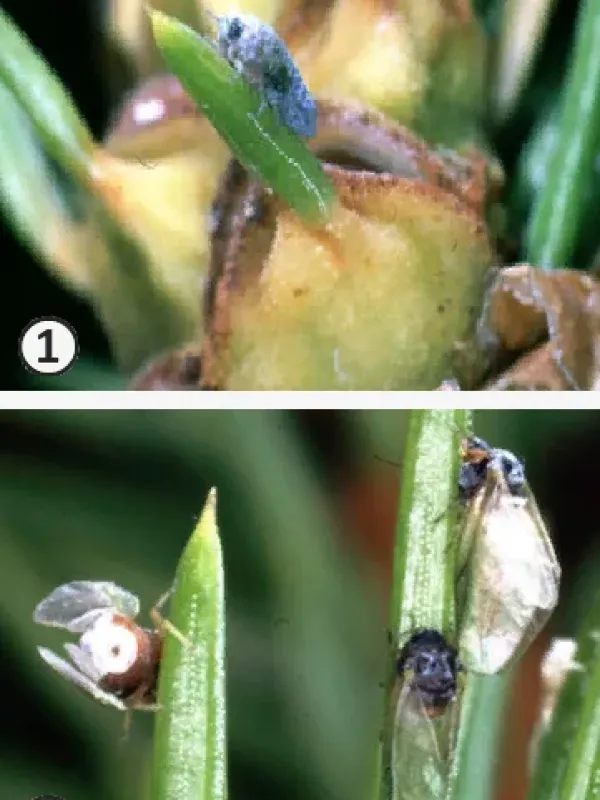
Description
How to identify
The spruce gall adelgid (Cholodkovskya viridula) is a small sucking insect belonging to the family Adelgidae, closely related to aphids.
These insects are known for their unique life cycle, which involves creating abnormal growths on spruce trees to house and protect their offspring.
The adult females are very small and often go unnoticed by gardeners until the symptoms of their feeding become visible on the host plant.
They are specialized pests that rely exclusively on spruce species to complete their life cycle and continue their lineage.
The insect populations can grow significantly in a short time if the environment is favorable and natural predators are absent.
What it damages
Spruce gall adelgids primarily attack various spruce species, causing significant aesthetic and physiological damage to the trees.
The feeding activity of these insects causes the tree to produce galls, which are distorted, pinecone-like growths on the young shoots.
Inside these galls, the nymphs live and feed, protected from the environment, while the tree sustains damage to its structural integrity and health.
Heavy infestations lead to stunted growth, needle yellowing, needle drop, and in severe cases, the death of individual branches or the entire tree.
The deformed branches often remain damaged even after the insects have emerged, leading to a permanent decline in the tree's appearance.
When it appears
The life cycle begins in early spring as temperatures rise, signaling the overwintering nymphs to resume feeding and development.
Spring is a critical window for detection, as the nymphs settle near budding sites and begin the process of gall initiation during shoot growth.
By late spring or early summer, the galls are fully developed and begin to open, allowing the next generation of winged adults to emerge.
The mid-summer period is often characterized by the migration of adults to new parts of the tree or to other healthy spruce trees.
As autumn approaches, the development cycle slows down, and the final generation seeks protected crevices on the bark to survive the winter.
Signs of infestation
The most distinctive sign is the presence of green or brownish galls that resemble small pinecones or pineapples on the branches.
White, fluffy wax filaments, produced by the insects as a defense mechanism, are frequently found on the needles and around the galls.
Yellowing or browning of the needles, combined with a distorted or "bent" appearance of the twigs, clearly indicates an adelgid infestation.
In addition to galls, a sticky substance may be visible on the needles if the infestation is heavy, providing a substrate for sooty mold growth.
- Pineapple-shaped galls on the shoots.
- White, cotton-like wax on the needles.
- Curved and stunted twig growth.
- Premature needle loss.
Control measures
Mechanical control is effective for young or small trees by pruning and removing galls before they open and release the insects.
Chemical control using systemic insecticides is highly recommended for larger infestations during the early spring before the galls harden.
Applying dormant oils in early spring can help suppress populations by suffocating the overwintering nymphs before they become active.
Monitoring is crucial; frequent inspections in late winter and early spring allow for timely intervention before significant damage occurs.
Ensuring trees are healthy through proper irrigation and soil care improves their resistance and helps them recover after an infestation.
Taxonomy
- Latin name
- Cholodkovskya viridula
- Order
- Hemiptera (bugs, aphids, leafhoppers)
- Family
- Aphididae
- EPPO code
- CHOOVR
Discussion
No discussions yet — be the first.