
Cholodkovskya oregonensis
Cholodkovskya oregonensis
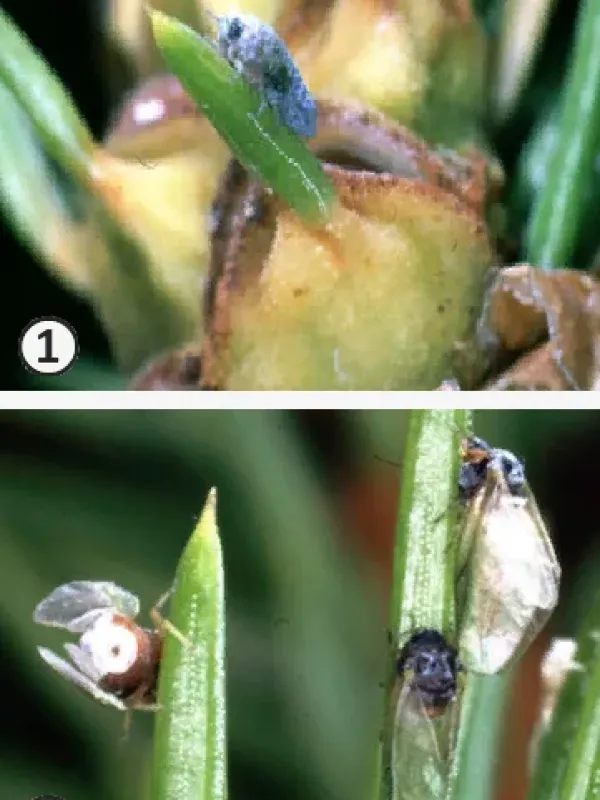
Description
How to identify
Cholodkovskya oregonensis is a species of adelgid (Adelgidae), a group of specialized sap-sucking insects that primarily infest coniferous trees. These insects are known for their intricate life cycles.
The insect possesses a specialized mouthpart apparatus designed for piercing plant tissue and extracting phloem sap, which is essential for its development and survival.
One of the most distinct features of this species is the secretion of white, waxy filaments that serve as a protective barrier against environmental stressors and predators.
The life cycle of this pest is highly complex, often involving several generations that may vary in appearance and host plant preference throughout the season.
Accurate identification usually requires microscopic examination, as the insects are small and often camouflage well against the bark or needles of the host.
What it damages
The primary hosts for Cholodkovskya oregonensis are various spruce species (Picea). The pest feeds on tender needles and young shoots, weakening the plant significantly.
Feeding activities disrupt the internal nutrient transport within the tree, which can lead to reduced vigor and stunted growth of the affected parts.
In cases of severe infestation, the damage manifests as yellowing needles, premature needle drop, and the distortion of new shoots, which impacts the tree's health.
The stress induced by the adelgids makes the tree more susceptible to secondary infestations by bark beetles or wood-boring insects, further threatening the tree's life.
Economic damage is particularly significant in nurseries and ornamental plantations, where the aesthetic value and marketability of the conifers are paramount.
Signs of infestation
The most reliable sign of an infestation is the appearance of white, cotton-like masses on the needles and twigs, which are the wax secretions of the adelgids.
Sticky honeydew secretions deposited by the insects often promote the growth of black sooty mold, which can cover large areas of the foliage and branches.
Infected trees may show signs of abnormal branching or stunted development of buds, which are consequences of the insect's direct feeding on localized tissue.
Discoloration of the needles, turning from a healthy green to yellow or brown, is a strong indicator that the colony has reached a critical density.
In the spring, one might observe the emergence of nymphs, which move to new growth areas to begin their feeding cycle and establish new colonies.
Control measures
Managing Cholodkovskya oregonensis requires a strategic approach that emphasizes prevention, monitoring, and targeted intervention with appropriate pest control methods.
Integrated Pest Management (IPM) practices are highly recommended to keep the population levels below the threshold of economic or aesthetic damage.
- Applying systemic insecticides that are absorbed by the tree tissues.
- Using horticultural oils during dormant or active stages to suffocate the insects.
- Sanitary pruning of infested branches to reduce the initial pest load.
- Encouraging biological control agents, such as predatory beetles and lacewings.
- Regular inspection of new nursery stock to prevent the introduction of the pest.
Consistent application of treatments is necessary because the waxy protection can shield the insects from many standard contact pesticides.
Long-term protection is best achieved by maintaining overall tree vigor through proper watering, fertilization, and site management to improve host resistance.
Taxonomy
- Latin name
- Cholodkovskya oregonensis
- Order
- Hemiptera (bugs, aphids, leafhoppers)
- Family
- Aphididae
- EPPO code
- CHOOOR
Discussion
No discussions yet — be the first.