
Cheiracanthium punctorium
Cheiracanthium punctorium
Description
How to identify
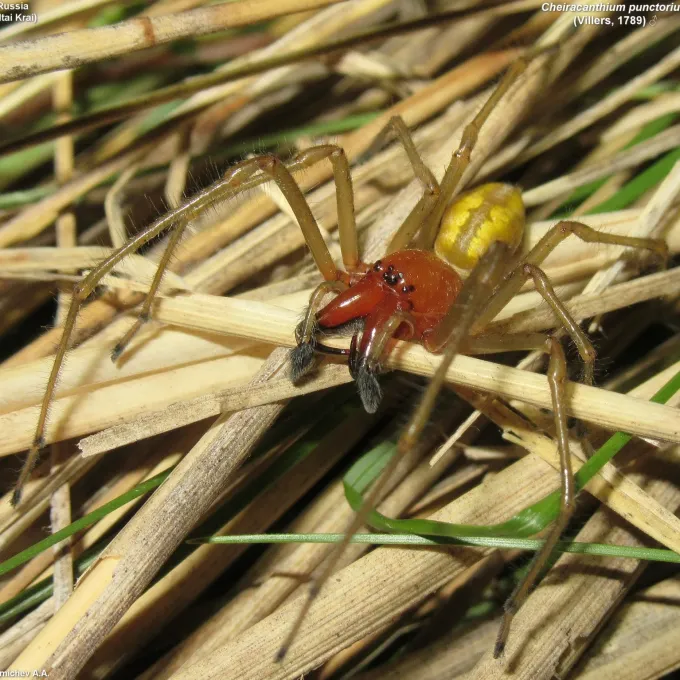
Cheiracanthium punctorium, commonly known as the yellow sac spider, belongs to the family Cheiracanthiidae. Adults typically measure between 10 and 15 mm in length.
The spider features a distinct yellowish-green to brown coloration. Its most prominent features are the relatively large and dark chelicerae, which are capable of piercing human skin.
This species is a nocturnal hunter that does not weave orb webs to catch prey. Instead, it actively wanders across plants at night, searching for small insects to consume.
During the daytime, these spiders hide in retreat tubes made of silk, which they construct by folding or rolling leaves. These retreats serve as both protective shelters and sites for egg deposition.
It is known for being territorial and aggressive when its nest is disturbed. The bite is considered painful, often resulting in localized swelling, burning sensations, and short-term malaise.
What it damages
While Cheiracanthium punctorium does not feed on plant tissues directly, its presence in agricultural fields causes significant structural and operational issues.
The spider curls leaves to create its retreats, which disrupts normal leaf surface area and interferes with photosynthesis, leading to localized leaf deformation and stunted growth in sensitive crops.
In vineyards, the presence of these spiders is particularly problematic. Their webbing between grapes can damage the visual quality of the clusters and pose a risk of bites to vineyard workers.
The accumulation of webbing and retreats can create a microclimate that fosters the development of secondary plant pathogens, such as molds and fungi, in dense crop foliage.
Operational efficiency is compromised as heavy infestations necessitate special safety precautions for staff, increasing the labor costs and difficulty of routine harvesting and maintenance tasks.
When it appears
The life cycle of the species begins in spring when warming temperatures trigger the emergence of overwintering individuals, who then start dispersing to colonize crop fields.
Population density typically peaks during the mid-to-late summer months, coinciding with the active growth and reproductive stages of many agricultural crops.
As autumn approaches, the spiders prepare for dormancy. They seek out sheltered overwintering sites, such as cracks in tree bark, plant debris, or agricultural infrastructure.
The species undergoes a life cycle consisting of egg, nymph, and adult stages. Its ability to adapt to diverse environments allows it to maintain consistent presence within agroecosystems.
Environmental factors, particularly temperature and the availability of prey insects, play a crucial role in determining the speed of its development and overall population success.
Signs of infestation
The primary diagnostic sign of a Cheiracanthium punctorium infestation is the presence of curled or folded leaves tightly bound with strong, white silk webbing.
Inspecting these silk retreats often reveals the spider itself or its protective egg sac. These retreats are easily identified when examining foliage systematically.
In corn and cereal crops, one may observe leaves folded against the stalk or around developing ears, held together by silken threads, often accompanied by necrotic tissue spots.
In vineyards, web-covered clusters are the most frequent sign. The silk threads stand out against the berries, serving as a clear indicator of the spider's activity in the vineyard.
A simple field monitoring method involves using an insect sweep net during dawn or dusk, when the spiders are most active and likely to be found wandering on the plants.
Control measures
Integrated pest management strategies focus on habitat modification and preventative sanitation to reduce the spider's capacity to build nests.
Effective weed control is essential, as overgrown borders and weedy patches within fields provide primary reservoirs for the spiders during the early stages of the season.
Chemical control is possible through broad-spectrum insecticides, but this should be approached cautiously to avoid disrupting beneficial predator populations that naturally keep spider counts in check.
- Maintain clean field margins to reduce overwintering habitat.
- Implement protective gear requirements for field staff to prevent bite incidents.
- Use systematic visual monitoring to locate and remove heavily infested areas.
Biological control measures are generally supportive, focusing on the preservation of natural enemies, though the predatory nature of the spider itself makes it a complex component of field ecology.
Taxonomy
- Latin name
- Cheiracanthium punctorium
- Family
- Cheiracanthiidae
- EPPO code
- CHIAPU
Discussion
No discussions yet — be the first.