
Cheiracanthium mildei
Cheiracanthium mildei
Description
How to identify
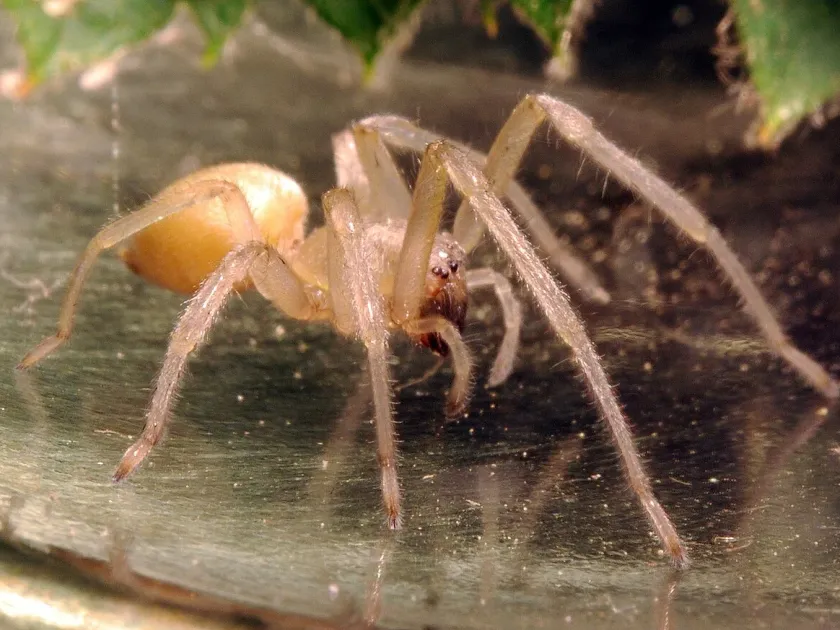
Cheiracanthium mildei is a spider species belonging to the Eutichuridae family. These are medium-sized spiders, typically ranging from 7 to 10 mm in body length, with females being slightly larger than males.
The coloration ranges from pale yellow to greenish-yellow, often featuring a darker or brownish hue around the chelicerae. A distinct morphological feature is the relatively long front pair of legs, which gives the spider a unique appearance when moving.
Unlike many other spider families, this species does not spin classic orb webs for hunting. It follows an active nocturnal lifestyle, constantly moving across plant surfaces in search of prey, making it difficult to spot during daytime monitoring.
This species possesses powerful chelicerae capable of piercing the tough skins of not only small insects but occasionally human skin as well, requiring caution during agricultural activities.
The biology of this spider is closely linked to warm climate zones, yet it successfully adapts to indoor conditions and commercial greenhouses, where it finds a stable supply of food.
What it damages
Cheiracanthium mildei is not a herbivore in the literal sense, but its presence indirectly harms crops. The spider prefers to reside in rolled-up leaves of cultivated plants, using them as daytime shelters.
While constructing its characteristic tubular nests, the spider binds parts of the leaves with silk threads, leading to leaf deformation and inhibiting photosynthetic processes.
The primary damage arises because these dense silken shelters become ideal microclimatic refuges for actual pests, such as aphids, whiteflies, and spider mites, which are protected by the webbing from beneficial natural enemies.
In agro-ecosystems, the presence of these spiders can reduce the effectiveness of biological control programs, as they actively prey on beneficial predatory insects like ladybugs or lacewings.
On ornamental and berry crops, the webbing left by the spider diminishes the aesthetic value of the produce, creating additional complications during the post-harvest preparation of the crop.
When it appears
The activity of Cheiracanthium mildei begins with the arrival of consistently warm spring temperatures. In open fields, the peak population density usually occurs in the second half of summer when plant foliage is at its maximum.
Under greenhouse conditions, the spider's life cycle lacks a distinct seasonality, allowing it to reproduce year-round provided there is a sufficient supply of prey.
Females lay eggs in cocoons, which are hidden within rolled leaves or under bark. Juvenile development is rapid, allowing the species to produce multiple generations within a single growing season.
Migratory activity of these spiders increases during periods of significant humidity fluctuations, when they move from weeds to cultivated plants in search of optimal environmental conditions.
As autumn approaches, individuals tend to seek hibernation sites, including cracks in structures, plant debris, or soil mulch, where they can survive in a state of diapause until the next growing season.
Signs of infestation
The first sign of the spider's presence is characteristically curled or silk-bound leaves at the tips of shoots. If one carefully unrolls such a leaf, the spider or its egg cocoon can often be found inside.
On leaf surfaces, one may notice thin, whitish silk threads that become visible early in the morning when dew settles on the spider silk structure.
Damaged areas of the leaf may eventually yellow or necrotize due to the disruption of vascular circulation and the mechanical impact of the spider's chelicerae during nest preparation.
An indirect sign is a sharp decline in the population of other predatory insects in a specific area where a high density of Cheiracanthium webbing is observed.
The presence of a large number of exuviae (cast-off skins) on plant stems also serves as evidence of active growth and development of the pest population in that zone.
Control measures
Effective management of Cheiracanthium mildei involves an integrated approach, starting with thorough sanitary cleaning of the area to remove weeds that serve as reservoirs for the spider.
In greenhouses, it is necessary to implement regular ventilation and maintain lower humidity levels, making the environment less favorable for spider nest construction.
Mechanical removal and destruction of rolled leaves containing cocoons during early infestation stages can significantly reduce population density without the need for chemical intervention.
If chemical protection is required, broad-spectrum insecticides should be prioritized, as specialized acaricides may not be sufficiently effective against spiders of this family.
It is essential to follow safety protocols during applications, using personal protective equipment to prevent painful bites, which can potentially trigger local allergic reactions.
Taxonomy
- Latin name
- Cheiracanthium mildei
- Family
- Cheiracanthiidae
- EPPO code
- CHIAMI
Discussion
No discussions yet — be the first.