
Viburnum aphid
Ceruraphis eriophori
Description
How to identify
The Viburnum aphid, scientifically known as Ceruraphis eriophori, belongs to the family Aphididae within the order Hemiptera.
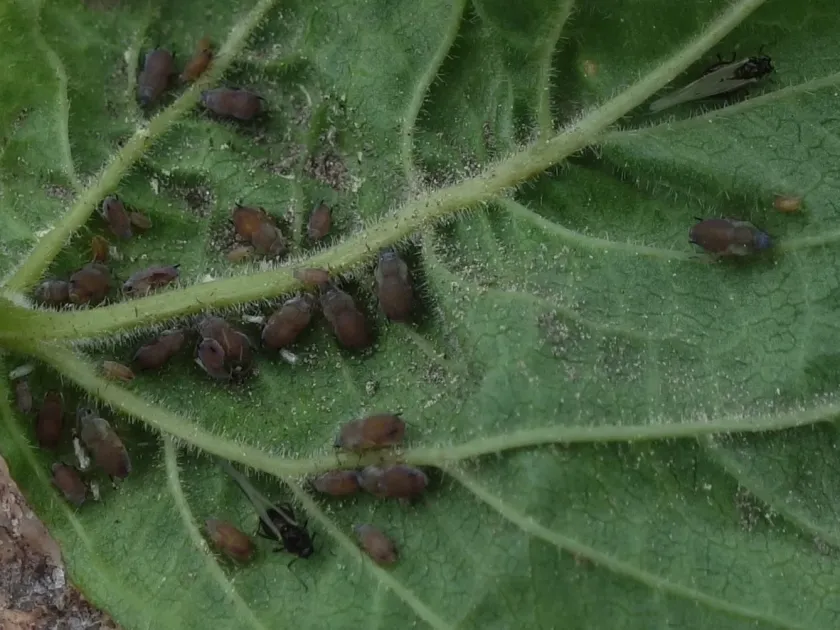
These are small, soft-bodied insects, typically measuring 2 to 3 millimeters in length, ranging in color from dark green to black.
They are characterized by their complex life cycle, which often involves moving between viburnum shrubs and host plants in the sedge family.
The insect produces both wingless and winged generations, allowing them to rapidly colonize new parts of the host plant throughout the season.
Overwintering occurs in the egg stage, with the small, black eggs deposited firmly on the bark near the buds of viburnum twigs.
What it damages
The primary host for this aphid is the Guelder rose or European cranberrybush, though other viburnum species are also susceptible.
By feeding on the sap of young, developing tissues, the aphids deprive the plant of essential nutrients and hydration.
This persistent feeding causes the plant to waste energy on repairing tissues instead of producing healthy leaves and berries.
As the aphids suck sap, they inject saliva that can contain toxic substances or plant viruses, further damaging the host.
The cumulative damage often results in stunted growth of the shrub and a significantly reduced yield of viburnum fruits.
When it appears
The lifecycle begins in early spring, synchronized with the bud burst, when the overwintered eggs hatch into fundatrices.
The population reaches its maximum density during the peak of spring and early summer when new growth is most abundant.
During the warmer months, winged forms develop, which migrate to intermediate hosts, effectively spreading the infestation.
Autumn triggers the production of sexual individuals, who return to the primary host for mating and egg-laying for the next winter.
Weather conditions, specifically cool and moist springs, often provide the ideal environment for explosive aphid population growth.
Signs of infestation
The most distinctive symptom is the severe curling and twisting of young leaves, which often fold inward to form protective pockets.
Upon closer inspection of these curled leaves, one can easily identify dense, dark-colored colonies of aphids feeding on the surface.
A sticky substance known as honeydew is excreted by the aphids, which coats the foliage and attracts other insects.
This honeydew serves as a growth medium for sooty mold, leading to blackened, unsightly leaves that struggle to perform photosynthesis.
If you see a trail of ants traveling up and down the shrub, it is a very strong indicator of an active aphid population colony.
Control measures
Regular monitoring of viburnum shrubs starting in early spring is crucial for timely detection before infestations become overwhelming.
For chemical control, systemic insecticides are the most effective, as they are translocated throughout the plant tissues to reach hidden aphids.
Encouraging biodiversity in the garden helps, as predators like ladybugs, lacewings, and hoverfly larvae feed voraciously on aphid colonies.
If the infestation is localized to only a few branches, pruning and destroying the affected tips can significantly reduce the pest population.
- Monitor for signs of leaf curling.
- Use systemic pesticides during the active growth phase.
- Promote natural biological control agents.
Taxonomy
- Latin name
- Ceruraphis eriophori
- Order
- Hemiptera (bugs, aphids, leafhoppers)
- Family
- Aphididae
- EPPO code
- NEOCER
Discussion
No discussions yet — be the first.