
Palm aphid
Cerataphis lataniae
Description
How to identify
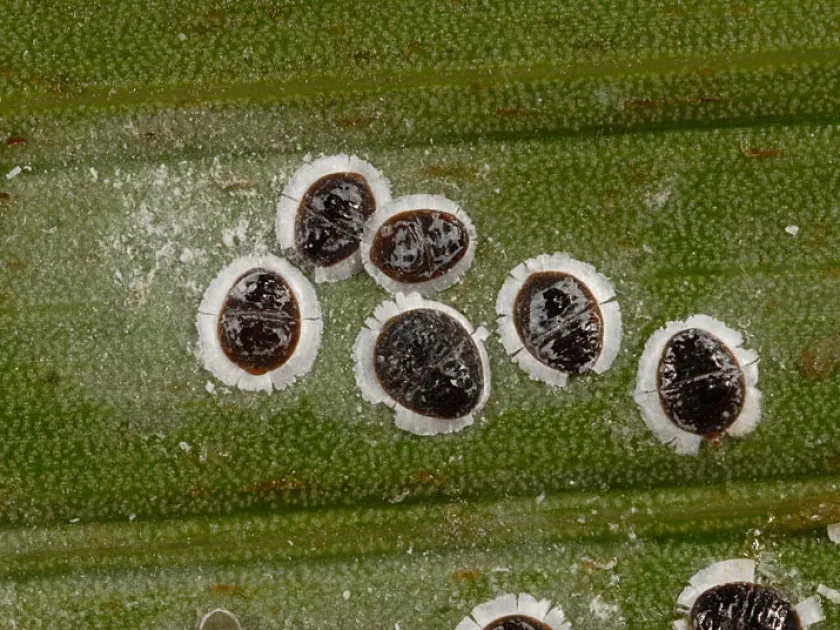
The palm aphid (Cerataphis lataniae) is a unique species that deviates from the common aphid appearance. Adults are oval, flattened, and dark brown or black, often fringed with a white waxy secretion that makes them look like scale insects.
Due to their sedentary lifestyle, they are frequently misidentified as soft scales. However, they belong to the family Aphididae, specifically the subfamily Hormaphidinae, and are true aphids despite their peculiar morphology.
Adults typically measure about 1.5–2 mm. The waxy edge serves as a protective barrier, allowing them to remain camouflaged against the dark green leaves of palm trees and other tropical hosts.
While the colony usually consists of wingless females, winged forms can develop when the population density becomes too high. These winged individuals are responsible for spreading the infestation to neighboring plants.
Young nymphs are more mobile than adults. They actively wander over the leaf surface until they find a suitable spot near a vein to insert their mouthparts and begin feeding on the plant sap.
What it damages
The primary hosts of this pest include a wide range of palms (like Chamaedorea and Howea), orchids, ferns, and various aroids. It is a common problem in indoor gardens and greenhouses.
By constantly extracting cellular sap, the aphids drain the plant's resources. This leads to reduced vigor, stunted growth, and a general decline in the plant's health over time.
A major side effect of their feeding is the production of copious amounts of honeydew. This sticky substance serves as an ideal growth medium for sooty mold, which can cover the leaves in thick black patches.
Sooty mold growth is particularly harmful because it blocks sunlight from reaching the leaf surface, severely inhibiting the plant's ability to perform photosynthesis efficiently.
Severe infestations often result in leaf curling, yellowing, and eventual tissue necrosis. If left untreated, delicate plants may suffer significant dieback or even complete collapse.
When it appears
In indoor environments such as homes, offices, and greenhouses, the palm aphid can reproduce throughout the year. There is no natural dormant phase, making it a persistent threat to plant collections.
The high humidity levels often maintained for tropical plants, combined with consistent indoor temperatures, create an ideal environment for rapid population growth and development.
These aphids reproduce via parthenogenesis, meaning females give birth to live nymphs without the need for mating. This reproductive strategy allows a colony to explode in size within just a few weeks.
Peak activity often aligns with the plant's growing season; however, central heating in winter can create dry, warm conditions that do not hinder these pests and may even accelerate their life cycle.
Because of their continuous breeding, vigilant monitoring is essential. Even a single missed individual can lead to a significant re-infestation of the entire plant within a short period.
Signs of infestation
The most immediate sign of an infestation is the presence of sticky honeydew on the foliage or the surfaces beneath the plant. This residue is often the first thing gardeners notice.
A closer inspection of the leaf undersides, particularly along the midrib, usually reveals clusters of small, dark, scale-like objects. Unlike actual scales, these can be easily dislodged with a fingernail or swab.
The development of black sooty mold on the leaves is a strong indicator of a long-term infestation, as the aphids have been feeding long enough to produce sufficient honeydew for fungal growth.
Leaves may show symptoms such as loss of gloss, fading color, or curling. As the plant loses nutrients, older leaves may turn yellow and wither prematurely, signaling that the infestation is advanced.
- Sticky leaf surface.
- Presence of black sooty mold.
- Dark, flattened, scale-like insects on the underside of leaves.
- Yellowing and stunted growth.
- Premature leaf drop.
Control measures
Mechanical control is the first step: wipe the leaves carefully with a solution of insecticidal soap or a mild soapy water mix. This removes the adults and disrupts the colony structure.
For more severe cases, systemic insecticides containing imidacloprid or acetamiprid are highly effective. These chemicals move through the plant's vascular system, poisoning the aphids as they feed.
When applying contact sprays, thorough coverage is critical. You must ensure the solution reaches the undersides of leaves and tight crevices, as the aphids are masters of hiding.
Quarantine is the most important preventive measure. Always isolate new plant arrivals for at least three weeks to ensure they are free of aphids before introducing them to your main collection.
Maintaining optimal plant health through balanced fertilization and proper hydration helps the plant resist colonization. Robust plants are significantly less attractive to palm aphid attacks than stressed ones.
Taxonomy
- Latin name
- Cerataphis lataniae
- Order
- Hemiptera (bugs, aphids, leafhoppers)
- Family
- Aphididae
- EPPO code
- CEATLA
Discussion
No discussions yet — be the first.