
Palm aphid
Cerataphis brasiliensis
Description
How to identify
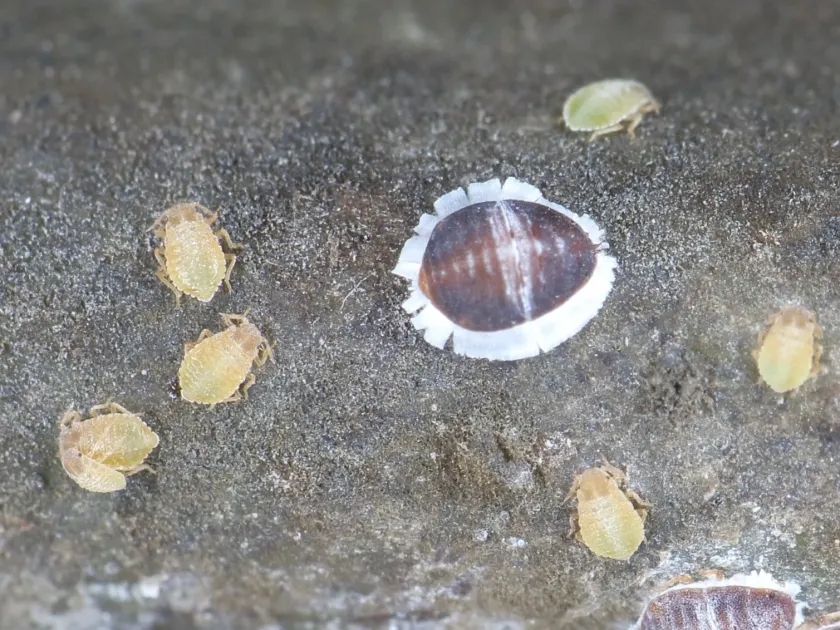
The palm aphid (Cerataphis brasiliensis) is a unique aphid species that is often mistaken for scale insects due to its flat body and waxy, fringe-like appearance.
Adults are typically oval or circular, dark brown to black in color, and possess a distinct white waxy fringe along the margin of their bodies.
Belonging to the Aphididae family, these pests are highly adapted to greenhouse environments and can exist in both winged and wingless forms.
They are relatively sedentary, usually clustering on the undersides of leaves, making early detection difficult without a close inspection of the foliage.
Reproduction is primarily parthenogenetic, allowing for rapid population growth that can overwhelm a host plant in a matter of weeks if left unchecked.
What it damages
The primary hosts for this pest include various palm species, such as Areca, Chamaedorea, and Caryota, but it also frequently infests orchids and other tropical ornamentals.
These aphids target tender new growth and leaf undersides, extracting essential sap and weakening the plant's structural integrity.
Indoor plants are particularly susceptible, as the lack of natural predators in home or greenhouse environments allows the population to thrive.
Beyond direct sap-sucking damage, their presence often leads to the development of sooty mold, which blocks photosynthesis on the leaf surface.
In severe cases, the infestation causes stunted leaf development, yellowing, and eventually the death of the plant if the nutrient deficiency becomes critical.
Signs of infestation
Look for small, brown, scale-like spots on the undersides of leaves, which are actually the adult aphids protected by their waxy secretions.
The presence of sticky honeydew on the foliage is a major warning sign, often followed by the growth of a black, powdery sooty mold.
Affected plants may show signs of yellowing, chlorosis, and leaf curling, as the aphids drain the plant of its vital fluids and nutrients.
Increased ant activity around the plant is a common indirect sign, as ants are often attracted to the honeydew secreted by the aphid colony.
In advanced stages of infestation, you may notice fine white dust or debris on the soil surface, which consists of shed waxy layers and aphid excrement.
Control measures
Manual removal using a soft brush or cotton swab dipped in soapy water or alcohol is effective for minor infestations on individual leaves.
For more established colonies, systemic insecticides containing imidacloprid are generally required to penetrate the plant tissues where the aphids feed.
It is essential to conduct multiple treatment applications, spaced roughly a week apart, to break the reproductive cycle and eliminate newly hatched nymphs.
Improving air circulation and maintaining appropriate humidity levels can help deter the spread, as these aphids thrive in stagnant, dry indoor air.
Always inspect new plants thoroughly before introducing them to your collection to prevent accidental contamination of your greenhouse or home garden.
Taxonomy
- Latin name
- Cerataphis brasiliensis
- Order
- Hemiptera (bugs, aphids, leafhoppers)
- Family
- Aphididae
- EPPO code
- CEATVA
Discussion
No discussions yet — be the first.