
Palm aphid
Cerataphis
Description
How to identify
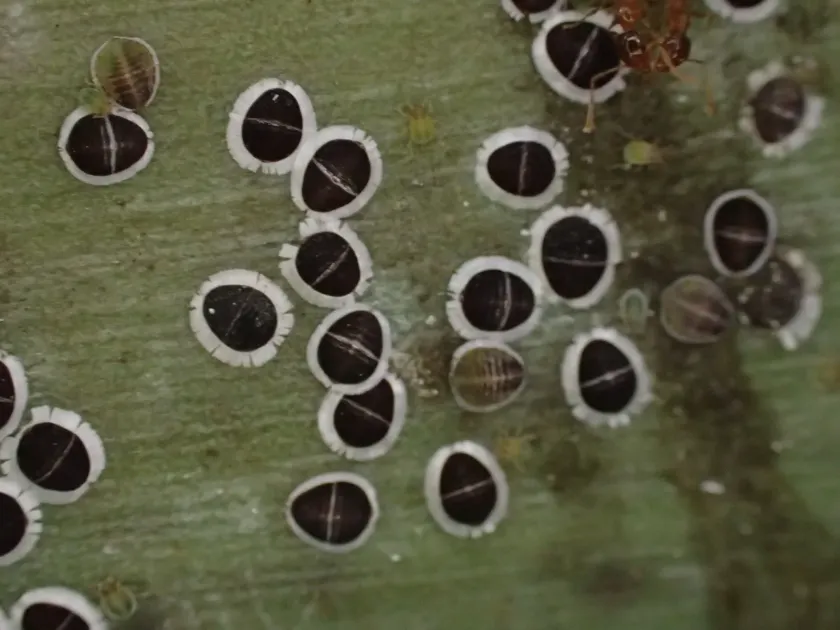
The palm aphid, scientifically known as Cerataphis, is a unique group of aphids that frequently mimics scale insects or whiteflies due to its flattened, shield-like body shape.
Belonging to the order Hemiptera and the family Aphididae, this insect has evolved a waxy fringe around its body that provides excellent camouflage on host plants.
Adults are typically dark brown or black, while the nymphs may appear more translucent or pale, often covered in white, woolly, or waxy secretions produced by special glands.
Their life cycle involves parthenogenetic reproduction, which allows a single founder aphid to establish a large colony in a very short period under warm greenhouse conditions.
These insects are highly specialized and often exhibit a sedentary behavior, remaining attached to the underside of leaves for extended periods to feed on plant sap.
What it damages
The primary hosts of Cerataphis include various ornamental palm species, as well as specific tropical plants like orchids and certain aroids found in interior landscapes.
The aphids aggregate along the main veins and midribs on the undersides of leaves, piercing the tissue to extract nutrients and cause significant stress to the host.
Their feeding activity results in the excretion of large quantities of honeydew, which serves as a substrate for the growth of sooty mold, blocking light from reaching the leaf surface.
This impairment of photosynthesis, combined with direct nutrient loss, leads to chlorosis, stunted growth, and in severe cases, the necrosis of the foliage.
Heavy infestations can cause irreversible damage to the aesthetic value of the plant, often leading to the premature shedding of leaves and potential plant decline.
Signs of infestation
The most distinctive sign is the appearance of dark, oval-shaped structures on the underside of leaves, which are often mistaken for scale insects by casual observers.
A sticky film of honeydew covering the leaves or the surface beneath the plant is a clear indication that a sap-sucking pest is present and active.
The presence of sooty mold—a black, powdery fungus—often signals the infestation, as it thrives on the excess sugars produced by the aphids.
Yellowing or mottled patterns on leaves, combined with the presence of ants patrolling the stems, strongly suggest that a colony of aphids is being farmed by ants.
Leaves may show visible signs of twisting or stunted development if the aphid population is concentrated on newly emerging, soft tissue.
Control measures
Effective management requires the application of systemic insecticides, which are absorbed by the plant and kill the aphids upon ingestion of the sap.
Frequent monitoring and early intervention are crucial, as Cerataphis colonies can quickly reach numbers that are difficult to manage with simple contact sprays.
For minor infestations, wiping the foliage with a damp cloth or a solution of insecticidal soap can physically remove the aphids and their waxy protective coverings.
- Quarantining new plants before introducing them to the main collection.
- Applying systemic products containing neonicotinoids or similar chemistries.
- Ensuring proper ventilation to reduce humidity and hinder sooty mold growth.
Consistency is key to success; treatments should be repeated according to the life cycle of the pest to ensure that all emerging generations are eliminated.
Taxonomy
- Latin name
- Cerataphis
- Order
- Hemiptera (bugs, aphids, leafhoppers)
- Family
- Aphididae
- EPPO code
- CEATSP
Discussion
No discussions yet — be the first.