
Cedrobium bark beetle
Cedrobium
Description
How to identify
The Cedrobium bark beetle is a genus of insects within the Curculionidae family. These tiny beetles are specialized pests that inhabit the subcortical layers of coniferous trees, particularly members of the Cedrus genus.
Adult beetles are small, cylindrical, and typically dark-colored, which allows them to camouflage perfectly against the bark of host trees. They possess strong mandibles adapted for boring through the bark and phloem.
Larvae are white, legless, and have a distinct head capsule. They spend their entire developmental period tunneling through the cambium and inner bark, causing severe disruption to the tree's vascular system.
The biological cycle is highly adapted to the host tree's physiology. These beetles typically target trees that are already physiologically stressed, although massive population explosions can lead to the successful colonization of healthy trees.
Their life cycle is mostly hidden under the bark, making it difficult for predators or environmental factors to regulate their population naturally, which often necessitates human intervention in managed stands.
What it damages
The primary hosts for these beetles are cedar species and other related conifers. By feeding on the cambium and phloem, the beetles effectively girdle the tree, preventing the transport of essential nutrients and water.
When it appears
The activity of Cedrobium peaks during the warm months, starting in late spring and continuing throughout the summer. This period is critical for mating and the emergence of new generations searching for host trees.
Environmental conditions, particularly temperature and drought, play a significant role in their developmental speed. A warm spring can lead to early emergence and multiple generations within a single growing season.
Signs of infestation
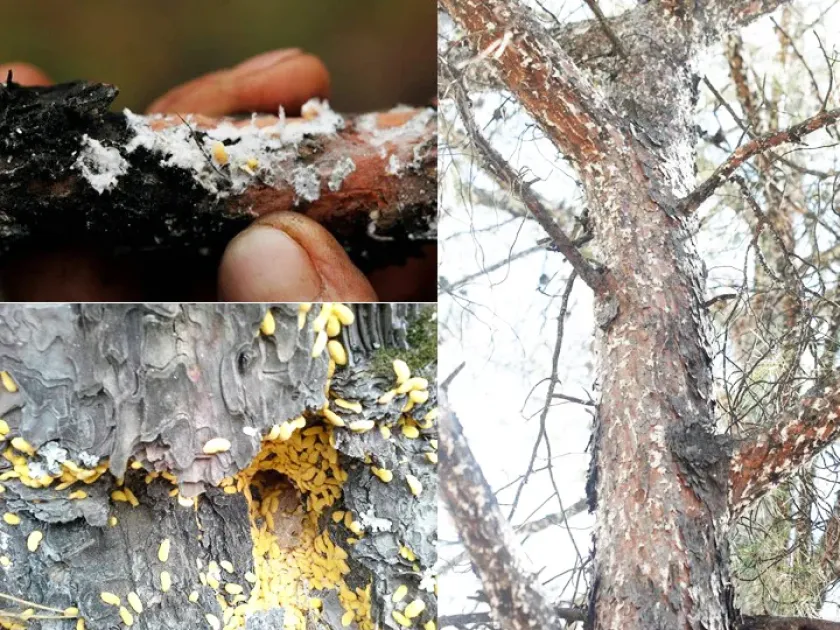
One of the earliest signs of infestation is the presence of frass (boring dust) on the bark surface or near the base of the tree. This material is expelled by the beetles as they construct their galleries.
Resin flow or "pitch tubes" appearing on the trunk are common defensive responses of the tree. While resin can trap beetles, heavy infestations quickly overwhelm the tree's natural defense mechanisms.
Needle discoloration, ranging from yellowing to complete browning, is a clear indicator that the tree's vascular system is compromised. Once the crown changes color, the tree is often near the point of no return.
Peeling back a section of the bark reveals the complex pattern of maternal and larval galleries, which permanently destroy the living tissues necessary for the tree's survival.
Control measures
Effective management of Cedrobium relies on rigorous sanitation. Removing and destroying infested or dead trees is the most effective way to eliminate breeding grounds and slow the spread of the population.
Systemic insecticides can be applied to protect high-value ornamental trees. Applications are most effective when timed with the adult emergence period to prevent new colonization of healthy wood.
Promoting forest health through proper site selection, irrigation, and fertilization is essential. Trees that are not stressed are much more capable of resisting beetle attacks through their own resinous defenses.
Monitoring using pheromone traps is highly recommended in parks and botanical gardens to keep track of population levels and prevent small outbreaks from becoming widespread infestations.
- Regular inspection for boring dust and resin flow.
- Immediate removal of dead or dying trees.
- Targeted application of systemic insecticides.
- Enhancing tree vigor through irrigation.
Taxonomy
- Latin name
- Cedrobium
- Order
- Hemiptera (bugs, aphids, leafhoppers)
- Family
- Aphididae
- EPPO code
- CEDRSP
Discussion
No discussions yet — be the first.