
Willow-carrot aphid
Cavariella konoi
Description
How to identify
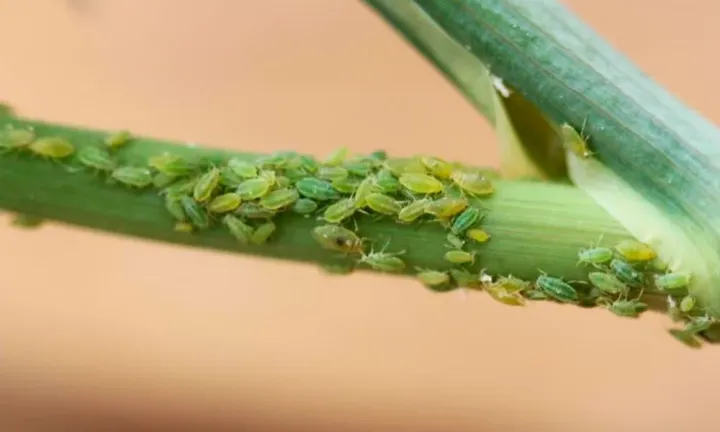
The willow-carrot aphid (Cavariella konoi) is a small, soft-bodied insect belonging to the family Aphididae within the order Hemiptera. Adults are typically light green to yellowish-green, measuring about 1.5–2.5 mm in length.
The diagnostic feature distinguishing C. konoi from other aphid species is the presence of a distinct supracaudal process on the eighth abdominal tergite, which appears as a prominent lobe extending over the cauda.
This species exhibits a heteroecious holocyclic life cycle, meaning it alternates between primary woody hosts (Salix species) and secondary herbaceous hosts in the family Apiaceae.
During the summer, the aphid reproduces via parthenogenesis, allowing for rapid colonization of host plants, which facilitates the quick spread of infestations across agricultural fields.
The winged morphs, or alatae, are responsible for long-distance dispersal and migration between the wintering host and summer crops, playing a critical role in the population dynamics.
What it damages
The willow-carrot aphid primarily attacks members of the Apiaceae family, including carrots, parsley, celery, parsnips, and dill. Infestations often begin on the underside of leaves and spread to petioles.
Feeding by sucking plant sap leads to physiological stress in the host. This results in leaf curling, stunting, and significantly reduced photosynthetic capacity of the plant.
Beyond direct feeding, C. konoi is a notorious vector of several plant viruses, such as the carrot motley dwarf virus, which can devastate crop yields if introduced early in the season.
The production of honeydew promotes the growth of sooty mold, a black fungal layer that covers the foliage, further inhibiting photosynthesis and degrading the market quality of the harvest.
Severe infestations drastically reduce the size and quality of root crops, causing them to become malformed or woody, making them unsuitable for commercial sale.
When it appears
The life cycle commences in spring when eggs, which overwintered on the bark of willow trees, hatch into fundatrices. Several generations develop on the primary host before the appearance of winged migrants.
The migration to summer hosts typically occurs in late spring or early summer, synchronized with the development of apiaceous crops in nearby fields.
Throughout the summer, multiple parthenogenetic generations are produced. The population growth is heavily influenced by temperature, with warm, dry conditions favoring explosive outbreaks.
As day length decreases in autumn, the aphid produces sexual morphs (gynoparae and males) that migrate back to the willow hosts to mate and deposit eggs for the winter.
In temperate climates, the number of generations per season can be substantial, requiring growers to remain vigilant from the time of crop emergence until harvest.
Signs of infestation
One of the earliest signs of an infestation is the yellowing and curling of leaves, particularly at the center of the carrot rosette. This leaf deformity is often severe and characteristic.
Upon closer inspection, clusters of aphids can be found on the undersides of leaves or along the petioles near the soil surface. Their presence is often accompanied by white shed skins (exuviae).
Increased ant activity around the base of the plants is a strong indicator of aphid presence, as ants protect the colonies to feed on the excreted honeydew.
Sticky residue or "honeydew" on the leaves is a common sign of a significant infestation that has likely been established for several days.
Stunted growth of the entire plant or patch of plants in the field indicates a prolonged period of feeding, leading to chlorosis and general plant collapse.
Control measures
Cultural management is the first line of defense. Avoiding the planting of apiaceous crops in close proximity to willow windbreaks can significantly reduce early-season pressure.
Sanitation is crucial; eliminating weed hosts such as wild carrots or hemlock around the field perimeter helps remove reservoirs of the aphid population.
Chemical control should be applied based on economic thresholds. Systemic insecticides are generally effective, but they should be rotated to prevent the development of pesticide resistance.
Integrated Pest Management (IPM) encourages the conservation of natural enemies such as lady beetles, lacewings, and parasitic wasps, which can suppress aphid populations naturally.
- Use reflective mulches to deter winged aphids from landing on young crops.
- Monitor populations using yellow sticky traps to detect migratory influxes.
- Ensure early planting to allow crops to pass their most vulnerable stages before peak aphid migration.
- Apply neem-based oils or insecticidal soaps as early-intervention treatments.
- Regular field inspections focusing on the underside of leaves in early summer.
Taxonomy
- Latin name
- Cavariella konoi
- Order
- Hemiptera (bugs, aphids, leafhoppers)
- Family
- Aphididae
- EPPO code
- CAVAKO
Discussion
No discussions yet — be the first.