
Willow-carrot aphid
Cavariella capreae
Description
How to identify
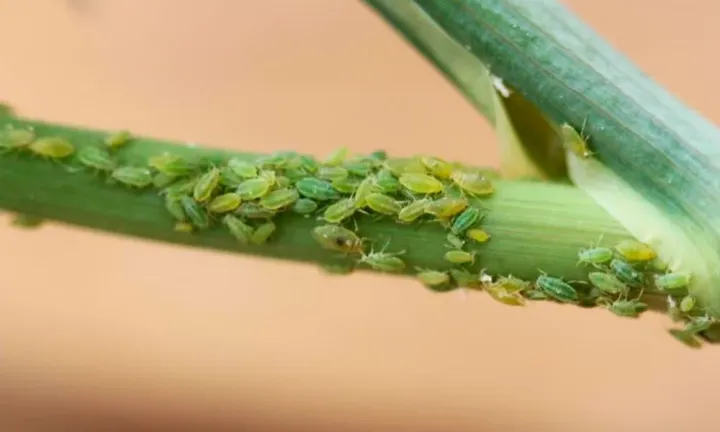
The willow-carrot aphid (Cavariella capreae) is a member of the Aphididae family, order Hemiptera. These insects are small, typically 1.5 to 2.5 mm long, with a body color ranging from light green to yellowish-green.
The defining feature of this species is a distinct, elongated supracaudal process (a tail-like protrusion) on the eighth abdominal segment. Additionally, the siphunculi on the abdomen have a characteristic club-shaped appearance, making them identifiable under magnification.
The aphid follows a heteroecious life cycle, meaning it alternates between primary and secondary hosts. Eggs overwinter on Salix (willow) species, where they hatch into stem mothers in early spring.
As the season progresses, winged forms (alatae) are produced. These individuals migrate from willow trees to secondary hosts, which include various members of the Apiaceae (umbelliferous) family, such as carrots, celery, and parsley.
During the summer, the aphids reproduce through parthenogenesis on these secondary hosts, allowing the population to increase rapidly under favorable environmental conditions.
What it damages
This pest primarily attacks plants in the Apiaceae family. The most significant agricultural losses are observed in carrot, parsnip, celery, and dill cultivation.
The aphids feed by sucking sap from the tender leaves and stems. This nutrient extraction stunts plant growth and leads to the wilting and curling of foliage, which significantly impairs the crop's ability to photosynthesize.
Beyond direct damage, Cavariella capreae serves as a critical vector for several plant viruses. These viruses cause severe distortion and stunted root development in carrots, making them unsuitable for commercial sale.
The presence of large aphid colonies can cause the central growing point of the carrot plant to die, resulting in stunted, low-quality roots or complete crop failure in severe cases.
High infestation rates can lead to yield losses exceeding 40% in vulnerable carrot varieties, especially if the infestation occurs during the critical early stages of crop development.
Signs of infestation
The first noticeable symptom of an infestation is the curling and distortion of the carrot leaves, which often become yellowish and brittle. This curling provides a sheltered microclimate for the aphid colonies.
Visual inspection of the underside of the foliage often reveals dense clusters of green aphids. Feeding typically results in the excretion of honeydew, a sticky substance that encourages the growth of sooty mold, which appears as black, powdery patches.
Infested plants appear weak and stunted compared to healthy ones in the field. When pulled, the carrots often show signs of irregular growth or malformation of the root structure.
The presence of ant activity around the carrot plants is a common secondary sign, as ants are often attracted to the honeydew produced by the aphids.
If aphids are present, the overall vigor of the carrot stand will decline rapidly, with leaves beginning to turn necrotic as the infestation progresses unchecked.
Control measures
Integrated pest management (IPM) is essential for effective control. Cultural practices, such as increasing the distance between carrot fields and willow plantings, can reduce initial migration pressure.
Field hygiene is critical; removing wild umbelliferous weeds around the field perimeter helps eliminate secondary reservoirs that allow the aphid population to survive throughout the season.
Chemical intervention should be based on scouting and threshold levels. When aphid counts exceed the economic threshold, systemic insecticides are the most effective method of control.
- Systemic insecticide application to reach aphids hidden inside curled leaves.
- Encouraging natural predators such as lady beetles, hoverflies, and lacewings.
- Monitoring fields closely during the peak migration period from willow trees.
For sustainable production, consider the use of biological control agents and ensure that insecticide applications are timed correctly to protect pollinators and natural enemies in the area.
Taxonomy
- Latin name
- Cavariella capreae
- Order
- Hemiptera (bugs, aphids, leafhoppers)
- Family
- Aphididae
- EPPO code
- CAVACA
Discussion
No discussions yet — be the first.