
Carrot aphid
Cavariella
Description
How to identify
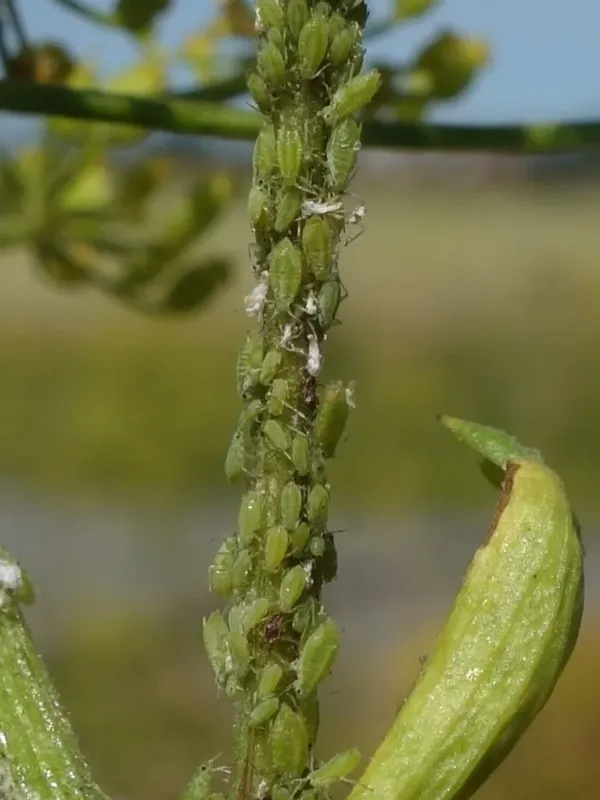
The carrot aphid (Cavariella aegopodii) is a small sap-sucking insect belonging to the family Aphididae. Adult aphids typically measure between 1.5 and 2.5 mm in length and display colors ranging from pale yellow to green.
They possess specialized piercing-sucking mouthparts, known as stylets, which allow them to extract vital fluids directly from the phloem of host plants, causing systemic stress to the vegetables.
The life cycle of this species is complex and often host-alternating. Eggs overwinter primarily on species of willow (Salix) or wild Umbelliferae, before winged females migrate to carrot fields in late spring.
Their reproduction strategy relies heavily on parthenogenesis, enabling populations to multiply exponentially during the warm summer months when environmental conditions are optimal.
Because they possess both winged and wingless forms, these pests are highly efficient at colonization, allowing them to spread rapidly across entire vegetable production plots.
What it damages
Carrot aphids primarily target members of the Apiaceae family, including carrots, parsley, celery, parsnips, and dill. They feed by clustering on the undersides of leaves and around the plant crown.
This feeding activity causes severe leaf curling and stunted growth. The plant's metabolic processes are disrupted, leading to reduced root development and poorer overall crop quality.
Perhaps the most significant threat posed by Cavariella is their role as a vector for various plant viruses, most notably the Carrot Red Leaf Virus (CRLV).
Infected carrots often exhibit stunted roots, chlorosis, and a purple or reddish discoloration of the foliage, making them unmarketable and susceptible to rot.
Furthermore, the excretion of honeydew promotes the growth of sooty mold, which blocks sunlight from reaching the leaves, further hindering photosynthesis and plant vitality.
Signs of infestation
The earliest signs of an infestation include the curling and yellowing of young leaflets, which become twisted and stunted as the colony population grows.
Careful inspection of the lower leaf surfaces will reveal clusters of these small insects, which are often well-camouflaged due to their greenish hue matching the foliage.
Sticky residue on the stems and leaves, known as honeydew, is a tell-tale sign of aphid activity. This substance often attracts ants, which protect the aphids from natural predators.
If the plants have been exposed to viruses carried by the aphids, the leaves will develop intense reddish or purple tints and appear distorted and hardened.
Plants struggling with an aphid colony will generally appear smaller and less vigorous compared to healthy plants, with a noticeable lag in seasonal development.
Control measures
Cultural control is essential. This includes removing weeds such as wild parsley or hemlock from field borders, as these act as alternative hosts for the aphids during the early season.
Strategic planting practices, such as avoiding areas near willow trees and ensuring proper crop rotation, can significantly reduce the risk of early-season colonization.
Biological control plays a key role in integrated pest management. Ladybugs, lacewings, and hoverfly larvae are highly efficient at reducing aphid populations if their habitats are protected.
If chemical intervention becomes necessary, systemic insecticides are generally the most effective, as they reach the sap that the aphids consume.
- Regular monitoring of carrot fields from seedling emergence through harvest.
- Using row covers (agrofibre) to create a physical barrier against migrating winged aphids.
- Applying insecticidal soaps or neem oil in smaller garden settings to manage early colonies.
Taxonomy
- Latin name
- Cavariella
- Order
- Hemiptera (bugs, aphids, leafhoppers)
- Family
- Aphididae
- EPPO code
- CAVASP
Discussion
No discussions yet — be the first.