

Pest · Coleoptera (beetles) · affects Winter wheat, Fodder beet, Winter barley
Beet tortoise beetle
Cassida nebulosa
Description
How to identify
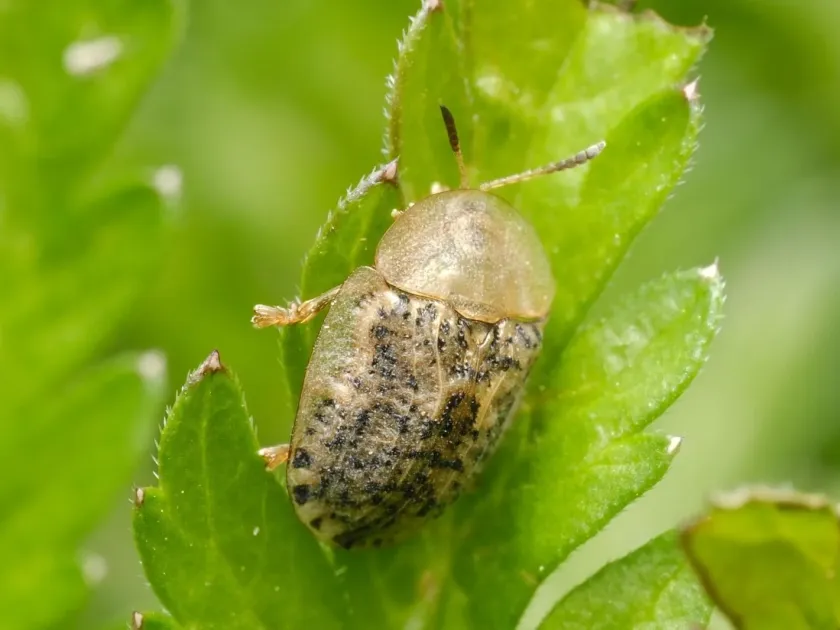
The beet tortoise beetle (Cassida nebulosa) is a member of the leaf beetle family (Chrysomelidae), known for its peculiar flattened shield-like appearance.
Adult beetles reach a size of 6–7 mm, with a color palette ranging from greenish-grey to brown, often featuring mottled patterns that blend in with plant tissue.
Larvae are easily recognized by their flattened, green bodies adorned with side appendages and a terminal fork used to carry waste products.
The life cycle includes a complete metamorphosis, where eggs are laid in clusters on the leaves of host plants, followed by larval growth and pupation.
These insects are well-adapted to temperate climates, with adults overwintering in soil or debris to emerge when spring temperatures rise.
What it damages
The primary host plants are crops belonging to the Amaranthaceae family, most notably sugar beet, mangel, and table beet varieties.
Adults and larvae both feed on the leaves, causing characteristic damage patterns ranging from small holes to extensive skeletonization of the leaf tissue.
Significant infestations can lead to a drastic reduction in the plant's photosynthetic capacity, which negatively impacts root growth and sugar accumulation.
Wild plants such as common lambsquarters serve as critical alternate hosts, allowing populations to persist even in the absence of cultivated beets.
Heavy damage in the early developmental stages of the plant is particularly dangerous, as it can cause stunting and lower overall crop yield.
When it appears
Overwintered adults typically emerge from their shelters in early spring once soil temperatures reach roughly 10°C.
The migration to fields usually coincides with the emergence of beet seedlings, which are then colonized for feeding and reproduction.
Egg-laying is a prolonged process, leading to the presence of overlapping larval generations during the peak of the summer season.
Pupation takes place directly on the host plant leaves, making the larvae and pupae highly visible during routine field inspections.
The new generation of adults typically completes its cycle by late summer, subsequently seeking overwintering sites as temperatures decline.
Signs of infestation
The first signs of infestation are circular holes or irregular patches eaten into the leaves of young beet plants.
The presence of fecal-covered egg masses and the distinct shield-like larvae on the undersides of leaves confirms an active infestation.
Infected leaves may curl, turn yellow, or show signs of heavy skeletonization where only the veins of the leaf remain intact.
Affected fields often show patches of stunted growth, which become increasingly apparent as the beetle population continues to feed.
The presence of adult beetles on the foliage, easily identified by their shape, is a clear indicator that immediate field intervention is needed.
Control measures
Effective management begins with strict crop rotation and physical isolation from fields that were used for beet cultivation in the previous season.
Cultural control includes the aggressive removal of wild host plants, such as Chenopodium species, from field margins to reduce reservoir populations.
Deep autumn tillage is highly effective in disrupting the overwintering cycle and reducing the density of the adult population in the soil.
Chemical control involving systemic insecticides is recommended when population numbers exceed the established economic damage threshold.
- Use of certified, pre-treated seeds to protect early development
- Regular scouting for egg clusters during the seedling stage
- Encouraging natural predators and parasitoids in the field
Content graph
Connections · Beet tortoise beetle
Most often together:
Marketplace
Products · 3

Fortran, k.e., (dichlorvos, 400 g/l)
Санрайз Кемікалз Ко. Лтд., Шанхай, Китай
Insecticides
0
0
·
53
1 offer
69.24 €per pack
Buy

Biology
Taxonomy
- Latin name
- Cassida nebulosa
- Order
- Coleoptera (beetles)
- Family
- Chrysomelidae
- EPPO code
- CASSNE
Community
Discussion
No discussions yet — be the first.