
Xanthium aphid
Capitophorus xanthii
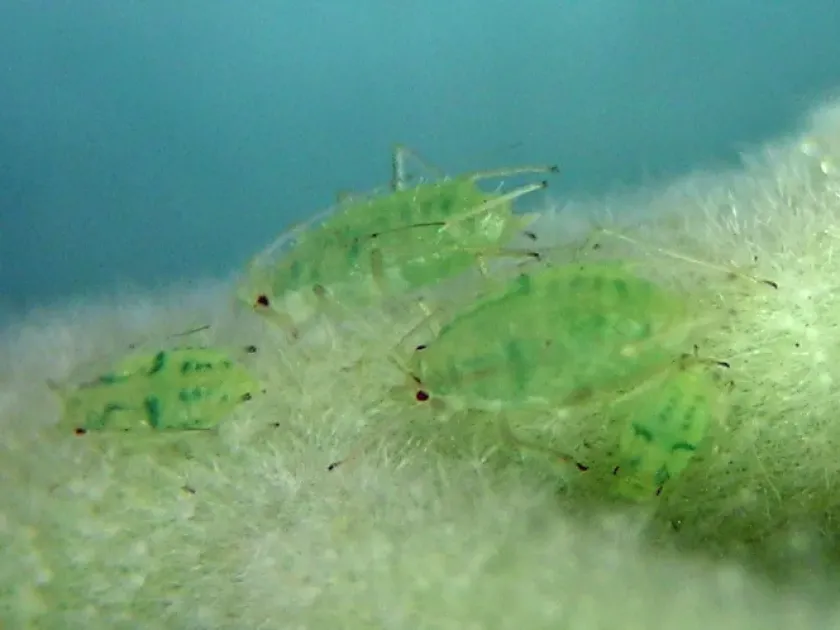
Description
How to identify
The Xanthium aphid (Capitophorus xanthii) is a small insect belonging to the order Hemiptera and the family Aphididae. It is specifically adapted to feeding on plants within the Asteraceae family.
The body of this aphid is typically elongated with relatively long antennae. Its coloration ranges from pale green to yellowish-green, providing effective camouflage among the foliage of its host plants.
Morphologically, these aphids are distinguished by the moderate development of the frontal furrow and the weak presence of lateral tubercles on the thorax and abdomen.
The life cycle involves both winged and wingless forms, allowing for efficient dispersal and colonization of host plants throughout the growing season.
Reproduction occurs through parthenogenesis during the summer months, leading to a rapid increase in population density when environmental conditions are optimal.
What it damages
The primary host of this aphid is the cocklebur (Xanthium). Feeding occurs by piercing plant tissue and sucking out the nutrient-rich sap from young leaves and shoots.
Severe infestations lead to the physiological weakening of the plant, resulting in stunted growth and a reduced ability to produce seeds or vegetative mass.
Feeding damage often causes leaves to curl, twist, and turn yellow, which significantly impairs the plant's photosynthetic capacity.
Beyond direct damage, the Xanthium aphid is known to act as a vector for various plant viruses, posing a threat to surrounding agricultural crops.
Secondary infections, such as necrotic spots and fungal growth, often develop on the injured plant tissue as a direct consequence of the aphid feeding activity.
When it appears
The seasonal cycle begins in spring when overwintering eggs hatch into nymphs, which immediately begin feeding on fresh vegetation.
Summer is the period of peak activity, where successive generations develop rapidly, resulting in dense colonies concentrated in the growing points of the host.
As the season progresses into autumn, the insect shifts its life cycle towards sexual reproduction to prepare for winter survival.
Overwintering occurs in the egg stage, which is deposited in protected areas such as the base of plants or on lingering plant debris.
Climate factors such as temperature and humidity directly dictate the population growth rates, with warm and stable weather favoring maximum reproduction.
Signs of infestation
The most immediate sign of infestation is the curling and distortion of young apical leaves, where colonies of aphids usually reside.
The presence of honeydew, a sticky substance secreted by the aphids, creates a shiny appearance on the leaves and attracts ants to the colony.
Sooty mold growth is frequently observed on the leaves as a result of the accumulation of honeydew, giving the plant a darkened, unhealthy appearance.
An increased presence of ant activity on the stems is a reliable indicator that an aphid colony is likely present and being tended by the ants.
- Curling and distortion of apical leaves.
- Sticky honeydew accumulation on leaf surfaces.
- Development of black sooty mold.
- Premature yellowing and wilting of plant parts.
- Constant presence of ant colonies on the host plant.
Control measures
Cultural control is a primary management strategy, involving the removal of host weeds to eliminate reservoir populations that could infest larger areas.
Biological control agents, such as lady beetles (Coccinellidae) and lacewings (Chrysopidae), are effective natural predators that help regulate aphid numbers.
If chemical intervention becomes necessary, systemic insecticides are often the most effective method, as they reach the aphids hiding within curled foliage.
Regular scouting of fields during the early stages of weed growth is essential for detecting the initial presence of aphids and taking prompt action.
Implementing proper soil management practices, such as deep plowing and removing crop residues, helps destroy overwintering egg sites and reduces future pest pressure.
Taxonomy
- Latin name
- Capitophorus xanthii
- Order
- Hemiptera (bugs, aphids, leafhoppers)
- Family
- Aphididae
- EPPO code
- CAPIXA
Discussion
No discussions yet — be the first.